AI Agent ROI: How to Measure Cost per Successful Task
Measure AI agent ROI with full-cost accounting, successful-task quality bars, and human review gates for dependable marketing and sales automation today.
Overview
Your automated SDR can send messages, AI copywriter produce drafts, and media-buying agent run continuously—yet token bills and seat licenses miss how much quality-approved work actually succeeded, leaving real value invisible. Starting from OpenAI CFO Sarah Friar’s sector-agnostic “useful intelligence per dollar” proposal, this guide shows marketing and sales leaders how to define successful tasks, count full costs, and measure AI agent ROI; at Van Data Team, we use explicit quality bars and human review gates.
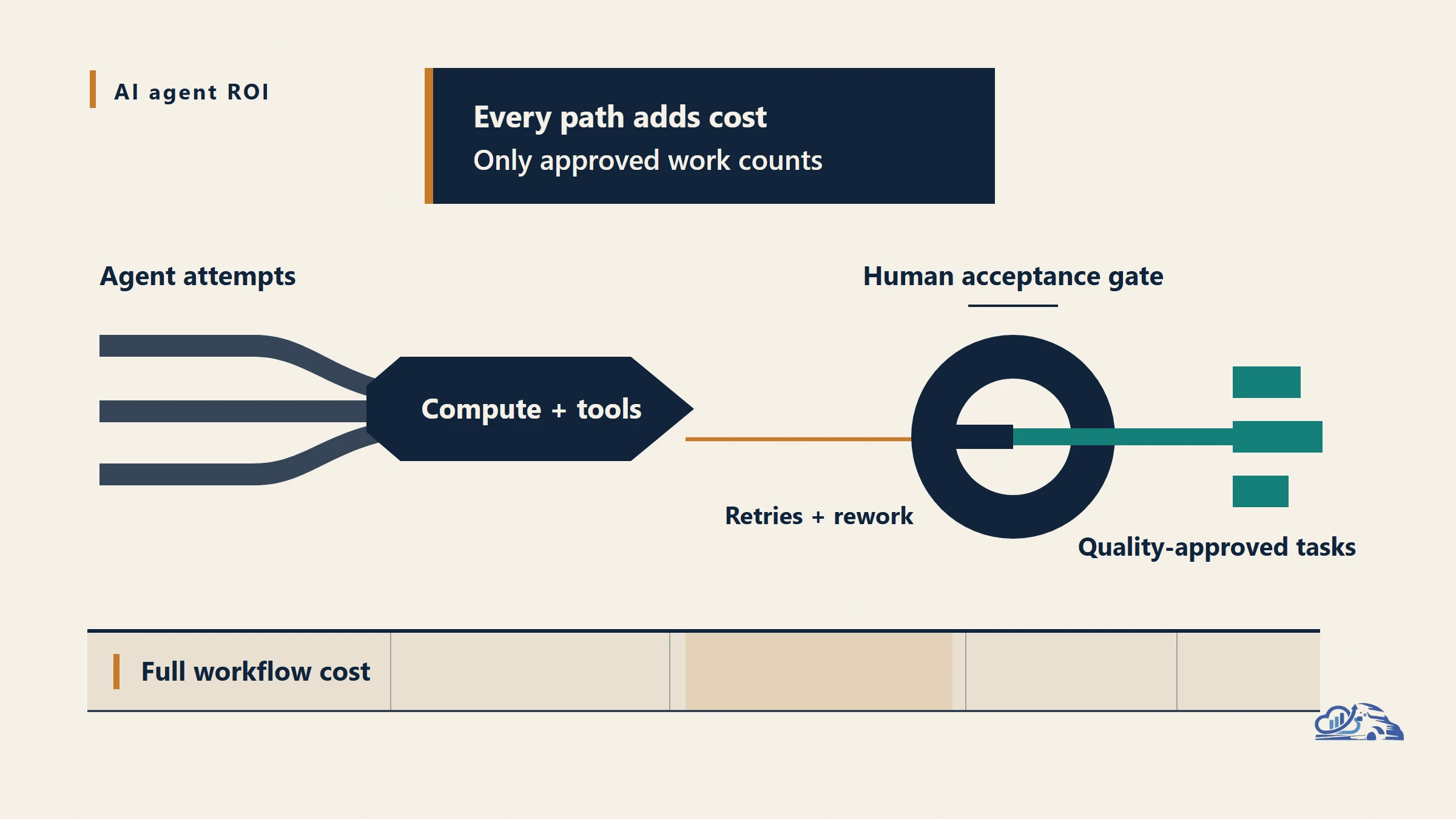
AI agent ROI should be measured by the verified value of quality-approved work relative to the full cost of producing it. Tokens, active users, generated drafts, and sent messages are inputs or activity. If the work fails review, a low token bill is not efficiency. It is cheap failure.
According to Fortune's July 17, 2026 report, OpenAI CFO Sarah Friar proposed "useful intelligence per dollar": measure work AI completes, not token cost or seat utilization alone. Her framework is sector-agnostic and never mentions marketing or sales. Our analysis applies it to automated SDRs, AI copywriters, media-buying orchestrators, and Vanaxity, Van Data Team's review-gated SEO, GEO, and AEO content agent. Vanaxity turns that idea into an operating pipeline across research, writing, illustration, publishing, and syndication, with review gates and task-level reporting around accepted work.
This guide gives marketing and sales leaders a task definition, cost model, quality-gate matrix, and measurement runbook. To see the operating model in motion, watch the agent move from research through publishing and syndication.
Key Takeaways
The core rule is simple: count work only after it clears a stable quality bar, then charge the workflow for every path required to get there.
- Tokens and licenses show usage or access, not dependable output.
- Cost per successful task divides full workflow cost by accepted tasks.
- Human review, retries, failures, and rework belong in full cost.
- Marketing and sales criteria in this guide are our application, not OpenAI recommendations.
- Business ROI requires verified value; without it, report production efficiency honestly.
Map your SEO, GEO and AEO workflow before you build.

What "Useful Intelligence per Dollar" Actually Means
Useful intelligence per dollar is a proposed economic lens for comparing dependable completed work with the cost of producing it.
Fortune records Friar's four questions verbatim:
"Is AI completing work that matters? What does each successful task cost? Can people depend on the result? And does each dollar produce more value as usage grows?"
OpenAI's first-party scorecard for the AI age states the governing economic test:
"The basic economic question facing CFOs and other business leaders is whether the value of the work AI completes grows faster than the cost of producing it."
This is Friar's proposed point of view, not a launched OpenAI product, index, benchmark, or measurement tool. It does not set a universal quality bar or tell marketers how to score leads, drafts, or campaigns. Token and compute costs still matter, but they sit inside an end-to-end cost model.
The timing matters. Axios connects the proposal to a growing enterprise AI cost reckoning, as companies demand clearer returns and increasingly route work to cheaper models. Marketing is an application of the framework, not its origin.
The Accounting Chain Behind AI Agent ROI
Honest measurement separates usage, attempts, completions, accepted work, and business value because each stage answers a different question.
usage -> attempted task -> completed task -> quality-approved task -> verified business value
A draft is a completed output. It becomes a successful task only when it passes predetermined acceptance criteria. It creates measurable ROI only when the team can connect that accepted work to credible value.
| Measurement lens | What it counts | What it answers | What it misses |
|---|---|---|---|
| Token or compute cost | Model usage | How expensive was inference? | Tools, review, quality, and value |
| Seat or license cost | Access to software | What did access cost? | Whether useful work finished |
| Cost per successful task | Full cost divided by accepted tasks | How efficiently did the workflow produce dependable work? | The value of each accepted task |
| Business ROI | Verified value net of full cost | Did the workflow create economic return? | Value that cannot yet be attributed credibly |
Cost per successful task and useful work per dollar are inverse operating views. Neither turns into ROI by changing the label. If downstream value is unavailable, call the result cost efficiency and keep measuring.
Defining Successful Tasks for Marketing and Sales Agents
A successful marketing or sales task needs a clear boundary, evidence requirements, an acceptance owner, and a review or escalation gate.
The specifications below are Vanaxity's applied analysis. OpenAI did not prescribe them for marketing teams.
| Agent workflow | Candidate successful task | Suggested agent quality bar | Do not count |
|---|---|---|---|
| Automated SDR | Qualified lead record or outreach-ready package | Agreed qualification fit, verifiable account and contact evidence, accurate personalization, brand and compliance approval | Duplicates, unsupported personalization, unverifiable records, or unapproved outreach |
| AI copywriter | Publishable, answer-ready draft | Accurate claims, required sources, brand fit, search-intent match, SEO/GEO/AEO structure, editorial approval | Raw drafts, unsourced claims, duplicate copy, or work needing substantial corrective rewriting |
| Media-buying orchestrator | Approved campaign plan, asset, or optimization action | Budget and targeting rules, policy compliance, brand safety, tracking readiness, audit trail, escalation outside authority | Unauthorized changes, broken tracking, rejected assets, or activity detached from an approved objective |
Illustrative scenario: Maya, a demand-generation lead, opens a dashboard showing a large queue of agent-produced prospects. Evidence review finds duplicates and claims that cannot be verified. Under activity accounting, the run looks productive. Under successful-task accounting, only records that pass qualification and evidence review count, while the entire run's compute, data, retry, and review costs remain.
The task boundary also controls comparability. Do not average lead qualification, article production, and campaign changes into a generic "agent task." Their risks, review burdens, latency, and business values differ.
Calculating Cost per Successful Task Honestly
Cost per successful task equals the full end-to-end workflow cost divided by tasks that passed the declared quality bar.
Full cost = compute + agent platform + tools and data + infrastructure + retries + human review + failures and rework + governance and incident handling
Cost per successful task = full cost / quality-approved tasks
Useful work per dollar = quality-approved tasks / full cost
Business ROI = (verified value from successful tasks - full cost) / full cost
These formulas are our operationalization of Friar's sector-agnostic framework. The first pair measures production efficiency from opposite directions. The ROI formula adds a value estimate that must come from business evidence, not from the agent's own completion label.
Teams commonly omit rejected runs, alternate model routes, paid data calls, observability infrastructure, editorial time, compliance review, corrections, and incident recovery. They also celebrate generation speed while ignoring time to acceptance. Track latency from task start to approved final state, because fast output followed by slow review is not a fast workflow.
Apply firm accounting rules:
- Count success only after the stated gate passes.
- Charge retries, failures, and abandoned work to the workflow.
- Keep task definitions and quality-bar versions stable during comparisons.
- Segment workflows whose tasks or value differ materially.
- Preserve rejected work in cost even though it does not enter the success count.
- Track downstream value separately from production acceptance.
- Never lower the bar to manufacture a cheaper metric.
Illustrative scenario: Jon's AI copywriter produces a polished draft quickly, but editors must rebuild its claims and structure. The model spend may be low; the accepted-draft cost is not. Once Jon charges research tools, revisions, review, and the rejected version to the task, the dashboard reflects the work required to reach publishable quality.
Quality Bars, Human Review, and Answer-Ready Content
The quality bar determines the economics because it decides which outputs are dependable enough to count as useful work.
At Van Data Team, we start by writing the acceptance test before designing the automation. Each criterion gets an evidence source, an owner, a pass or fail rule, and an escalation path. Rejection reasons become observable data for improving prompts, source inputs, tools, routing, and recovery logic. That makes agent economics a content, data, evaluation, and governance problem before it becomes a budget problem.
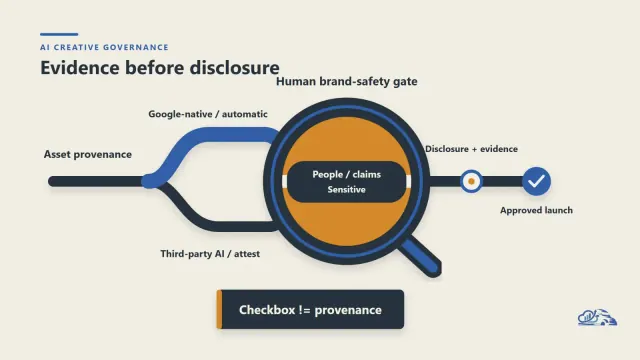
For a copywriter agent, answer-ready work must be accurate, clearly structured, source-supported, aligned with search intent, and safe to publish. SEO checks keywords and on-page relevance. GEO improves how generative engines understand and cite the material. AEO sharpens direct answers, structured sections, and extractable facts. A draft that exists but cannot survive editorial review has not completed the job.
Human oversight is therefore part of production, not invisible labor. Reduce a review gate only after workflow evidence shows dependable performance, and retain escalation for high-risk claims or actions. The Vanaxity versus checklist-led SEO comparison shows why governed output matters more than raw publishing volume.
Production success and market performance should remain separate. Approval proves the content met its quality bar. Rankings, AI citations, qualified traffic, and pipeline contribution are downstream outcomes that arrive later and need their own attribution.
An Implementation Playbook for Marketing Leaders
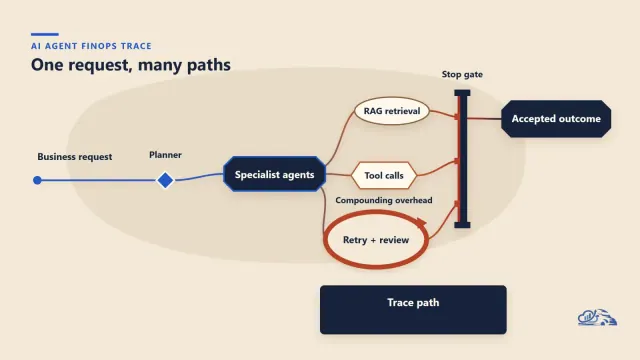
Marketing leaders can implement the model by treating every agent task as an observable state machine with cost, quality, and value events.
task created -> attempts and tool calls -> quality gate -> accepted, rejected, escalated, or abandoned -> downstream value update
Use this operating sequence:
- Define the boundary. State where agent responsibility begins and what approved deliverable ends the task.
- Version the quality bar. Record required evidence, acceptance criteria, authority limits, review ownership, and escalation triggers.
- Instrument full cost. Capture compute, token budget, platform, tools, data, retries, infrastructure, review, failure, and rework at task level.
- Classify every final state. Never let a failed or abandoned run disappear from the ledger.
- Compare like with like. Keep workflow classes separate and disclose any bar change.
- Connect accepted work to value. Update the record from CRM, content analytics, or campaign systems when credible downstream evidence appears.
- Improve failure modes. Fix weak data, missing tools, poor evaluation, bad routing, or unclear authority instead of endlessly rewriting prompts.
A minimum measurement record should include task_id, workflow, quality_bar_version, evidence references, models and tools used, attempts and routes, cost components, review effort, final state, rejection reason, approval owner, latency to acceptance, and downstream value status. This creates the observability needed for evaluation and failure recovery.
If you want this mapped to a real content operation, request a Vanaxity content scan. The output is a scoped workflow review, task definition, quality-bar draft, review-gate map, dashboard gap review, risk and recovery notes, and an implementation plan for the site.
Failure Modes and Honest Tradeoffs
The model fails when teams loosen success definitions, hide failed paths, or call production efficiency ROI.
Common mistakes include counting attempts as successes, excluding rework, blending unlike tasks, changing acceptance criteria during a test, granting the agent authority beyond its guardrails, and claiming GEO or AEO success from publishing alone. Cheap automation can destroy value through inaccurate outreach, off-brand content, broken tracking, or compliance exposure.
Successful-task measurement is harder than counting seats. Task values can differ, review creates a real burden, and downstream results may be delayed. That complexity is the point: the metric is closer to dependable work. Start with stable task classes and production efficiency, then add value attribution only where the evidence supports it.
How Van Data Team Makes This Operational
At Van Data Team, we make AI agent ROI operational by mapping the workflow before recommending automation. We trace handoffs, source systems, agent decisions, human review gates, dashboards, and recovery paths. This reveals where tasks fail, who owns acceptance, and what evidence proves the work succeeded.
The output is a scoped delivery plan:
- Signals required to evaluate each task.
- Workflow gaps that create retries or unreliable results.
- Decisions automation can make and those requiring human approval.
- Dashboards and runbooks that show owners what to do next.
For an automated SDR, that may mean verifying qualification evidence before outreach. For a copywriter agent, it means checking sources, brand fit, compliance, and publishability. For a media-buying orchestrator, material spend changes may require approval and a rollback path.
Every successful task is then charged for model and tool usage, retries, failed attempts, review time, and rework. Cheap output that repeatedly fails its quality gate no longer looks efficient.
Vanaxity, our AI content agent for SEO, GEO, and AEO, applies this approach to content production. Output counts only when it is accurate, structured, answer-ready, trustworthy, and approved through defined review gates. That turns AI agent ROI from a budget estimate into a repeatable operating practice.
Operational Budget
Before production rollout, test each candidate on the same representative task set. Score end-to-end cost per accepted output, latency, tokens per attempt and approval, retry rate, reviewer minutes, failure-recovery time and cost, and evaluation pass rates against the predefined quality bar. Vendor token pricing is only a starting point.
Cost per approved workflow result = (model, tool, infrastructure, retry, review, recovery, and rework costs) ÷ approved results
This is the operational denominator for AI agent ROI. A cheaper model may become the more expensive system if it consumes extra tokens through retries, stalls during tool use, or repeatedly sends off-brand or non-compliant work to reviewers. A faster candidate should not win if fewer outputs pass evaluation.
In our marketing application of Friar’s sector-agnostic framework, an automated SDR, copywriter, or media-buying orchestrator succeeds only when its lead, draft, or campaign action clears the agreed evaluation and human review gate. Track rejected and unrecovered runs separately. Excluding them turns the happy path into a fictional budget. Promote a candidate only when its results remain dependable and its cost per approved workflow result holds under representative operating conditions.
Tooling And Landscape Fit
Cost per successful task is the decision layer above—not a replacement for—lower-level metrics. Seat utilization fits copilots, while token, latency, and tool-call dashboards help engineers control infrastructure. Deterministic automation can be judged by throughput and error rates. For reasoning-and-acting agents, however, retries, branching, and human intervention make those measures incomplete; AI agent ROI still depends on accepted output and full workflow cost.
Orchestration changes what teams can inspect. A LangGraph agent workflow can expose state transitions, branches, and human review checkpoints. A managed orchestrator may reduce operational burden, while a scripted tool-use workflow is often cleaner when the path is predictable. None proves value by itself.
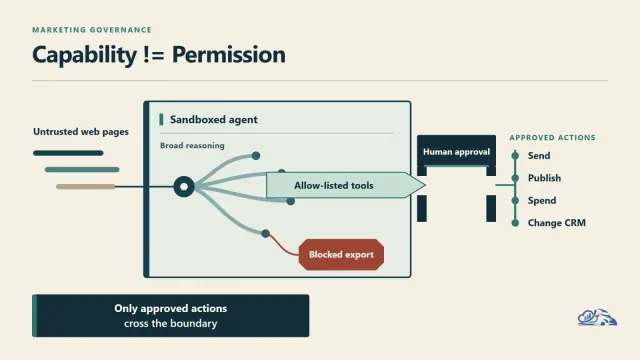
Pair any approach with evaluation tooling: rubric-based test sets for quality, agent observability for tracing failures and costs, and review queues for recording acceptance. Runtime controls—budget ceilings, retry limits, tool permissions, model routing, confidence thresholds, and stop-or-escalate rules—contain tail costs and unsafe behavior.
Applied to marketing, the right fit is the simplest architecture that reliably produces qualified leads, publishable content, or compliant campaign changes. Vanaxity follows this principle for SEO, GEO, and AEO: orchestration supports the work, but review-gated, answer-ready content is what counts as success.
Frequently asked questions
What is AI agent ROI?
AI agent ROI is the verified value created by an agent's quality-approved work, net of the full cost required to produce it, relative to that full cost. When value attribution is delayed, report cost per successful task separately instead of inventing an ROI claim.
Is cost per successful task the same as ROI?
No. It is an operating efficiency metric. ROI additionally requires a credible estimate of the value created by accepted tasks.
How should a team measure AI SDR ROI?
Define a qualified result, evidence rules, compliance requirements, and the human approval gate. Then include data, tools, compute, retries, review, rejection, and rework costs before connecting approved records to downstream sales value.
What counts as a successful AI copywriting task?
A task succeeds when its draft passes the team's accuracy, sourcing, brand, search-intent, structure, and editorial requirements. Generation alone does not qualify.
Should human review be included in agent cost?
Yes. If review is required to make the work dependable, its time and corrective effort are part of full production cost.
Does lower token cost automatically improve returns?
No. Lower model cost helps only when accepted quality and business value hold or improve. A cheaper failed run remains waste.