Meta Anthropic Compute Talks Reveal AI Agents' Real Cost
Meta Anthropic compute talks remain preliminary. Learn how marketing and RevOps teams can control agent cost, reliability, throughput, and vendor lock-in.
Overview
Executive Summary: The preliminary Meta Anthropic compute talks matter for marketing and RevOps teams because, in Vanaxity's analysis, they show how compute cost, capacity, and reliability quietly cap always-on agents — throttling throughput, slowing campaigns, and leaving pipeline missed — and why cost per successful task, not seat or token price, is the number operators should manage.
Reports of early Meta Anthropic compute talks over a proposed deal worth up to $10 billion—both companies declined to comment, and it may never close—surface a concrete problem for marketing and RevOps teams: always-on agents can overrun budgets or stall campaigns when compute is costly or unavailable. This article explains how to measure cost per successful task, route workloads, set quality gates and fallbacks, and limit vendor risk, reflecting Van Data Team’s governed, outcome-based approach to agent operations.
CNBC reported that Meta Platforms and frontier AI lab Anthropic are in early, preliminary talks. Quartz reports the proposed arrangement could be worth up to $10 billion over roughly two years, with Anthropic paying Meta in monthly installments. For marketing and RevOps leaders, the Meta Anthropic compute talks expose a harder truth: an autonomous agent cannot run campaigns, route leads, or publish useful content when affordable compute is unavailable.
Nothing is signed, closed, or confirmed. CNBC reports that both companies declined to comment; no agreement has been announced. That distinction separates the news from Vanaxity's analysis. See how Vanaxity's autonomous content agent turns research, writing, illustration, publishing, and syndication into a governed workflow for SEO, GEO, and AEO.
The blue-link era is dead as a complete visibility strategy. Brands also need content that AI Overviews, ChatGPT, Gemini, and answer engines can understand and cite. This guide shows how to price that continuous work, route it efficiently, protect throughput, and reduce infrastructure risk.
Key Takeaways
The practical lesson is that agent value comes from reliable, accepted outcomes rather than raw access to a model.
- The proposed Meta-Anthropic arrangement remains preliminary and may never close.
- Continuous agents make compute cost, capacity, and reliability operating concerns for marketing teams.
- Cost per successful task captures retries, tools, review, and remediation that seat or token prices miss.
- Batching, task-based model routing, early quality gates, bounded retries, and human escalation protect throughput.
- Portable orchestration and tested fallback routes reduce vendor-lock and capacity risk.
Map your SEO, GEO and AEO workflow before you build.

What the Meta Anthropic Compute Talks Actually Say
Meta and Anthropic are reportedly discussing a flexible compute supply arrangement, but no agreement has been signed or confirmed.
Table 1. Reported Meta Anthropic compute-talk details and unresolved points.
| Item | Reported detail | What remains unsettled |
|---|---|---|
| Stage | Early, preliminary negotiations | The talks may not produce an agreement |
| Proposed roles | Meta could supply data-center compute to Anthropic | No final capacity or service terms are confirmed |
| Proposed value and term | The potential arrangement could be worth up to $10 billion over roughly two years | No price, capacity, or service terms are confirmed |
| Agreement status | No agreement has been signed or confirmed | The talks may not produce a deal |
| Public comment | Both companies declined to comment when contacted | Neither company has confirmed the proposal |
If it closes, the arrangement could mark Meta's debut as an external compute or cloud supplier. According to CNBC's reporting on Meta's plan for up to $145 billion in 2026 capital spending and Zuckerberg's May 2026 cloud-business comments, Meta has been considering how its infrastructure spending could generate revenue beyond its own operations.
The reported dynamic is coopetition. Meta could sell raw processing capacity to Anthropic even though Anthropic competes with Meta's Llama models. CNBC's framing matters because it separates model ownership from control of the infrastructure needed to run those models.
CNBC's headline captures the status without overstating it:
"Anthropic in early talks with Meta to acquire compute power."
The report also says Anthropic has limited usage of advanced models because it lacks enough capacity to run them without restrictions. That is reported context, not independent confirmation by Vanaxity. The operational inference that follows is ours: when leading labs face capacity pressure, buyers should not treat inference as an unlimited utility.
Why Always-On Agents Change the Compute Equation
Always-on agents turn compute from a background vendor expense into a direct limit on campaign throughput.
A chatbot waits for a person to ask a question. An autonomous marketing agent may monitor signals, gather evidence, choose a route, call tools, generate an asset, validate the result, retry failures, request approval, publish, and update reporting. Every branch consumes resources, and every failure can trigger more work.
Vanaxity analysis: The right economic unit is not a seat or an isolated model call. It is an accepted business outcome.
Cost per successful task = total workload cost / tasks accepted by the defined quality gate
Total workload cost includes inference, tool calls, orchestration, storage, retrieval, monitoring, retries, human review, and remediation. A task counts as successful only when it reaches an agreed state. A generated draft that fails sourcing, brand, technical, or publishing checks is work in progress, not value delivered.
Table 2. Agent cost metrics and their limitations.
| Metric | What it reveals | What it misses |
|---|---|---|
| Cost per seat | Access cost for a team | Usage intensity, automation volume, and failed work |
| Cost per token | Inference consumption | Tools, retries, review, and whether the result was usable |
| Cost per successful task | Full cost of an accepted outcome | Requires a clear acceptance test and complete cost capture |
At Van Data Team, we start by defining the acceptance boundary. For an SEO production task, that can mean supported claims, correct search intent, on-page requirements, brand compliance, usable illustrations, and a valid publishing handoff. GEO and AEO add extractable answers, clear attribution, structured data, and citation-ready passages.
Consider a composite SEO workflow. A low-cost route produces a draft quickly, but its unsupported claims fail the factual gate. The agent retries, calls more tools, and sends the draft to an editor. A stronger route costs more per call but clears the same gate with less rework. The cheaper model is not cheaper if its cost per accepted article is higher.
This is why comparing an agent workflow with manual SEO should focus on completed, approved outputs. Token efficiency still matters, but only inside an outcome-based measurement system.
Design Workloads Around Capacity, Cost, and Risk
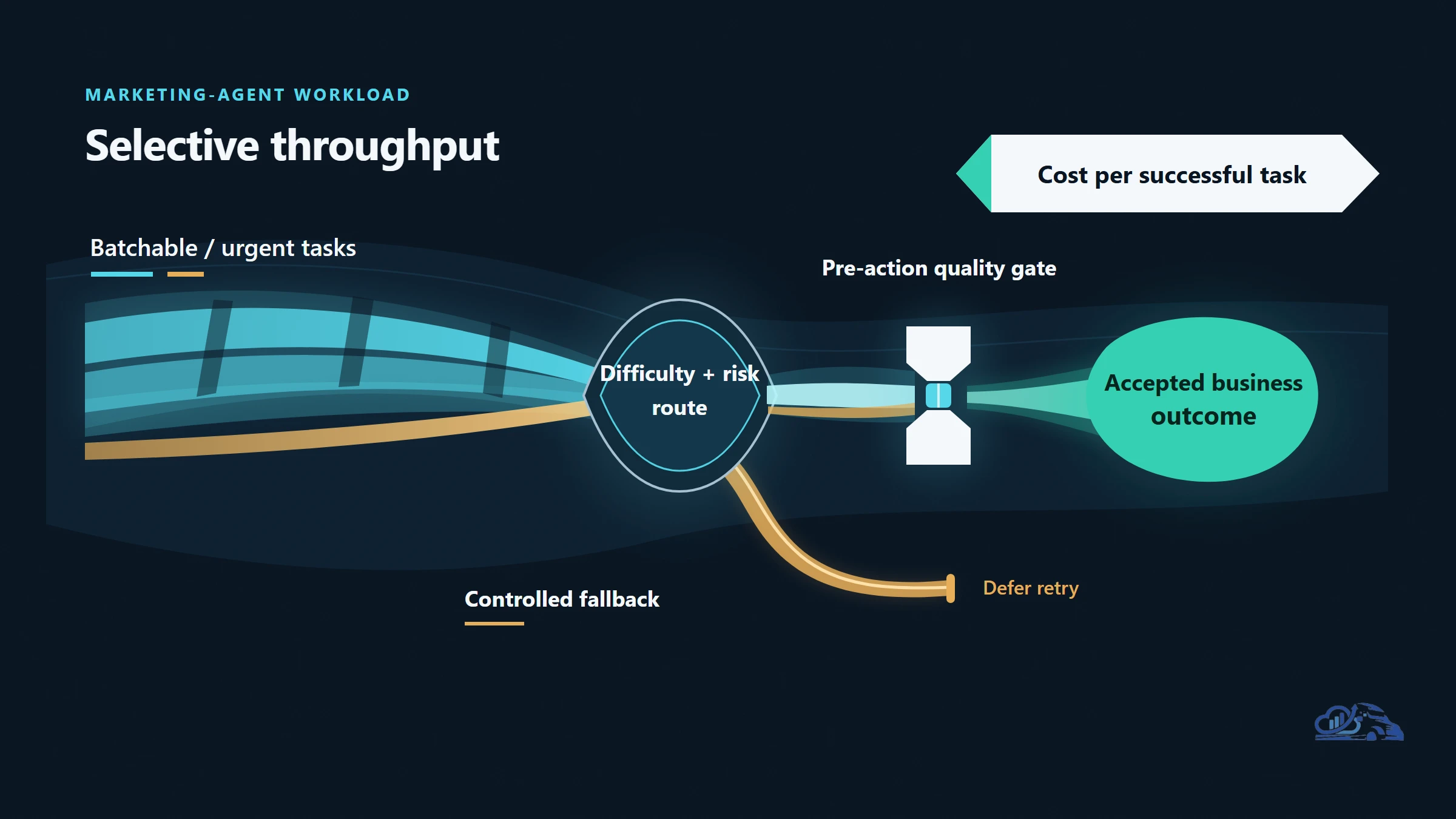
A resilient agent system batches delay-tolerant work, routes tasks by difficulty, validates early, bounds retries, and escalates uncertainty before it reaches customers or systems of record.
The implementation architecture should separate workflow policy from the model provider. Think of it as a queue with explicit gates, not a chain of prompts that assumes every dependency will remain available.
Table 3. Agent workflow stages, gates, and failure paths.
| Workflow stage | Default treatment | Required gate | Failure path |
|---|---|---|---|
| Intake | Validate data and permissions without a model where possible | Required fields, access, consent, and task type | Reject, repair, or queue |
| Research and extraction | Batch routine work and use the least costly proven route | Source presence, relevance, and deduplication | Reroute or defer |
| Generation | Select a route by complexity and business risk | Factual, brand, schema, and policy checks | Bounded revision |
| Review | Run deterministic checks before model judgment | Defined acceptance test | Human escalation |
| Publish and syndicate | Release only approved outputs | Destination, formatting, tracking, and approval | Hold safely |
| Monitoring | Record every transition and cost component | Complete logs and status visibility | Alert and recover |
Batch work that can wait
Evergreen research, keyword clustering, asset preparation, routine reporting, and nonurgent content QA are natural batch candidates. Batching reduces repeated setup work and keeps scarce real-time capacity available for signals whose value decays quickly.
A lead-routing agent is different. It may need to act as qualified inbound activity arrives. Reserve responsive capacity for that path, validate the required CRM fields before inference, and send uncertainty to a reviewer instead of letting the agent retry indefinitely.
Route by difficulty and consequence
Use a lower-cost route for classification, extraction, normalization, and other bounded tasks that pass deterministic checks. Escalate ambiguous research, strategic decisions, customer-facing copy, or repeatedly failing work to a stronger route or a human.
Model routing should be evidence-based. Maintain an evaluation set for each task class, apply the same acceptance gate to every route, and retain the lowest-cost option that meets the required quality reliably. Do not use the premium route everywhere merely because procurement was simpler.
Put gates before expensive downstream work
Validate inputs, permissions, required fields, source availability, and output schema before generation. After generation, check claims and brand requirements before commissioning illustrations, building schema, publishing, or syndicating.
This matters for Vanaxity because a search asset serves several surfaces. A page can be technically publishable yet still fail if it lacks a direct answer for AEO, evidence for GEO, or on-page structure for SEO. Gates prevent a weak stage from multiplying cost across every later channel.
Bound retries and make failure useful
Every retry policy needs a stopping condition, a fallback, and a record of the last failure. When the policy is exhausted, defer the task, switch to an approved route, or escalate with the source material and error context attached.
A campaign-monitoring agent should preserve revenue-sensitive alerts during capacity pressure and postpone low-priority report generation. That is graceful degradation: the system protects valuable work instead of failing unpredictably.
Want to pressure-test the workflow before scaling it? See the autonomous agent in action, then request a scoped review that maps task classes, quality gates, fallback paths, reporting gaps, and an implementation sequence for your team.
Make Reliability and Portability Part of Agent ROI
Agent ROI depends on whether work finishes on time, passes evaluation, and can move when a provider is constrained.
An API bill alone cannot show whether the operation is healthy. Marketing and RevOps leaders need workload observability that connects infrastructure behavior to accepted business output.
Track:
- Accepted-task throughput and queue age
- Completion latency by task class
- Retry behavior and repeated failure causes
- Cost per accepted result
- Token-budget use against the task's quality requirement
- Quality-gate rejection and remediation
- Human escalation and review burden
- Tool failures, fallback use, and deferred work
These signals explain why throughput changed. A growing queue may reflect demand, provider limits, broken tools, stricter evaluation, or overloaded reviewers. Buying a stronger model will not fix all those causes.
Design graceful degradation before capacity disappears
Classify tasks by urgency, business impact, reversibility, and review need. When premium capacity tightens, preserve high-value operations and delay lower-priority work. A content agent can hold an evergreen draft; it should not silently publish an unsupported claim. A RevOps agent can defer routine enrichment; it should protect a time-sensitive handoff.
Failure recovery should be explicit. The operator needs to know what stopped, what completed, which fallback ran, and what must be reviewed before resumption. Silent partial success is dangerous because dashboards can show activity while the actual business outcome remains incomplete.
Reduce vendor-lock before procurement becomes an emergency
Vendor-lock is not merely a contract issue. It appears when prompts, tool bindings, logs, evaluations, and output formats are so provider-specific that the workflow cannot move.
Keep orchestration portable with stable task schemas, provider adapters, canonical logs, exportable data, and evaluation sets that can test an alternate route against the production gate. Test that alternate before an outage or quota restriction. A backup that cannot produce an acceptable result is only a diagram.
When providers and labs compete for the same GPU capacity, a vendor's model quality does not guarantee available throughput. Evaluate vendors as infrastructure partners. Ask how capacity is allocated, how bursts and rate limits behave, which regions are supported, how data is handled, how model changes are announced, what observability is exposed, and how your workflow data can be exported. Treat price and latency as measured criteria, not permanent promises.
The mistake we see is choosing a model first and designing the operating system around its quirks. Start with the task contract, the acceptance gate, and the recovery path. Then plug in the route that performs best. For more operator guidance, explore Vanaxity's AI search and content insights.
Before expanding an agent, confirm that:
- Success is defined in business terms.
- The full cost stack is captured.
- Tasks are classified by urgency, complexity, and consequence.
- Delay-tolerant work is batched.
- Routes are tested against the same evaluation.
- Expensive stages sit behind early validation.
- Retries stop and produce useful failure context.
- Human review protects high-impact actions.
- Queue health and accepted throughput are visible.
- Fallback routes pass the real production gate.
- Orchestration, logs, and data can move between providers.
How Van Data Team Makes This Operational
The reported Meta Anthropic compute talks—an early proposal worth up to $10 billion over roughly two years—show why compute belongs in the operating plan for autonomous marketing agents. Both companies declined to comment, and the discussions may not produce a deal. The reporting is the signal; the recommendations below are Vanaxity’s analysis.
At Van Data Team, we begin by mapping the current handoff: source systems, trigger signals, decisions, review gates, dashboards, and recovery paths. We then scope which signals to collect, which workflow gaps to close, and which actions can run automatically versus requiring human approval.
The core metric is cost per successful task: the full cost of model calls, tools, retries, review, and remediation divided by accepted outcomes. This exposes agents that look inexpensive per token but consume capacity through repeated failures.
We protect throughput by batching non-urgent work, routing routine tasks to lighter models, reserving stronger models for complex or high-risk decisions, stopping weak outputs at early quality gates, bounding retries, and escalating exceptions to people. Dashboards connect spend and latency to completed, approved work—not raw activity.
Finally, portable orchestration, prompts, evaluation criteria, and data interfaces limit vendor lock-in. Tested fallback routes and a capacity-incident runbook reduce the risk that one provider’s limits, pricing, or availability silently stalls campaigns.
Frequently asked questions
Are Meta and Anthropic signing a compute deal?
No signed or confirmed deal has been announced. They are in early, preliminary talks, both companies declined to comment, and the discussions may not produce an agreement. Procurement teams should treat it as an infrastructure scenario, not an assured supply relationship.
Why could Meta supply compute to an AI competitor?
The reporting describes a coopetition dynamic. Meta could monetize infrastructure capacity while Anthropic buys the raw processing power it needs, even though their models compete. If the arrangement closes, competition at the model layer would coexist with supply at the infrastructure layer.
Why does compute availability matter to marketing agents?
An autonomous agent runs multi-step workflows rather than isolated conversations. Capacity limits can create queues, slow lead routing, delay campaign decisions, interrupt content production, and increase retries. The business effect depends on workload design and fallback behavior.
What is cost per successful task?
It is total workload cost divided by outputs that pass a defined quality gate. The numerator should include inference, tools, orchestration, monitoring, retries, review, and remediation. The denominator should include accepted outcomes, not every attempted run.
How should teams route work across AI models?
Route by measured task performance and consequence. Use economical routes for bounded work with reliable checks. Escalate ambiguity, high-impact decisions, repeated failures, and customer-facing actions to stronger routes or human review.
How can marketing teams reduce AI vendor-lock risk?
Separate orchestration from the provider, standardize task and output schemas, keep canonical logs, export workflow data, maintain portable evaluations, and test an approved alternate route under the same production gate.