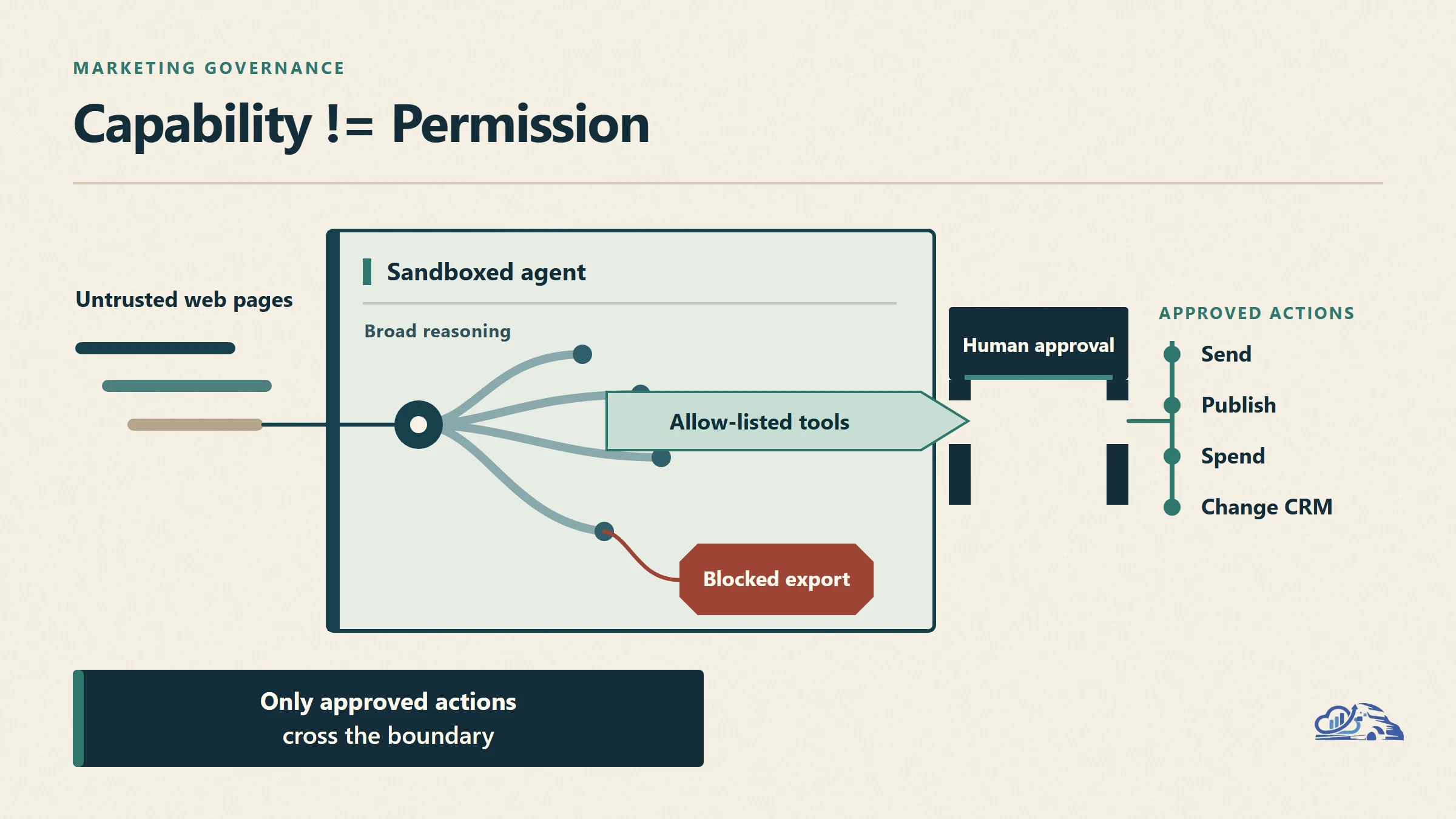
Google Ads AI Labeling: The Brand-Safety Playbook
Build an AI ad disclosure workflow, block deepfake risk, map EU transparency duties, and retain launch evidence with a practical governance checklist.
Overview
Marketing, brand, and RevOps teams running paid media with AI-made creative now face a specific Google Ads AI labeling risk: an honor-system disclosure checkbox for third-party tools, paired with a ban on deepfake-style depictions of real people, means one unlabeled or prohibited asset can trigger ad disapproval or potential account suspension. This article gives you an AI-content disclosure and brand-safety governance checklist, while Van Data Team approaches the work by keeping asset provenance, human review, disclosure evidence, and campaign approvals connected.
Industry coverage presents Google Ads AI labeling as a production-control issue for marketing, brand, and RevOps teams running paid media with AI-made creative. Under that coverage, an advertiser self-attestation checkbox for third-party tools, combined with a reported deepfake ban, means a single risky or unlabeled asset could get an ad disapproved or expose the account to potential suspension. This guide gives you an AI-content disclosure and brand-safety governance checklist.
The risk starts upstream, before a media buyer sees the checkbox. Vanaxity, Van Data Team's AI content agent, connects research, writing, illustration, publishing, and syndication through one governed workflow. That is how Vanaxity works: approved claims and source evidence stay connected as content moves into ads, search pages, and answer engines.
This article separates Google's reported requirements from Vanaxity's recommended controls. It offers marketing-governance guidance, not legal advice. Your legal or policy owner should interpret regional obligations for your campaigns.
Key Takeaways
Marketing teams need asset provenance, human review, accurate disclosure, and retained evidence before AI-made creative reaches a live campaign.
- Digital Applied reports that Google's disclosure experience rolled out globally on July 9, 2026 across Search, YouTube, and Discover.
- GROAS reports that creative built with Google's own generative AI receives automatic disclosure and that third-party AI depends on advertiser self-attestation, which it says Google does not verify for truthfulness.
- Audit Socials reports that deepfake-style content depicting real people is prohibited and that disclosure cannot make prohibited creative acceptable.
- Pink Dog Digital reports that the Google rollout is separate from the EU transparency rule associated with August 2, 2026.
- Provenance records, review gates, disclosure confirmation, and audit logs are Vanaxity recommendations, not extra Google requirements.
Map your SEO, GEO and AEO workflow before you build.

What Google Ads AI Labeling Requires
Industry coverage says Google tells people when covered ad creative was generated or edited with AI, while advertisers remain responsible for third-party AI disclosures.
Google Ads Help says advertisers can add text or visual labels to AI-generated or AI-modified image and video creative. The page also describes an AI label setting and says these notices are permitted even where text overlays or watermarks would otherwise face restrictions.
Digital Applied describes a consumer-facing "How this ad was made" panel in My Ad Center. The outlet says it explains whether AI created or edited the ad and reports that the rollout includes an "AI Generated" label.
Digital Applied reports that this disclosure applies globally across Search, YouTube, and Discover. It describes the change as Google's first broader ad-disclosure requirement beyond election advertising since the 2023 political-ad policy.
Based on Digital Applied, GROAS, and Audit Socials, the reported mechanics and recommended controls are:
| Creation path | Disclosure path | Advertiser action | Main governance risk |
|---|---|---|---|
| Google's generative-AI tools | Reported automatic disclosure | Confirm the expected label or panel appears | The asset may still contain unapproved claims or brand risks |
| Third-party AI generation or editing | Reported advertiser self-attestation | Record provenance, complete the checkbox, and independently verify the submission | The media buyer may receive no reliable creation record |
| Deepfake-style depiction of a real person | Labeling is not a remedy under the reported prohibition | Reject the creative and stop submission | Reported ad-disapproval and potential account-suspension risk |
| Revised AI-made creative | Disclosure decision should be reconsidered | Reopen review after material changes | An approved asset can become noncompliant after editing |
GROAS reports that since about Q1 2026, Google has required disclosure when AI substantially generates or modifies ad text, images, or video. The supplied sources don't define "substantially" with a numerical threshold. Teams should document uncertain cases instead of inventing their own percentage test.
The linked Google guidance also makes an essential compliance boundary clear:
Google Ads Help cautions that using its AI label setting does not itself establish compliance with applicable regulations.
Treat the label as a transparency mechanism, not a legal safe harbor. To see where evidence and approval checkpoints fit into production, watch the publishing process.
Why an Honor-System Checkbox Raises the Governance Bar
Under the third-party self-attestation model reported by GROAS, creative provenance becomes an advertiser responsibility even though the relevant facts originate earlier in production.
GROAS reports that Google-native assets receive disclosure automatically, with no separate advertiser action, while advertisers using third-party tools must tick the disclosure box. The same source says Google will not verify whether that attestation is truthful.
That gap matters. A checkbox records a decision, but it doesn't prove how the asset was made. It can't identify the model, source files, edits, affected media, consent status, or reviewer.
Consider a hypothetical handoff. Maya, a paid-media manager, receives a polished product video from an agency. The delivery note says it was "enhanced," but doesn't say that a third-party AI tool altered the spokesperson's voice and facial movements.
Without provenance, Maya must guess at submission time. A controlled workflow gives her a better outcome: pause the launch, request the source record, route the video through real-person review, and document the disclosure decision.
At Van Data Team, we start by moving the control upstream. Creative operations records AI involvement when the asset is created. Brand reviews people and claims, while the media buyer confirms the platform disclosure. RevOps keeps the evidence connected to the campaign and final asset version.
This is the practical difference between an operating system and a checklist living in someone's inbox. The same principle explains Vanaxity versus manual SEO: reliable delivery comes from connected ownership, evidence, and review states.
Build the Disclosure and Brand-Safety Workflow
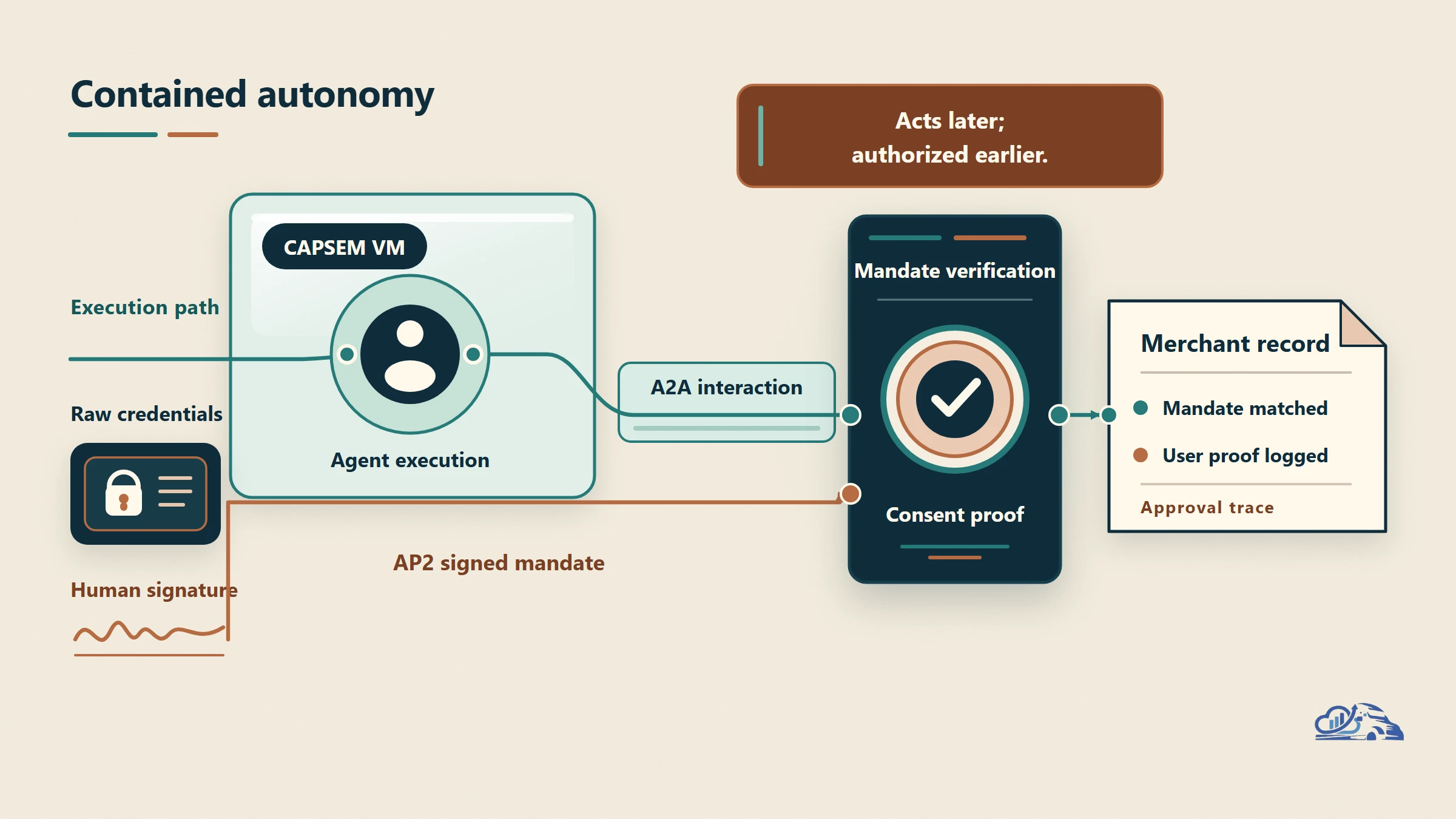
The following illustration summarizes the checkbox is the last step:
Figure 1. A governed AI ad carries provenance through risk review, disclosure confirmation, and retained launch evidence; a checkbox alone is not proof.
A reliable AI ad disclosure workflow attaches provenance, risk decisions, and evidence to every asset from creation through launch.
Using the reported mechanics above, use the following asset lifecycle:
- Register the asset. Assign an asset ID and preserve its source files, current version, destination page, and campaign owner.
- Record AI involvement. State whether AI generated or modified the text, image, voice, or video.
- Identify the tool path. Separate Google-native generation from third-party tools because industry sources report different disclosure actions.
- Flag higher-risk content. Mark recognizable people, material claims, comparisons, testimonials, and sensitive subject matter.
- Route human review. Send flagged assets to the appropriate brand, policy, compliance, or legal owner.
- Complete disclosure. Where the reported workflow applies, confirm automatic disclosure for Google-native creative or complete self-attestation for third-party assets.
- Verify the live experience. Preview the ad and confirm the expected label or My Ad Center panel.
- Retain evidence. Save the decision, reviewer, approval state, timestamp, preview, and source comparison.
- Reopen changed assets. Treat a revised claim, visual, voice, or video as a new review event.
Creative asset management, consent and disclosure tracking, approval workflows, and brand-safety evaluations can support this lifecycle. The system should keep the record beside the asset, not inside a private message or individual inbox.
Vanaxity-recommended AI-creative disclosure and brand-safety checklist:
| Check | Trigger | Recommended decision | Evidence to retain | Suggested owner |
|---|---|---|---|---|
| Asset provenance | Every new or revised asset | Record AI involvement and the creation tool | Asset ID, version, tool origin, source files | Creative operations |
| Google-native generation | Creative made with Google's AI | Confirm the reported automatic disclosure appears | Preview or My Ad Center evidence | Google Ads owner |
| Third-party generation | Creative made or edited outside Google's AI tools | Complete the reported self-attestation and require an independent check | Attestation, reviewer, final preview | Media buyer and brand reviewer |
| Modification scope | AI affects text, image, voice, or video | Describe the change and escalate unclear cases | Change summary and source comparison | Creative operations |
| Real-person depiction | Creative contains a recognizable person | Reject any deepfake-style depiction prohibited by applicable policy | Review decision and escalation record | Brand-safety owner |
| Claims or sensitive content | Creative contains material claims or higher-risk subject matter | Require human approval before submission | Approved source and reviewer | Brand, policy, or legal owner |
| Regulatory mapping | A transparency regime may apply | Map the platform action to internal policy | Region, rule, decision, and approval | Compliance owner |
| Final launch check | Asset is ready for activation | Confirm disclosure, approvals, page consistency, and evidence | Final preview and durable audit log | Account owner |
Gate AI depictions of real people
Any AI creative depicting a recognizable real person should receive human review. If the content makes someone appear to say or do something they didn't, stop publication and investigate. Under the prohibition described by Audit Socials, an AI-generated content label doesn't cure prohibited deepfake-style creative.
Audit Socials reports that violations can cause immediate ad disapproval and potential account suspension. Suspension isn't automatic for every mistake, but the reported account-level risk is real enough to justify a hard review gate.
Gate claims and sensitive subject matter
Product claims, comparisons, testimonials, and outcome statements should be checked against an approved source. This is Vanaxity's brand-safety recommendation, not a separate labeling rule stated in the cited Google guidance.
Sensitive subject matter should go to the appropriate policy or legal owner. Don't let an automated evaluator approve content outside its defined scope.
Imagine Lena, a brand lead, reviewing an AI-edited video of a real executive. The edit makes the executive deliver a claim that was never recorded or approved. Lena rejects the asset rather than adding a label, preserving both policy compliance and the executive's credibility.
Measure review burden and failure recovery
Good governance should be observable without blocking every low-risk asset. Route routine Google-native creative through a lightweight confirmation step. Reserve deeper human review for people, claims, sensitive topics, and uncertain disclosures.
Track missing provenance, queue age, reviewer overrides, reopened assets, disapprovals, and incomplete evidence. For model-based brand-safety evaluations, monitor token spend, processing latency, false negatives, and override patterns. Automated evaluation can prioritize work, but it shouldn't replace accountable approval.
Build failure recovery into the process. Quarantine the asset, pause activation, restore the last approved version, reopen review, and log the incident. That limits campaign downtime and prevents the same unsupported asset from re-entering another channel.
Map Platform Disclosure to the EU Transparency Regime
Industry sources describe Google's reported product rollout and the claimed EU deadline as separate events that should map into one internal policy.
Digital Applied reports that Google's labels rolled out on July 9, 2026. Pink Dog Digital reports that the transparency obligations under EU AI Act Article 50 became enforceable on August 2, 2026. The same source describes Article 50 as covering transparency for deepfakes and certain AI-generated content disclosures.
In campaign documentation based on these reports, don't merge those dates. Digital Applied frames the Google date as a platform change, while Pink Dog Digital frames the EU date as a regulatory transparency deadline.
Campaign documentation should separately verify any AI disclosure regimes that may apply in the European Union, India, and New York. A campaign may face platform requirements and regional obligations at the same time.
Vanaxity recommends a simple compliance crosswalk attached to the asset record. Capture the applicable region or rule, required disclosure, platform action, named reviewer, retained evidence, and final approval. This makes an audit reconstructable after team members or agencies change.
The reported Google checkbox can be one field in that record. It shouldn't be the record itself. Legal counsel should determine which laws apply and whether additional disclosures are needed.
Align Brand-Safe Ads With Structured Content and AEO
Approved, structured source content helps teams keep ad claims consistent across landing pages, schema, search results, and answer engines.
Start with a controlled claim library linked to current evidence and page copy. Creative operations should draw from that source instead of generating unsupported language from a loose prompt. When a claim changes, update the source and reopen every dependent asset.
Schema and structured data aren't identified as Google Ads labeling requirements in the supplied sources. Vanaxity recommends them because they make approved facts easier to maintain and interpret across SEO, GEO, and AEO workflows. They also reduce the chance that ads and answer-engine content describe the same product differently.
Performance Max now offers greater channel-level reporting visibility, while Google Ads is becoming more connected to AI Overviews and answer-seeking search behavior, according to the Google Ads platform update summary. These are reporting and discovery developments, not new ad-display standards.
For example, Priya, a RevOps lead, spots AI-generated ad copy claiming the product is the "fastest" option. The approved landing page only supports a narrower speed improvement. She stops the asset, corrects the claim, and aligns the ad, page, and structured data before launch.
That alignment matters because blue-link visibility is no longer the whole search market. Vanaxity's research-to-syndication workflow helps brands publish answer-ready information while preserving the approvals behind it.
How Van Data Team Makes This Operational
At Van Data Team, we treat Google Ads AI labeling as an operating workflow, not a policy memo. We map every handoff from creative asset management and third-party generation tools through campaign upload, approval, reporting, and incident recovery. This exposes where provenance disappears, who makes disclosure decisions, and which risky assets can bypass review.
The delivery plan becomes a practical AI-creative disclosure and brand-safety checklist:
- Capture each asset’s ID, version, source tool, AI generation or editing status, consent record, owner, and target market.
- Route depictions of people, sensitive topics, and material claims through human review, supported by brand-safety evals.
- Record the disclosure decision, checkbox submission, reviewer, approval date, and evidence in a searchable audit log.
- Use a dashboard and recovery runbook to pause affected campaigns, replace rejected creative, and preserve the incident trail.
We also connect approved claims to structured content and schema, then evaluate what AI Overviews and answer engines surface. That supports brand-safe AEO, but it isn’t a Google labeling requirement. These are Vanaxity’s recommended operating controls, not legal advice.
Frequently asked questions
Do I have to label ads made with a third-party AI tool?
According to GROAS, yes. The outlet reports that when third-party AI substantially generates or modifies the creative, the advertiser must use Google's self-attestation path. GROAS also says Google does not verify whether the checkbox was completed truthfully, so require a provenance record and independent review before submission.
Does Google label creative made with its own AI automatically?
According to GROAS, yes. It reports that ads created with Google's generative-AI tools receive automatic disclosure, with no separate advertiser attestation required. Teams should still retain the tool origin, final asset version, approval record, and disclosure preview for internal governance.
What counts as substantially generated or modified by AI?
The supplied sources cover AI-generated or modified text, images, and video but don't provide a numerical threshold for "substantially." Document what changed, compare the source and final asset, and escalate unclear cases to the responsible policy owner.
Are deepfakes allowed if the ad carries an AI label?
According to Audit Socials, no. The outlet reports that deepfake-style content depicting real people is prohibited. Under that reported prohibition, disclosure doesn't make prohibited creative acceptable. Stop the asset and route it through brand-safety review instead of treating the label as permission.
Is the Google rollout date the same as the EU AI Act deadline?
The cited sources describe them as separate dates. Digital Applied reports that Google's disclosure experience rolled out on July 9, 2026. Pink Dog Digital reports that the Article 50 transparency obligations became enforceable on August 2, 2026. Record them as separate platform and regulatory events.
Is structured data required for Google's AI ad labels?
No supplied source identifies schema or structured data as a labeling requirement. Vanaxity recommends structured content for claim consistency, GEO, and AEO. It supports a controlled source of brand-safe information but doesn't control Google's reported disclosure panel.