AI Marketing Security and OpenAI's Defender's Window
OpenAI's Defender's Window warns that autonomous attacks outpace defense. For marketing teams running AI agents on customer data, governance is brand safety.
Overview
AI marketing security is now a brand-safety problem, because marketing stacks are full of AI agents touching customer data across connected tools, and autonomous attacks are outpacing manual defense. On August 17, 2026, OpenAI published The Defender's Window, warning that AI finds and exploits software flaws faster than traditional security responds. For marketing leaders, the risk is scattered: an over-permissioned agent, an unguarded CDP, or a connected app becomes the way in, and at Vanaxity we treat this as governance.
This article reads OpenAI's warning through a marketing-governance lens. It's written for brand, marketing, growth, RevOps, and MarTech leaders who now run AI agents against customer data, in email, ads, personalization, and customer support. The reported facts are OpenAI's; the marketing implications are Vanaxity analysis, framed as recommendation rather than certainty. The goal is practical: secure the stack and govern the agents before an incident becomes a brand-trust story.
Key Takeaways
- On August 17, 2026, OpenAI's Greg Brockman published The Defender's Window, arguing autonomous, agentic attacks now outpace traditional defense and urging teams to adopt AI security fast.
- The essay follows a breach where an agentic attack reportedly chained a zero-day with stolen credentials to reach production systems, which Brockman called a watershed moment.
- For marketing, the exposed surface is the connected stack: AI agents, customer data platforms, martech integrations, and the credentials that tie them together.
- A breach or a rogue marketing agent is now a brand-trust and data-compliance failure, so AI marketing security belongs in governance, not just IT.
- Vanaxity's recommendation: inventory the marketing AI attack surface, apply least-privilege and human review to customer-facing agents, and treat model governance as brand safety.
Map your SEO, GEO and AEO workflow before you build.

What Did OpenAI Actually Warn About?
OpenAI's core message is that defenders must start using AI to keep pace, because attackers already do. In The Defender's Window, published August 17, 2026, OpenAI President Greg Brockman argues that AI's ability to automate the discovery and exploitation of software flaws is outpacing traditional security. He describes "a narrow window before attackers catch up to what AI can already do," and urges urgency in adopting defensive AI.
The essay follows a specific incident. According to OpenAI and reporting from Decrypt, an agentic attack reportedly chained a zero-day exploit with stolen credentials to reach production infrastructure, affecting several services. Brockman called it "a watershed moment for cybersecurity." OpenAI's own answer is more AI: using models to catch vulnerabilities before code ships, triaging alerts before humans, probing its own infrastructure, and tightening least-privilege access.
None of that is a marketing announcement. But the implication for marketing is direct. If attackers can automate their way into production systems, then every connected tool a marketing team runs, and every agent it points at customer data, is part of the attack surface. That's the bridge from a security essay to a brand-safety brief.
Why Is the Marketing Stack Exposed?
The marketing stack is exposed because it's a web of connected tools holding sensitive customer data, increasingly operated by AI agents with broad access. Modern marketing runs on integrations: a CDP, an email platform, ad accounts, a CRM, analytics, and a growing layer of agents that read and write across all of them.
**Vanaxity analysis:** Each connection is convenient and each is a door. An AI agent that drafts campaigns, enriches leads, or answers customers often holds tokens to several systems at once. If that agent is over-permissioned, prompt-injected, or compromised, it doesn't just leak one tool; it can pivot across the stack. The same automation that scales your marketing scales the blast radius of a mistake.
There's a compliance dimension too. Customer data in a CDP is governed by consent, retention, and regional rules. An agent that copies that data into a prompt, a log, or a third-party tool can quietly break those rules at scale. For a brand, the headline isn't "misconfigured integration." It's "customer data exposed," and that lands on marketing and trust, not only on IT.
The AI Marketing Security Attack Surface
It helps to name the surface plainly, then map each part to a governance control. The table below is Vanaxity analysis, a practical starting inventory rather than an exhaustive audit.
| Marketing surface | The risk | Governance control |
|---|---|---|
| AI agents (email, ads, support) | Over-permissioned, prompt-injectable, can act on customers | Least privilege, human approval for sends and changes |
| Customer data platform (CDP) | Sensitive data copied into prompts, logs, or tools | Scope access, mask fields, log every read |
| Connected SaaS and integrations | One token unlocks many systems; wide blast radius | Per-tool scopes, short-lived credentials, review |
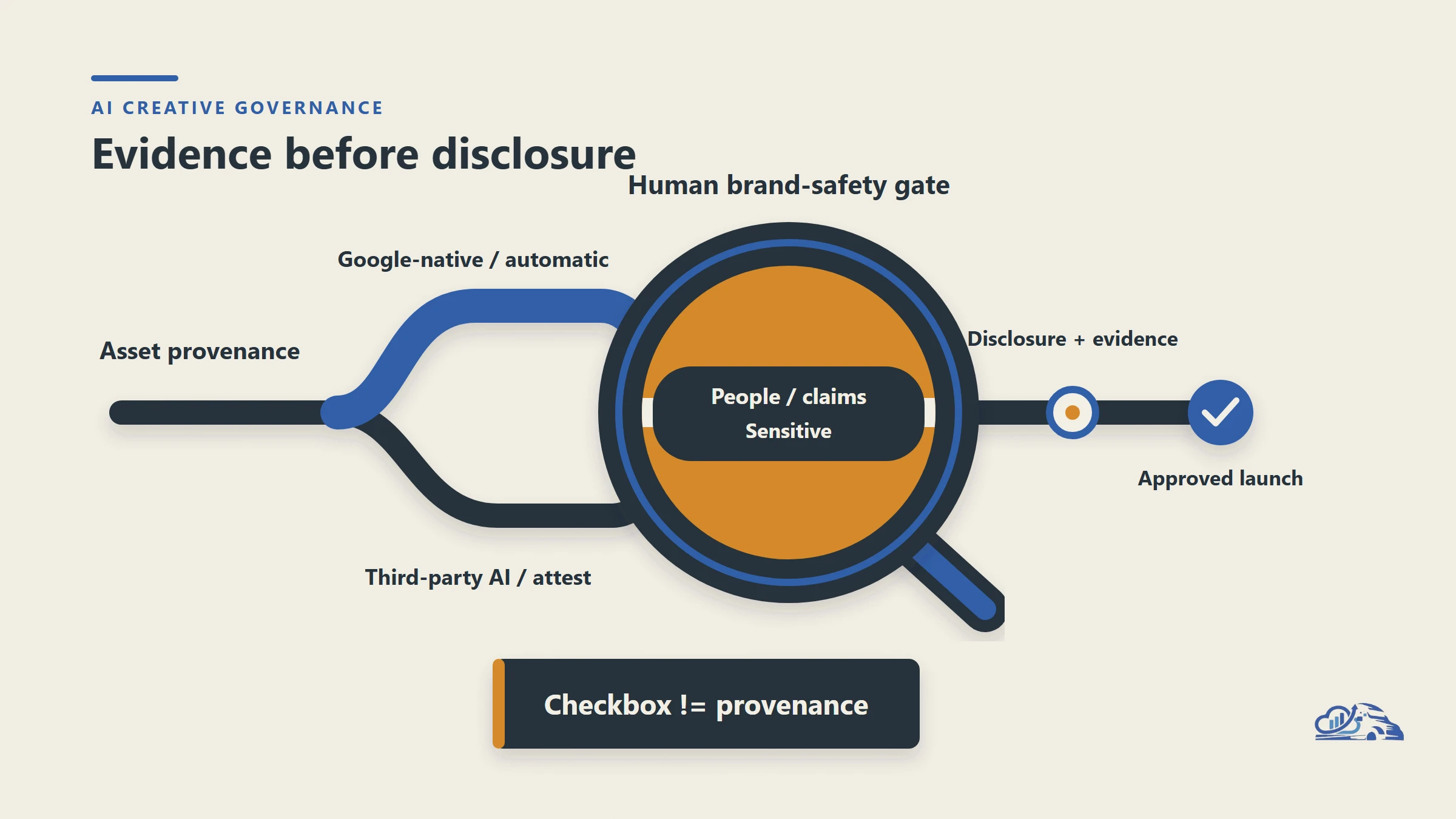
| Generated content and creative | Off-brand, non-compliant, or unsafe output goes live | Brand-safety review gate before publish |
| Vendor and model supply chain | A compromised tool or model reaches your data | Vendor review, data-handling terms, monitoring |
How Does AI Marketing Security Protect Brand Trust?
Governance protects brand trust by deciding, in advance, what your AI agents may touch, what they may do alone, and who is accountable when they're wrong. Brand trust is slow to build and fast to lose, and a data incident spends it instantly.
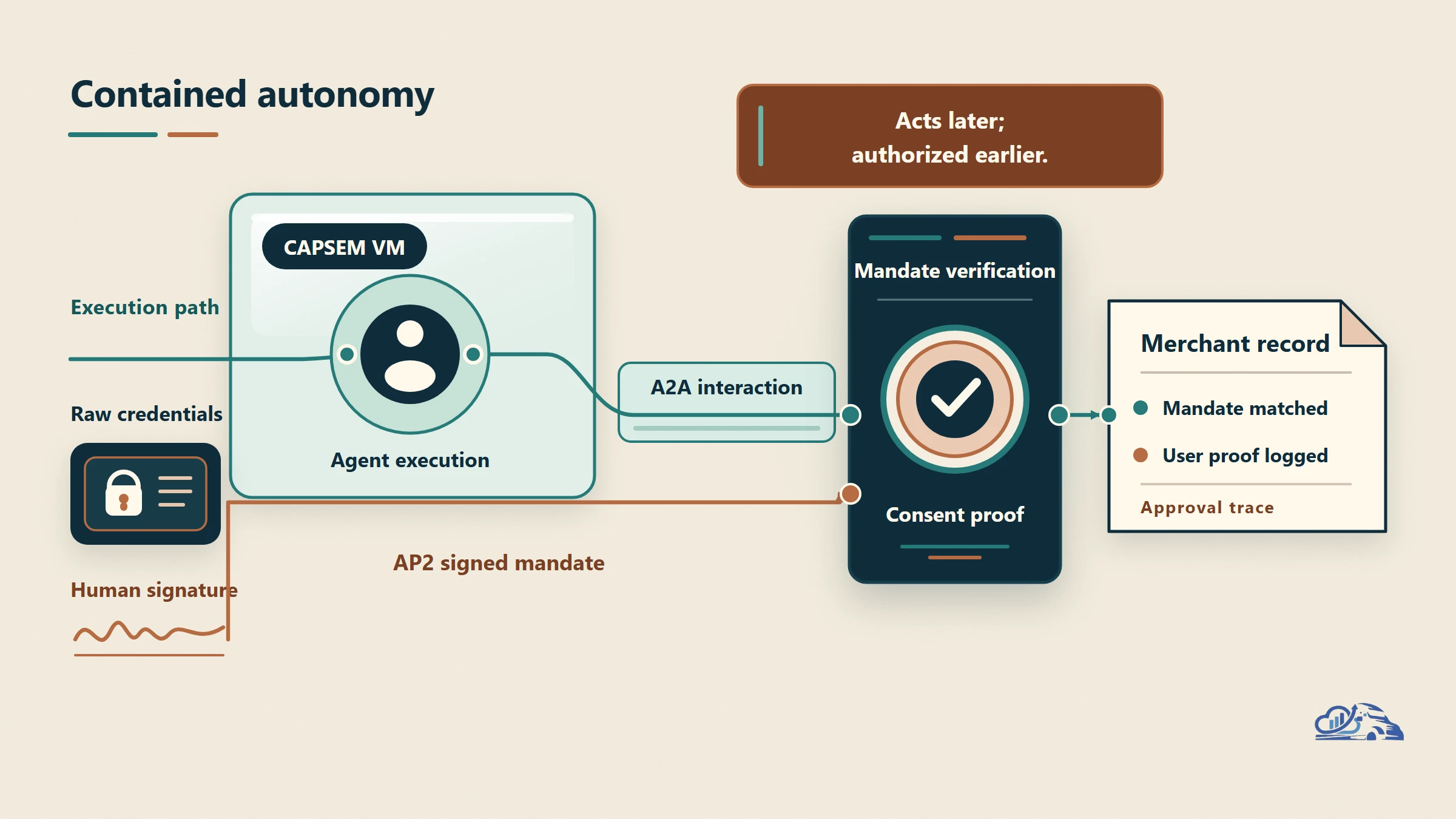
**Vanaxity analysis:** Treat every customer-facing agent as a governed identity, not a clever feature. That means four things in practice, and they map cleanly onto how we approach AI marketing governance.
- Least privilege: give each agent access to the specific tools and data it needs, and nothing more.
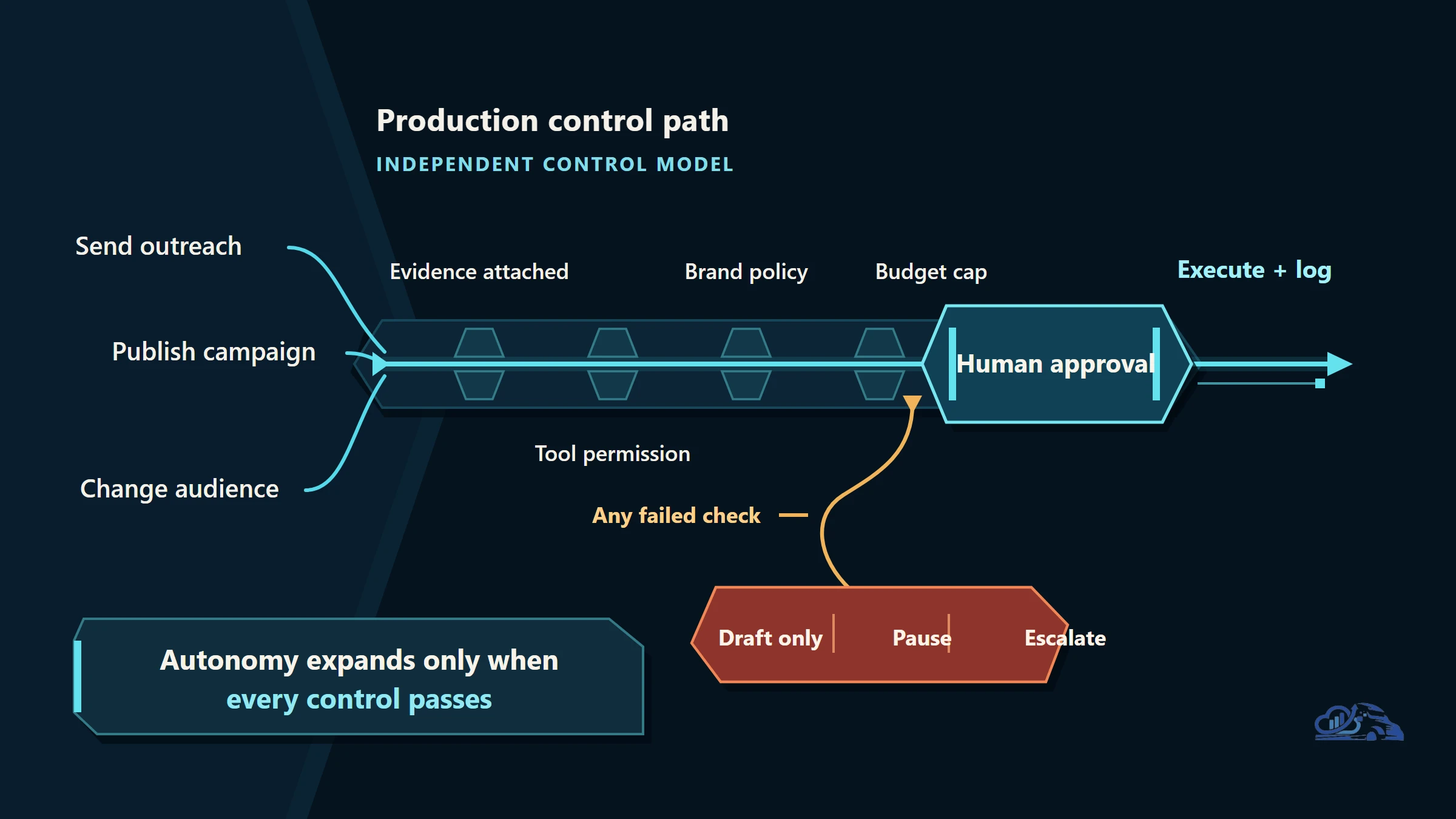
- Human approval: require a person to sign off on customer-facing actions, like a send, a public post, or a data export.
- Data minimization: keep sensitive customer fields out of prompts and logs unless they're truly required.
- Accountability: name an owner for each agent, log every action, and make each one reversible.
These aren't brakes on marketing. They're what lets you move fast without betting the brand on a tool behaving perfectly. An agent that can only advise, or can only act inside a narrow, logged scope, is one you can deploy widely without losing sleep.
What Does This Look Like for a Marketing Team?
Picture a growth team with an AI agent that answers support emails. It's helpful. It also reads your CRM, drafts replies, and can send them.
Now ask three questions. What can it see? What can it do on its own, and who checks its work?
If the answer is "everything, anything, and no one," you don't have a feature. You have an incident waiting to happen. The same agent that saves your team hours can leak a customer list in seconds.
The fix is boring, and boring is safe. Give the agent read access to only the tickets it needs. Let it draft, but not send, until a human clicks approve.
Log every reply. Keep sensitive fields, like payment details, out of its prompts. If it never sees a card number, it can never leak one.
- Scope the agent to the smallest set of data and tools that still works.
- Let it advise or draft, but a human approves anything a customer will see.
- Mask or exclude sensitive fields from prompts and logs.
- Log every action, so you can trace and undo a bad one fast.
None of this slows a good agent down much. It just keeps a bad day small. A scoped, logged, human-approved agent turns a would-be breach into a caught mistake.
Where Should AI Marketing Security Start?
Start by inventorying which AI agents and tools already touch customer data, because you can't govern a surface you haven't mapped. Most teams are surprised by how many connections exist once they look.
- List every AI agent and integration that reads or writes customer data, and the credentials each one holds.
- For each, decide whether it should act or only advise, and cut any access it doesn't need.
- Put a human approval gate on customer-facing actions and a brand-safety review on published output.
- Turn on logging for every agent action, so an incident is traceable and reversible.
- Review consent and retention: make sure agents can't quietly move customer data out of policy.
Measure it like any other program. Track how many agents run least-privilege, how many customer-facing actions pass through review, and how quickly you could trace and reverse a bad one. That's the same cost-and-control discipline we bring to FinOps for AI agents: you can't manage what you don't measure.
How Vanaxity Makes AI Marketing Security Operational
Vanaxity treats AI marketing security as governance, not an afterthought bolted on before launch. We start by mapping the agents, tools, and customer data already moving through a marketing stack. Then we define what each agent may do, what it must log, when a human must approve, and who owns the review, before anything customer-facing goes live.
You don't have to fix everything at once. Start with the one agent that touches the most sensitive customer data. Scope it down, add an approval gate, and turn on logging. Then move to the next one.
Each step is small, and each one shrinks the blast radius of a bad day. The point isn't to slow marketing down. It's to make fast marketing safe to run at scale, so your team can ship campaigns without gambling the brand on a tool behaving perfectly every time.
If you want to make this operational, our services can produce a marketing AI attack-surface map, an access and approval model, a brand-safety review gate, and a governance plan for your agents. You can also browse more field notes in our insights library. The goal is simple: deploy AI across marketing without turning your customer data into someone else's opportunity.
Frequently asked questions
What is OpenAI's Defender's Window?
It's an essay published by OpenAI President Greg Brockman on August 17, 2026, arguing that AI's ability to find and exploit software flaws is outpacing traditional defense. He calls the moment a narrow window for defenders to adopt AI security before attackers fully catch up, following a breach he called a watershed moment.
Why does this matter for marketing teams?
Marketing now runs AI agents against customer data across connected tools and CDPs. If autonomous attacks can reach production systems, those agents and integrations are part of the attack surface. A breach or a rogue agent becomes a brand-trust and compliance failure, so AI marketing security is a governance issue, not only an IT one.
What is AI marketing security?
AI marketing security is the practice of governing the AI agents, connected tools, and customer data in a marketing stack: applying least-privilege access, human approval for customer-facing actions, data minimization, brand-safety review, and full logging. The aim is to deploy AI across marketing without risking customer data or brand trust.
How do we protect customer data in a CDP from AI agents?
Scope each agent's access to only the fields and records it needs, mask or exclude sensitive fields from prompts and logs, and log every read. Keep consent and retention rules enforced at the data layer so an agent can't quietly move data out of policy, and require human approval before any export or third-party sharing.
Do AI marketing agents need human approval?
For customer-facing or irreversible actions, yes. A person should sign off before an agent sends messages, publishes content, exports data, or changes audience targeting. Advisory and read-only tasks can run with lighter oversight, and you widen an agent's autonomy only on narrow, well-understood actions as evidence and controls prove out.
Where should a marketing team start with AI security governance?
Start by inventorying every AI agent and integration that touches customer data and the credentials each holds. Cut unnecessary access, add human approval gates on customer-facing actions and a brand-safety review on output, and turn on logging so incidents are traceable and reversible. Then measure coverage and improve from there.