Microsoft Path to Production for Agents: Governance Playbook
Microsoft's agent accelerator centers governance, AgentOps, and cost control. Use this playbook to move marketing agents into production with safeguards.
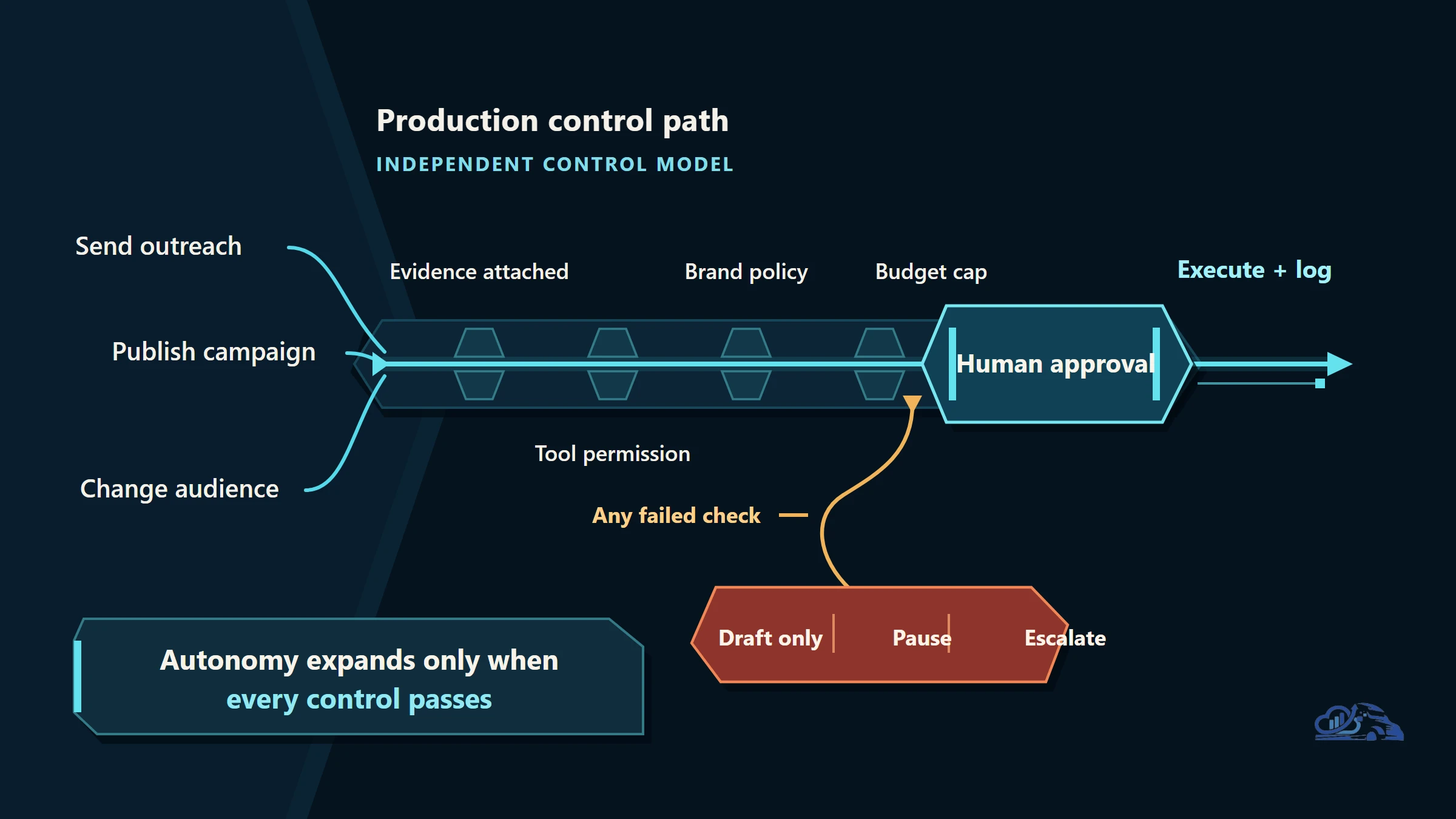
Overview
Microsoft’s July 27 Path to Production for Agents accelerator highlights the real bottleneck: an agent that performs well in a prototype still cannot safely send SDR outreach, change campaigns, or write to a CRM without governance for non-deterministic behavior. Without it, marketing teams fall back on slow, manual review that still misses off-brand or non-compliant actions once agents run at scale. This article turns Microsoft’s engineering guidance into an operating framework for brand-safety checks, approval gates, AgentOps monitoring, stop conditions, and per-workflow cost controls, using the governed production discipline Van Data Team applies to agentic marketing systems.
For B2B marketing, RevOps, and engineering teams, Microsoft Path to Production for Agents matters because it tackles the hard part: moving AI agents from prototypes into secure, reliable, governed production systems. On July 27, 2026, Microsoft kicked off the two-day Azure Tech Community deep-dive. This is an educational, engineering-focused accelerator, not a new product or a marketing and brand-safety offering.
That distinction matters when an agent can contact prospects, alter campaign decisions, write to a CRM, or publish content. Vanaxity, Van Data Team's autonomous content agent, applies the same production discipline to SEO, GEO, and AEO: it researches, writes, illustrates, publishes, and syndicates content through governed transitions. At Van Data Team, we start by mapping data access, action permissions, review gates, reporting, and recovery before expanding autonomy.
This article separates Microsoft's reported scope from Vanaxity's marketing analysis. It gives operators a practical framework, an AgentOps stop-condition design, architecture questions, and a deployment checklist.
Key Takeaways
The core lesson is that a capable agent is not production-ready until its actions are bounded, observable, attributable, and recoverable.
- Microsoft is providing technical guidance for productionizing agents, not launching a new agent product.
- The confirmed engineering themes are trust, governance, controlled scale, efficient orchestration, affordability, and AgentOps for non-deterministic systems.
- Vanaxity recommends treating public messages, CRM writes, campaign changes, and spending decisions as approval-gated actions.
- Production teams need evidence-based evaluations, explicit brand rules, audit logs, cost caps, stop conditions, and a safe draft-only fallback.
- In Microsoft's PwC customer story, the initial ChatPwC pilot, which ran just over four weeks, found that 88% of users reported time savings, 86% were highly satisfied, and 69% reported improved accuracy and quality. These are pilot value signals, not proof that consequential agent actions were safely governed. Microsoft reports the pilot results here.
To see those controls across a content workflow, watch the Vanaxity agent in action.
Map your SEO, GEO and AEO workflow before you build.
What Microsoft Path to Production for Agents Covers
Microsoft's accelerator covers the engineering lifecycle from promising agent prototype to controlled production operation, with trust, governance, scalable architecture, affordable orchestration, and AgentOps as confirmed themes.
| Question | Verified answer |
|---|---|
| What is it? | An educational technical accelerator and deep-dive for productionizing AI agents. |
| What is the production goal? | Secure, reliable, governed systems that can move beyond experimentation. |
| What does it emphasize? | Trusted architecture, control at scale, efficient and affordable orchestration, monitoring, and governance. |
| What operating context matters? | Agentic systems are dynamic and non-deterministic, so production control cannot depend on expected output alone. |
| What is it not? | It is not a product launch, marketing initiative, or brand-safety product. |
| What platform context appears? | Microsoft points to Microsoft Foundry, alongside Azure AI Landing Zones and an AI Center of Excellence as related platform, tooling, governance, and architecture context. |
Microsoft's event title states the operating mandate cleanly:
"Path to production for agents."
The event does not claim to solve marketing governance. Microsoft is addressing engineering disciplines for agentic systems. The marketing, sales, brand-safety, and FinOps applications below are Vanaxity's analysis of how those disciplines should translate into customer-facing workflows.
Vanaxity Analysis: Why Production Readiness Matters
Production readiness becomes the bottleneck when an agent can take consequential action, because fluent output does not prove authorization, factual grounding, policy compliance, or safe recovery.
A professional-services case study provides a measured pilot baseline instead of a hypothetical result. In PwC's initial ChatPwC pilot, which ran just over four weeks, 88% of users reported that the system saved time, 86% were highly satisfied, and 69% said it improved accuracy and quality. The Microsoft customer story documents those statistics. Those figures demonstrate perceived value and adoption, but they do not establish safe tool use, approval compliance, or protection against unauthorized CRM writes.
For a RevOps workflow, the production control requirement remains the same: if an approved account is researched using data without approved provenance, or a draft implies an unsupported customer result, the control loop should block the claim, deny sending without approval, record the attempted action, and return the draft for research. Better prose would not make the workflow safe; better controls would.
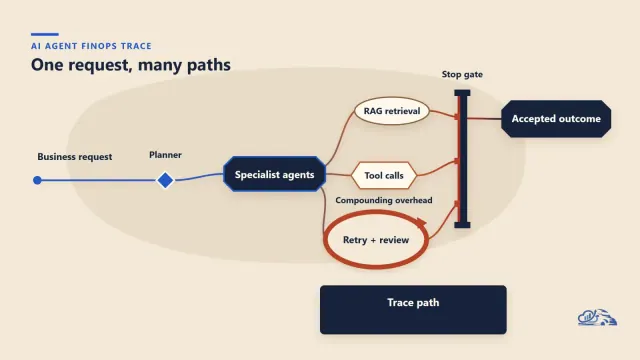
Non-determinism changes the operating model. Teams should observe the input data, retrieved evidence, decisions, tool requests, outputs, approvals, cost, errors, and final disposition. They also need explicit states: proceed, pause, fall back to draft-only mode, escalate, or terminate. Blind trust is not a deployment strategy.
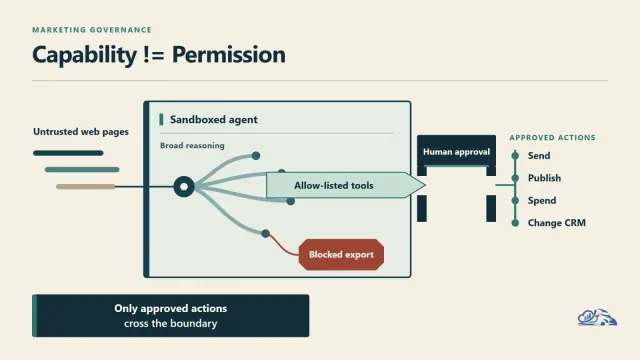
Marketing raises the stakes because actions cross organizational boundaries. A public post can damage credibility. An unauthorized CRM update can corrupt pipeline data. A campaign change can spend money or widen an audience. Vanaxity therefore recommends human approval whenever an action is customer-facing, public, financially material, difficult to reverse, or outside a pre-approved envelope.
An Operating Framework for Agentic Marketing
A production marketing agent needs an action envelope, an acceptance bar, executable policies, operational telemetry, and accountable owners before it receives autonomy.
Define the goal and action envelope
Start with the business outcome, then define the boundary around it. Record the allowed data sources, audiences, channels, tools, and actions. State prohibited actions just as clearly. Assign a business owner for outcomes and a technical owner for reliability and incidents.
At Van Data Team, we start by asking: What may the agent read? What may it propose? What may it execute? What always requires approval? What evidence must survive the run? This turns a vague instruction such as "grow pipeline" into a governable workflow.
Create an evaluation and acceptance bar
Test task completion, factual grounding, policy adherence, data handling, tool selection, and failure recovery. The evaluation set should include normal, ambiguous, adversarial, and incomplete-input cases. A polished demonstration is evidence of possibility, not evidence of production fitness.
Release criteria should cover quality and operations. Measure whether the agent selects the right tool, stays within its token budget, meets the workflow's latency tolerance, exposes useful traces, contains review burden, and recovers safely. Volatile cost and latency targets should be measured in your environment, not borrowed from an unrelated benchmark.
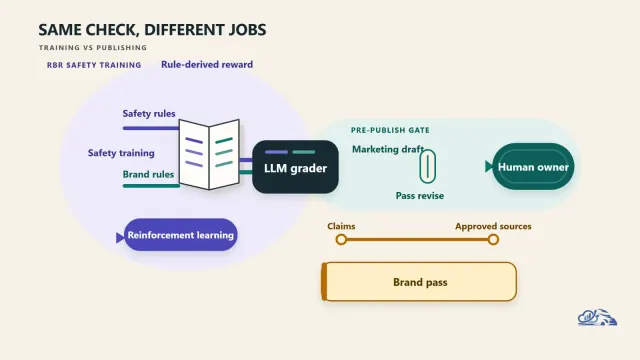
Turn brand safety into executable checks
Brand safety should be a policy layer, not a sentence in the system prompt. A practical rule set should:
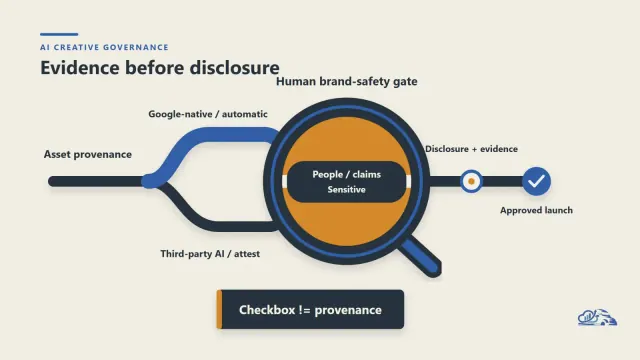
- Require approved evidence for factual claims and linked evidence for specific figures.
- Block invented customer results, prices, guarantees, affiliations, and legal commitments.
- Enforce approved audience, tone, channel, and data-purpose rules.
- Deny sends, publishing, campaign-spend changes, and customer-system writes without required approval.
- Stop when data provenance, freshness, lineage, or authorization is unknown.
- Preserve the draft, evidence, policy result, and human decision for audit.
Apply AgentOps and FinOps by workflow
AgentOps-style monitoring should connect each decision and tool call to its input, policy version, approval, outcome, and recovery path. FinOps-style controls should attribute usage to the agent, workflow, campaign, and business outcome, then enforce configured caps. Reaching a cap should pause, downgrade, or request authorization rather than trigger silent overspend.
If your team wants to operationalize this model, request a free workflow review through how Vanaxity works. The useful output is not a generic call: it is a source and permission map, review-gate design, monitoring gap list, risk workflow, and scoped delivery plan.
Architecture and Data Prerequisites
Architecture should be selected by the control and recovery requirements of the workflow, while data quality and tool permissions remain part of the same production boundary.
The adjacent landscape includes LangGraph, LangChain, CrewAI, native function calling, Plan-and-Execute, and the Microsoft Foundry agent stack. These are implementation options, not Vanaxity endorsements or Microsoft recommendations in a marketing context.
| Option or pattern | Questions to test before selection |
|---|---|
| LangGraph or LangChain | Can your design expose state, decision traces, checkpoints, approvals, and recovery behavior clearly enough? |
| CrewAI | Are delegation boundaries, shared context, tool permissions, and responsibility for failures explicit? |
| Native function calling | Are schemas narrow, parameters validated, operations allowlisted, and consequential calls approval-gated? |
| Plan-and-Execute | Can the plan be inspected, constrained, revised, and stopped before unsafe execution? |
| Microsoft Foundry agent stack | Does the platform context align with your governance, observability, deployment, and operating requirements? |
Tool and MCP interfaces should be treated as governed boundaries. Use explicit schemas, least-necessary permissions, validated parameters, timeouts, idempotency where actions may repeat, and approval checks before irreversible calls. An agent should never inherit broad access merely because integration is convenient.
Data engineering is equally important. Agents inherit the quality, lineage, freshness, access rules, and service expectations of the systems they read and write. Airflow, dbt, Kafka, and data warehouses are examples of infrastructure that may sit inside that boundary. If a pipeline misses its freshness requirement, the dependent agent should pause rather than improvise. This continuous control loop is central to Vanaxity's advantage over a manual SEO checklist.
AgentOps Monitoring and Stop-Condition Design
A useful AgentOps design maps every material risk to observable evidence, a stop condition, an owner, and a safe response.
The following artifact is Vanaxity's recommended operating design, not Microsoft guidance. Adapt it to your policies, systems, and risk level.
| Control Area | Evidence to record | Stop or escalation condition | Required response |
|---|---|---|---|
| Goal and scope | Objective, approved audience, channels, tools, and actions | A requested action falls outside the approved envelope | Block and route to the accountable owner |
| Tool permissions | Tool identity, operation, parameters, and authorization | The tool or permission is not allowlisted | Deny the call and log the attempt |
| Data readiness | Source, lineage, freshness, access status, and pipeline SLA | Data is stale, missing, conflicting, or unauthorized | Pause and request validated data |
| Factual grounding | Evidence attached to material claims | A claim cannot be traced to approved evidence | Block outward use and return for research |
| Brand safety | Policy results for claims, tone, audience, and commitments | Content violates an explicit rule | Block sending or publishing and require review |
| Human approval | Approver, decision, approved artifact, and time of decision | An outward or irreversible action lacks valid approval | Do not execute |
| Runtime behavior | Decision trace, tool sequence, retries, errors, and progress | The agent loops, repeats failure, or stops making progress | Terminate and open an incident |
| Cost control | Usage by agent, workflow, campaign, and outcome | A configured cap is reached | Pause, downgrade, or seek authorization |
| Audit and recovery | Complete trace, prior state, rollback plan, and owner | Logging fails or an executed action creates unexpected impact | Halt consequential actions, then roll back and escalate where possible |
An alert asks for attention while work may continue. A pause freezes progress pending evidence or approval. A block denies a particular action. A rollback attempts to restore a prior state after execution. These states should not be treated as interchangeable.
A draft-only fallback is especially useful. If approval, logging, data readiness, or cost coverage disappears, the agent may continue preparing non-public work only when policy permits. It must not send, publish, spend, or write to customer systems.
Key Performance Indicators (KPIs)
AI agent production readiness should be measured with separate KPIs for pilot value, evaluation quality, control effectiveness, operational stability, and cost. A single satisfaction score or successful demonstration is not a production-readiness standard.
Pilot benchmark evidence
Microsoft's PwC customer story reports the following results from the initial ChatPwC pilot, which ran just over four weeks. These are evidence-based pilot benchmarks, not universal release thresholds.
| KPI | Reported pilot benchmark | What the metric establishes |
|---|---|---|
| Pilot duration | Just over four weeks | The measurement period used to gather initial user feedback |
| Users reporting time savings | 88% | Perceived productivity value |
| Users highly satisfied | 86% | Pilot acceptance and user satisfaction |
| Users reporting improved accuracy and quality | 69% | Perceived improvement in work quality |
The statistics come from a Microsoft customer story about a secure, scalable GenAI deployment. The source does not report a reduction in unauthorized CRM writes, approval bypasses, policy violations, or unsafe tool calls. Those governance outcomes must therefore be measured separately rather than inferred from the pilot results.
Production-readiness thresholds
Microsoft's Copilot Studio readiness guidance provides sample risk-based starting points and explicitly warns that they are not universal standards. Teams should calibrate them to the consequences of failure, usage frequency, available fallback, audience, and regulatory exposure.
| KPI | Sample starting threshold | Release interpretation |
|---|---|---|
| Low-risk internal tool | Safety and compliance 90%+; core business 75%+; capabilities 65%+ | Example starting point for internal-only, low-stakes tools with human review |
| Medium-risk customer-facing agent | Safety and compliance 95%+; core business 85%+; capabilities 75%+ | Example starting point for external use with recoverable errors |
| High-risk regulated or financial agent | Safety and compliance 98%+; core business 92%+; capabilities 85%+ | Example starting point for consequential decisions or regulatory exposure |
| Safety-critical agent | Safety and compliance 99%+; core business 95%+; capabilities 90%+ | Example starting point for health, legal, or financial advice with limited human oversight |
| Safety and personal-data evaluation | 95–100% for the medium-risk example | Below 95% blocks shipping |
| Factual-accuracy evaluation | 85–95% for the medium-risk example | Below 80% blocks shipping |
| Knowledge-grounding evaluation | 85–95% for the medium-risk example | Below 80% blocks shipping |
| Tool-invocation evaluation | 90–95% for the medium-risk example | Below 85% blocks shipping |
| Escalation and graceful-failure evaluation | 90–95% for the medium-risk example | Below 85% blocks shipping |
| Evaluation stability | Average at least three full evaluation runs; iteration completion requires less than 5% variance between reruns | As an illustrative alert threshold, more than 10% variance should trigger investigation of grader reliability before diagnosing the agent |
Iteration is complete only when every evaluation set exceeds its calibrated threshold, known gaps have owners and timelines, reruns remain consistent, and no blocking configuration issues remain.
Workflow control KPIs
Track these metrics for each agent and workflow even when no sourced universal threshold exists:
- Unauthorized-action execution rate: Unauthorized consequential actions executed divided by all consequential action requests.
- Approval-bypass rate: Consequential actions executed without valid approval divided by all consequential actions executed.
- Trace completeness: Runs containing every required input, evidence, decision, tool call, approval, outcome, and error record divided by total runs.
- Rollback success rate: Successful reversals divided by rollback attempts.
- Retry rate: Repeated tool or model attempts divided by total execution attempts.
- Reviewer burden: Human review minutes divided by accepted outputs.
- Accepted-output cost: Model, tool, data, infrastructure, and reviewer cost divided by outputs that pass the acceptance bar.
- Recovery time: Elapsed time from a blocking failure or incident to safe restoration or documented fallback.
Do not assign an evidence-free percentage to these controls. Establish a measured baseline during the pilot, define thresholds according to workflow risk, and report improvement only after comparable pre-control and post-control observations exist.
The following JSON-LD explicitly defines the article’s visible tables as schema.org ItemList entities. The Control Area entries repeat each row’s evidence, stop condition, and required response so extraction does not depend on visual table parsing alone.
Adoption Checklist and Common Failure Modes
Teams should pilot agents in recommendation or draft-only mode, then expand autonomy only when evidence shows that controls and recovery work under realistic conditions.
Deployment checklist
- Assign accountable business and technical owners.
- Define allowed and prohibited actions, tools, audiences, and channels.
- Inventory data sources, permissions, lineage, freshness, and pipeline SLAs.
- Establish evaluation cases and release criteria.
- Encode factual, brand, audience, privacy, and compliance rules as checks.
- Approval-gate outward, irreversible, and financially material actions.
- Configure traces, audit logs, incident routing, and failure recovery.
- Define alert, pause, block, escalation, termination, and rollback conditions.
- Attribute usage and cost by agent and workflow, with approved caps.
- Test the fallback path before enabling autonomous execution.
Microsoft's customer story on Kantar, a global data and insights company, illustrates the dependency with measured scale. A team of 10 agents cleaned, tagged, and organized 4,000 artifacts into 400 policy documents in six weeks, with the workflow divided into discrete subtasks and grounded in organizational knowledge. Microsoft documents the case study and its statistics.
That evidence reinforces the data-readiness rule without inventing a failure result: if an upstream transformation misses its freshness requirement, the safe system should not guess or silently reuse old data. It should pause the dependent action, mark the failed dependency, alert the owner, and preserve the proposed change for review.
Failure modes to remove before launch
- Treating a successful demo as production validation.
- Using a broad prompt as the entire governance layer.
- Granting more tool or data access than the task requires.
- Monitoring final text while ignoring decisions and tool calls.
- Allowing unbounded retries or silent continuation after a stop condition.
- Tracking aggregate AI spend without workflow attribution.
- Presenting Vanaxity's marketing analysis as Microsoft guidance.
How Van Data Team Makes This Operational
At Van Data Team, we treat Microsoft Path to production for agents as an operating workflow, not a theory exercise. Microsoft provides the engineering frame—trust, governed scale, efficient orchestration, and AgentOps for non-deterministic systems. Applying those disciplines to SDR outreach and campaign operations is Vanaxity’s analysis, not a Microsoft claim.
We start by mapping the current handoff: source systems, data lineage and freshness, agent decisions, tool permissions, review gates, dashboards, and recovery paths. The resulting delivery plan specifies:
- Signals to capture, including inputs, evidence, tool calls, approvals, outcomes, errors, and cost.
- Workflow gaps to close, such as missing ownership, stale-data checks, evaluation thresholds, or rollback procedures.
- Actions that require human approval, especially external messages, CRM writes, campaign changes, publishing, and spending.
- Dashboards and runbooks that define alerts, cost caps, stop conditions, escalation owners, and safe draft-only fallback states.
This converts governance into something operators can execute. Instead of trusting an agent because a demonstration worked, the team receives explicit acceptance criteria, brand-safety checks, auditability, and a recovery path for when behavior or upstream data departs from expectations.
Operational Budget
The Microsoft Path to production for agents accelerator puts operational economics on the production-readiness agenda through its confirmed emphasis on efficient, affordable orchestration. Vanaxity’s analysis is that vendor token pricing is only the starting point. A cheap model can become expensive after retries, tool calls, human review, and recovery work.
Run every candidate against the same representative tasks and record:
- Accepted-output cost: Model, tool, data, infrastructure, and reviewer costs divided by results that pass the acceptance bar.
- Execution profile: End-to-end latency, token consumption against budget, retry rate, and reviewer minutes per accepted result.
- Quality and resilience: Evaluation results for task success, factual grounding, policy compliance, and brand safety, plus recovery time, rollback success, and post-failure rework.
Set cost and token caps per agent and workflow. Define stop conditions for overspending, repeated retries, latency breaches, evaluation failures, or unsafe tool requests. When a threshold is crossed, suspend outward or irreversible actions and fall back to draft-only operation.
The right production candidate is not the one with the lowest prompt price. It is the one that delivers approved, auditable outcomes within quality, risk, latency, and recovery limits.
Frequently asked questions
What is Microsoft's Path to Production for Agents accelerator?
It is an educational Microsoft Azure AI technical accelerator focused on moving agentic systems from prototypes into secure, reliable, governed production. Its confirmed themes cover trusted architecture, control at scale, efficient and affordable orchestration, and AgentOps for dynamic, non-deterministic systems.
Is it a new Microsoft product?
No. It is a technical event and initiative, not a product launch. Microsoft products and governance constructs appear as platform context, but the event itself should not be described as a newly released tool.
What does AgentOps mean for a marketing or sales agent?
In Vanaxity's analysis, AgentOps means tracing the data, decisions, tool calls, outputs, approvals, errors, costs, and final disposition of a run. It also means defining who responds when the agent pauses, fails, violates policy, or causes unexpected impact.
Which agent actions should require human approval?
Require approval for customer-facing messages, public publishing, campaign-spend changes, audience expansion, CRM writes, legal or pricing commitments, and actions that are difficult to reverse. Lower-risk drafting and recommendations can remain autonomous inside a defined envelope.
How should a team control agent costs?
Attribute model, tool, infrastructure, and review usage to the responsible agent and workflow. Set measured budgets and caps, expose them in monitoring, and define what happens at the threshold: downgrade, pause, or seek authorization. Do not rely only on an aggregate AI bill.
Where do frameworks, MCP, and data platforms fit?
Frameworks help teams structure agent execution; MCP and tool interfaces define action boundaries; data platforms supply and receive operational data. The selection should follow governance needs. Regardless of stack, teams still need explicit permissions, validated inputs, observability, data lineage, freshness controls, and recovery.