The Scaling and Institutionalization of Autonomous Marketing Agents: Governance as the Enterprise Unlock
Governance unlocks autonomous marketing agents at enterprise scale. Learn tiers, controls, audit trails, and review gates for safer AI execution now.
Overview
The scaling and institutionalization of autonomous marketing agents is the shift from one-off prompt experiments to agentic AI that runs marketing work as a permanent operating function - and governance, not raw model capability, is now the enterprise unlock. To scale agents safely across campaign optimization, bidding budgets, and SDR workflows, teams codify what each agent may decide, which systems it may access, and when a human must approve - turning autonomy into an auditable, brand-safe institution rather than an uncontrolled experiment.
Summary Fact-Sheet
| Fact-sheet field | Scrape-ready answer |
|---|---|
| Core definition | Scaling autonomous marketing agents means moving from isolated prompts to governed workflows where agents can plan, execute, observe outcomes, and escalate decisions inside defined permissions. |
| Enterprise unlock | Governance unlocks scale because agent capability grows faster than manual review capacity. |
| Control model | Tier autonomy by action risk and system access: observe only, recommend, prepare for execution, execute within limits, pause and escalate. |
| Minimum controls | Scoped access, approval gates, audit trails, source attribution, confidence thresholds, budget caps, rollback paths, exception queues, and named human owners. |
| Metrics to track | Incident rate per 100 agent runs, policy-block rate, escalation rate, rollback frequency, cost per approved output, rejection rate, review minutes per asset, and published-output correction rate. |
| Primary risk | Agents fail when speed, access, and ambiguity outrun permissions, observability, evaluation, and recovery paths. |
The Scaling And Institutionalization Of Autonomous Marketing Agents: Governance As The Enterprise Unlock breaks down when source systems are scattered, reviews stay manual, handoffs are unclear, and risk is hard to prove. This guide is for operators who need a practical map, workflow, dashboard signal, review gate, and implementation plan. At Van Data Team, we start by tracing source systems, ownership, automation boundaries, and escalation paths before turning the review into production work.
Scaling and institutionalizing autonomous marketing agents means moving AI systems from isolated prompt experiments into governed operating workflows where agents can plan, execute, observe outcomes, and escalate decisions inside defined permissions. The scaling and institutionalization of autonomous marketing agents: governance as the enterprise unlock is not a trend label; it is the operating problem facing enterprise marketing teams now.
The 10 blue links are dead, but the risk surface is not. Founders, marketers, and operators are being asked to show up in Google, AI Overviews, ChatGPT, Gemini, and Perplexity while also proving that their AI systems will not overspend, hallucinate, publish off-brand content, expose data, or bury decisions in a black box. Vanaxity, Van Data Team's AI SEO/GEO/AEO agent, exists for that exact pressure: research, write, illustrate, publish, and syndicate content through a workflow that can be reviewed rather than guessed at.
At Van Data Team, we start by mapping what an agent is allowed to read, recommend, change, publish, and escalate. That is how automated SEO/GEO/AEO becomes operational: data pipelines feed the agent, review gates shape the workflow, dashboards show what happened, and governance defines when humans must intervene.
If your team is evaluating agents for content, campaigns, sales development, or media optimization, the output of this guide is practical: an autonomy model, a control table, workflow examples, failure modes, and an implementation checklist you can use before handing an agent real authority.
Map your SEO, GEO and AEO workflow before you build.

Tooling And Landscape Fit
Do not evaluate the topic in isolation. Compare the main approach against adjacent frameworks, orchestration choices, and runtime controls so the reader can see when each option fits.
Review adjacent options such as LangGraph, LangChain, CrewAI, native function calling, MCP before choosing the implementation path.
Key Takeaways
Governed autonomy is the practical path from AI marketing pilots to production marketing systems.
- Forrester's AEGIS framework is useful because it ties agent governance to identity, data security, application security, threat operations, and Zero Trust.
- Marketing agent controls must cover budget caps, brand-safety filters, approval gates, audit trails, permission boundaries, performance thresholds, and escalation rules.
- A mature content agent does not just generate copy. It makes research, validation, review, improvement, publishing, and distribution visible enough to govern.
- A governance dashboard should track incident rate per 100 agent runs, policy-block rate, escalation rate, rollback frequency, cost per approved output, rejection rate, review minutes per asset, and published-output correction rate.
- Gartner's 2026 AI-agent governance warning, covered by TechRadar, says up to 40% of enterprises may roll back autonomous AI agents by 2027 if governance is insufficient; Deloitte's State of AI in the Enterprise reports that only around 21% of respondents have robust safety and oversight for agents; MIT's GenAI Divide reports that 95% of enterprise GenAI implementations had no measurable P&L impact because of integration problems. Those are failure and oversight signals, not excuses to avoid agents.
The Control Model That Lets Agents Scale
Enterprise teams can scale autonomous marketing agents only when autonomy is tiered by action risk and system access.
The mistake we see is treating governance as a single yes-or-no switch. A content research agent with read-only access to keyword data does not need the same controls as a media-buying agent that can change bids, pause campaigns, or move budget. The control model should ask two questions every time: what can the agent do, and what can the agent touch?
| Autonomy tier | Access scope | Allowed actions | Required controls | Escalation trigger |
|---|---|---|---|---|
| Observe only | Read-only analytics, SERP, CRM, or content data | Summarize, classify, detect anomalies | Scoped data access, usage logs, source attribution | Missing data, sensitive data, uncertain source |
| Recommend | Read data and propose action | Draft briefs, suggest bids, prioritize accounts | Human approval, rationale capture, confidence threshold | Low confidence or high business impact |
| Prepare for execution | Limited tool access, no final commit | Build drafts, stage campaign changes, prepare publish package | Approval gate, diff view, rollback path | Any policy conflict or material spend change |
| Execute within limits | Approved systems, capped budget, constrained publishing | Publish, update, bid, syndicate, route tasks | Budget caps, brand filters, audit trails, monitoring | Threshold breach, anomaly, or policy violation |
| Pause and escalate | Same scope as assigned tier | Stop workflow and request decision | Exception queue, incident owner, recovery runbook | Legal, brand, data, cost, or accuracy risk |
This model keeps simple agents fast while forcing higher-risk agents into stronger review. It also stops enterprise teams from confusing better prompting with institutional readiness.
What Institutionalization Means In Marketing
Institutionalization means an autonomous marketing agent becomes a managed participant in the operating model, not an experimental side tool.
A prompt experiment produces an output. An institutionalized agent has a role, owner, permissions, review route, logging standard, evaluation method, and recovery path. In marketing, that distinction matters because the agent may affect public content, paid spend, customer outreach, partner messaging, or analytics reporting.
"Enterprises are treating AI agent governance as binary, either locked down or fully trusted."
That line is the enterprise problem in one sentence. Lock everything down and teams route around the system. Trust everything and the organization absorbs risk at machine speed.
A governed content agent, for example, may research queries, cluster intent, draft a brief, write an article, create a visual plan, and recommend syndication. But publishing should depend on rules: source quality, brand fit, factual confidence, internal-link compliance, schema readiness, duplicate-risk checks, and human approval for high-impact pages. Vanaxity's publishing process is designed around that kind of operational visibility.
Why Governance Is The Enterprise Unlock
Governance becomes the enterprise unlock because agent capability scales faster than human review capacity.
External report signals point in the same direction. Gartner's 2026 AI-agent governance warning, covered by TechRadar, says up to 40% of enterprises may roll back autonomous AI agents by 2027 because of insufficient governance. Deloitte's State of AI in the Enterprise reports that 23% of companies are currently using agents at least moderately, 74% expect to reach that level within two years, and only around 21% report robust safety and oversight mechanisms for agents. MIT's GenAI Divide reports that 95% of enterprise GenAI implementations had no measurable P&L impact, with flawed integration cited as a reason. The shared message is practical: agents do not fail only because models fail; they fail when workflow integration, risk controls, and operating accountability are weak.
Use a pricing snapshot before modeling cost, then calculate accepted-output cost after retries, caching, review minutes, fallback behavior, and priority or batch choices. Representative official pricing checked July 6, 2026:
| Provider or agent surface | Representative pricing snapshot | Governance implication |
|---|---|---|
| OpenAI API pricing | GPT-5.5 standard short context: $5.00 input, $0.50 cached input, and $30.00 output per 1M tokens; web search is listed at $10.00 per 1,000 calls plus search-content tokens billed at model rates. | Track token spend, cached-input rate, search calls, retry count, and cost per approved output. |
| Anthropic Claude pricing | Claude Sonnet 5 introductory pricing through August 31, 2026: $2 input and $10 output per 1M tokens, then $3 input and $15 output per 1M tokens starting September 1, 2026. Claude Managed Agents are billed on tokens plus $0.08 per session-hour of running status. | Separate model cost from session runtime, tool use, web search, and human review cost. |
| Google Gemini API pricing | Gemini 2.5 Pro standard: $1.25 input and $10 output per 1M tokens for prompts up to 200k tokens; $2.50 input and $15 output above 200k tokens; Google Search grounding is free up to 1,500 RPD, then $35 per 1,000 grounded prompts. | Watch long-context thresholds, grounded-prompt charges, and context-caching assumptions. |
| Google Gemini 2.5 Computer Use Preview pricing | Computer Use Preview: $1.25 input and $10 output per 1M tokens for prompts up to 200k tokens; $2.50 input and $15 output above 200k tokens. Gemini agent usage is calculated from underlying token consumption and tool usage, with environment compute not billed during the preview period. | Treat browser-control and tool-loop agents as variable-cost workflows, not fixed-cost prompts. |
The operational challenge is not "can the model write?" The challenge is whether the agent can be trusted to act inside a business system. That trust is built through governance architecture: identity, permissions, observability, evaluation, review gates, and rollback.
Architecture: From Agent Idea To Controlled Execution
A production marketing agent needs a workflow architecture that connects intent, data, tools, policy, review, and reporting.
Forrester's AEGIS framework is useful because it frames agent security around governance, identity, data, application security, threat operations, and Zero Trust. Marketing teams can translate that into a practical operating layer:
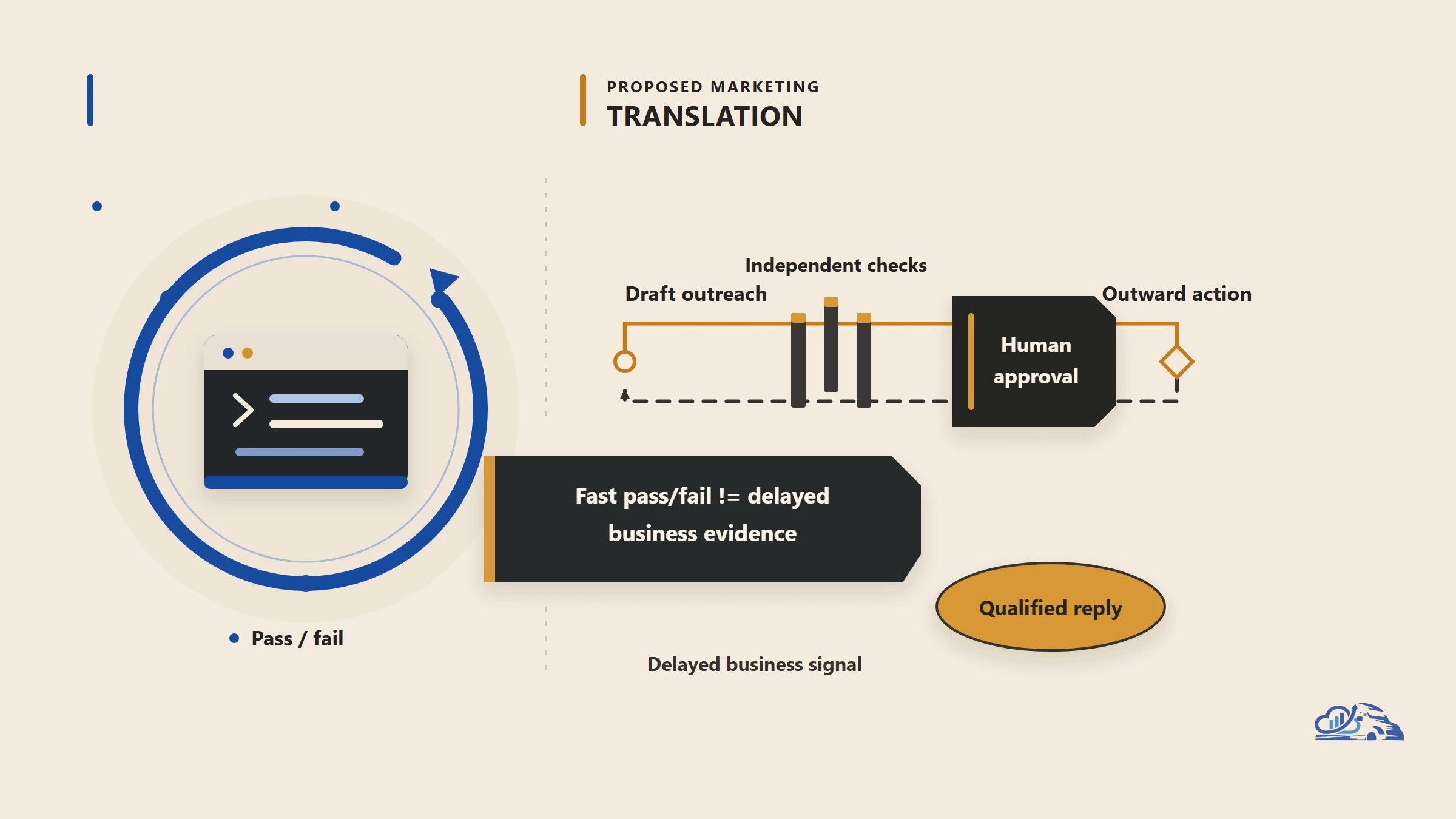
1. Define the business objective: rank, cite, convert, retain, upsell, reduce spend waste, or improve cycle time. 2. Assign an agent owner: a human who is accountable for outcomes, incidents, and thresholds. 3. Register access: what the agent can read, write, approve, publish, spend, or trigger. 4. Connect data sources: analytics, CRM, CMS, keyword data, content inventory, product facts, ad accounts, and brand guidelines. 5. Enforce policy: budget caps, restricted topics, compliance rules, data boundaries, and brand-safety standards. 6. Run evaluations: factual accuracy, source quality, hallucination risk, ranking fit, answer-readiness, and conversion intent. 7. Log every decision: inputs, retrieved sources, recommendations, approvals, tool calls, exceptions, and final output. 8. Recover cleanly: pause, revert, notify, re-run, or route to a human decision queue.
A compact governance artifact can be as simple as this policy register:
python def run_reviewed_step(state, tool): if state.risk == "high": return {"status": "needs_review", "reason": "risk gate"} result = tool(**state.allowed_args) if not result.get("evidence"): return {"status": "needs_review", "reason": "missing evidence"} return {"status": "ready", "result": result}
The point is not the YAML. The point is explicit delegation. If the agent has no policy register, your governance probably lives in tribal memory.
Marketing Guardrails That Matter In Production
Marketing teams operationalize agent governance by separating budget, brand, data, publishing, and outreach permissions.
A campaign optimization agent should be allowed to recommend allocation changes before it can execute them. If it eventually gets execution rights, those rights need spend ceilings, channel boundaries, conversion-quality checks, and performance thresholds. A bidding agent might increase bids only inside an approved range, pause underperforming campaigns after enough data, and escalate if cost per acquisition rises beyond a set threshold.
An SDR workflow agent needs different controls. It may enrich accounts, draft outreach, summarize buyer signals, or prioritize follow-ups. But it should not scrape unapproved data, send messages to restricted segments, invent claims, or contact buyers without an audit trail. The review burden is different from content production because reputational risk arrives one message at a time.
A content agent needs its own guardrails. For SEO, the agent must map intent, headings, internal links, schema, and on-page structure. For GEO, it must make claims answer-ready, source-backed, and easy for generative engines to lift. For AEO, it must produce direct definitions, FAQs, snippets, and structured answers. This is why why an agent beats a checklist is not about volume alone. It is about repeatable quality under control.
A founder named Maya might start with one agent that drafts three blog posts a week. In month one, the output looks impressive. By month three, the team cannot remember which claims were sourced, which posts used old positioning, and which articles were syndicated. The agent did not fail because it lacked language ability. It failed because nobody created review gates, source logs, or publishing rules before volume arrived.
Best Practices For Enterprise Rollout
The best rollout pattern is to start with bounded workflows, prove control, then expand autonomy by tier.
1. Start with a high-value workflow where the inputs and outputs are easy to inspect. Content refreshes, SEO briefs, campaign QA, and dashboard summaries are good starting points. 2. Write the permission map before connecting tools. Define read, recommend, write, approve, publish, spend, and escalate permissions separately. 3. Separate brand, data, budget, and publishing rights. One agent should not inherit broad authority because one workflow feels safe. 4. Require logs for inputs, retrieved sources, tool calls, approvals, rejections, and final actions. 5. Evaluate by workflow outcome, not only model quality. Track rankings, citations, conversions, review time, exception rate, cost per output, and rollback frequency. 6. Build a threshold system. Agents should pause when confidence is low, cost spikes, data is missing, or policy conflicts appear. 7. Review role design. If agents now perform research, drafting, QA, and reporting, humans need new roles as reviewers, operators, policy owners, and exception handlers. 8. Treat governance as a product. Policies, tests, thresholds, and dashboards should be maintained like production systems.
At Van Data Team, we usually start with the signal map: which search, content, funnel, and operational signals should the agent use, and where should each signal appear in the review workflow? That gives the business a practical path from "AI content idea" to controlled production.
Failure Modes And Evaluation Criteria
Autonomous marketing agents fail when speed, access, and ambiguity outrun controls.
The common failures are predictable. An agent optimizes for clicks while ignoring lead quality. It refreshes a high-value page without preserving revenue-critical messaging. It pulls a claim from a weak source. It spends more tokens than the workflow is worth. It creates so much review work that the human team becomes the bottleneck. It cannot explain why a decision was made.
Use this evaluation table before increasing autonomy:
| Decision area | What to evaluate | Production question |
|---|---|---|
| Cost | Tool calls, model usage, review labor, failed runs | Is the unit cost justified by business value? |
| Latency | Research time, generation time, approval time, publish time | Does the workflow meet the operating cadence? |
| Token budget | Context size, retrieval quality, repeated revisions | Is the agent spending reasoning on the right work? |
| Observability | Logs, sources, approvals, exceptions, action history | Can we reconstruct what happened? |
| Evaluation | Factuality, brand fit, SEO/GEO/AEO readiness, conversion intent | Are outputs judged by business-specific criteria? |
| Review burden | Human review time, rejection rate, escalation volume | Is the agent reducing work or moving it downstream? |
| Failure recovery | Rollback, pause, re-run, notify, audit | Can the team recover without a forensic project? |
A useful incident dashboard should make failure measurable before autonomy expands:
| Metric | Why it matters | Example threshold format |
|---|---|---|
| Incident rate per 100 agent runs | Shows whether agent scale is creating more operational risk | Pause expansion if incident rate rises for two review cycles |
| Policy-block rate | Shows whether rules are catching risky actions before execution | Investigate if blocks cluster around one workflow or data source |
| Escalation rate | Shows how often humans must intervene | Tune permissions when escalations are mostly low-risk repeats |
| Rollback frequency | Shows whether approved actions are being reversed | Require root-cause review after repeated rollback patterns |
| Cost per approved output | Shows accepted-output economics after retries and review | Compare against human or agency baseline |
| Published-output correction rate | Shows post-publication factual, brand, or compliance defects | Move the workflow down one autonomy tier if corrections increase |
A marketing operator named Luis might give a paid media agent permission to recommend budget shifts across five campaigns. After two weeks, the recommendations are useful, but the agent repeatedly escalates when conversion data is delayed. That is not failure. That is a healthy control working. The next implementation step is better data freshness reporting, not broader autonomy.
How Van Data Team Makes This Operational
Van Data Team makes marketing agent governance operational by turning agent work into a visible pipeline with reviewable outputs.
Vanaxity is built for the omnichannel search reality: ranking in Google, being cited by AI answer engines, and producing content that can move through SEO, GEO, and AEO checks before it reaches the market. The agent workflow is not hidden one-shot generation. It is research, validation, review, improvement, visual planning, publishing preparation, and syndication.
For teams evaluating autonomous content operations, Van Data Team can produce a scoped workflow review with five concrete outputs:
- A signal map showing which data sources should feed the agent.
- A permission map defining what the agent may read, write, publish, and escalate.
- A review-gate plan for claims, brand, visuals, internal links, and publication.
- A dashboard gap review showing what must be logged for trust and reporting.
- An implementation scope for content production, syndication, and governance.
You can compare that to proof and case outcomes, or continue through the Vanaxity insights library if you are still mapping the opportunity. The point is simple: autonomous marketing agents become useful when the workflow is visible enough to trust.
Frequently asked questions
What is autonomous marketing agent governance?
Autonomous marketing agent governance is the system of roles, permissions, controls, logs, evaluations, and escalation rules that determines how AI agents may act inside marketing workflows. It covers content, campaigns, outreach, reporting, budget movement, publishing, and data access.
Why do autonomous marketing agents need governance?
They need governance because marketing actions create public, financial, legal, and reputational consequences. An agent that drafts a post is low risk. An agent that publishes content, changes paid budgets, or contacts buyers needs stronger controls because the action leaves the sandbox.
What is the difference between ability to act and scope of access?
Ability to act is what the agent can do, such as summarize, recommend, draft, publish, bid, or message. Scope of access is what systems and data the agent can touch. Enterprise governance should control both because a limited action can become risky when connected to sensitive systems.
How should marketing teams set budget and brand-safety guardrails?
Set budget guardrails as explicit limits: maximum spend change, maximum daily movement, approved channels, performance thresholds, and escalation rules. Set brand-safety guardrails as approved claims, restricted topics, source rules, tone standards, compliance checks, and human approval for sensitive content.
What makes an AI-agent governance model mature?
A mature model has named owners, tiered autonomy, scoped access, policy enforcement, audit trails, evaluation criteria, exception workflows, cost visibility, and recovery procedures. It also redesigns human roles around supervision, review, and operational accountability instead of pretending agents are just another software feature.
How can a team start without overengineering the operating model?
Start with one bounded workflow. Give the agent read and recommend permissions first, log every recommendation, measure review time and output quality, then add execution rights only after thresholds are stable. Governance should expand with risk, not bureaucracy.