The AI Marketing ROI Gap: Adoption Up, Proof Missing
Marketers adopted AI almost universally, but most can't prove it works. Here's why the AI marketing ROI gap exists and how to actually close it with measurement.

Overview
Marketing adopted AI faster than almost any technology before it. Proving it works has gone far slower. That gap, between how much teams spend on AI and how little they can show for it, is quietly becoming the defining problem of AI in marketing, and boards have started to notice.
This article looks at the evidence for that gap and, more usefully, how to close it. The survey figures are from third-party research; the recommendations are Vanaxity analysis, framed as guidance rather than certainty. It builds on our work on FinOps for AI agents and AI agent ROI, and it follows directly from why AI speeds production but not results.
Key Takeaways
- Adoption is near-universal: Comviva's 2026 Global CMO Survey found 90% of organizations raised AI marketing investment over two years.
- Proof isn't: only 16% of leaders feel confident defending AI spend to their board, and just 12% can rigorously isolate AI's incremental revenue impact.
- Boards are asking: 86% of marketing leaders say they've been asked to justify AI spending at the board level.
- A widely-cited MIT report claims 95% of enterprise genAI efforts show no measurable return, though it's a preliminary, non-peer-reviewed study that drew debate.
- Vanaxity's recommendation: treat this as a measurement problem, isolate AI's incremental impact, consolidate fragmented costs, and report cost per outcome, not efficiency.
Map your SEO, GEO and AEO workflow before you build.
What Is the AI Marketing ROI Gap?
The AI marketing ROI gap is the distance between how much marketing teams spend on AI and how little they can prove it returns. Adoption is near-universal, 90% of organizations raised AI marketing investment, yet only 16% of leaders feel confident defending that spend to their board, and just 12% can isolate AI's real revenue impact. Efficiency isn't the problem; proof is. Closing the gap takes measurement discipline, not a more powerful tool.
The efficiency case for AI has been settled for a while. Content moves faster, campaigns launch quicker, and mundane work disappears. But efficiency was never what marketing promised its leadership. It promised results, and that is where the evidence thins out. Faster production is easy to feel and hard to bank.
**Vanaxity analysis:** The uncomfortable truth is that most marketing teams adopted AI on a productivity argument and are now being asked a performance question. Those are not the same thing, and the gap between them is exactly what boards are probing.
A team can be visibly busier and more prolific while its actual contribution to revenue stays flat, or simply unmeasured. When that happens, the story of efficiency stops being persuasive. The person asking wants proof, not activity. And "we ship more, faster" is an answer to a question the board didn't ask.
The Proof Gap in Numbers
The surveys line up around a single, consistent story: heavy investment, thin evidence. They come from different researchers and different samples, which makes the agreement more telling, not less. Here are the figures that define it.
| Finding | Figure | Source |
|---|---|---|
| Organizations that raised AI marketing investment | 90% | Comviva 2026 |
| Leaders confident defending AI spend to the board | 16% | Comviva 2026 |
| Can rigorously isolate AI's incremental revenue impact | 12% | Comviva 2026 |
| Asked to justify AI spending at board level | 86% | Comviva 2026 |
| Struggle with fragmented AI costs (cloud, talent, data, vendors) | 62% | Comviva 2026 |
| Enterprise genAI efforts with no measurable return (preliminary) | 95% | MIT NANDA 2025 |
**Vanaxity analysis:** Read the 90% against the 16%. Nearly everyone is spending more, and almost no one can confidently say it's working. That's not a rounding error; it's a systemic accountability gap.
The MIT figure deserves a caveat. Its "95% no measurable return" claim comes from MIT NANDA's 2025 report, which was issued as preliminary findings rather than peer-reviewed research and drew calls to release its underlying data. So treat it as a loud signal, not a settled fact. Even discounted heavily, the direction it points matches everything else on this list.
Why Is AI Marketing ROI So Hard to Prove?
Because the thing that's easy to measure, output, isn't the thing that matters, revenue, and the path between them is tangled. Three problems compound to make proof genuinely difficult, not just neglected.
- Attribution: AI touches many steps of a campaign, so isolating its incremental effect from everything else that drives a result is a hard measurement problem, which is why only 12% do it rigorously.
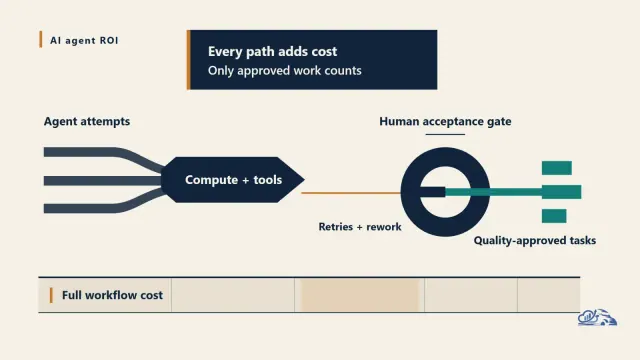
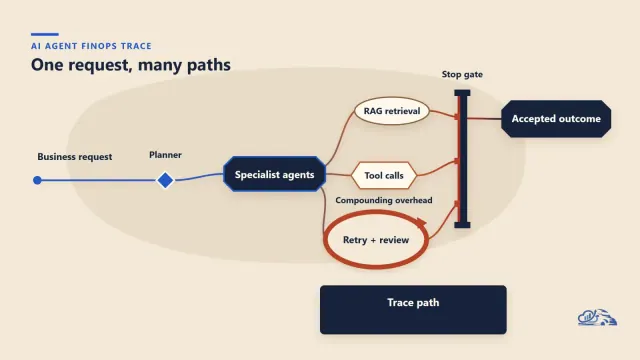
- Cost fragmentation: AI spend is scattered across cloud bills, tools, data, and talent, so 62% of teams can't even total what AI actually costs them, let alone divide it into a return.
- Proxy metrics: it's tempting to report what's easy, drafts produced, hours saved, and call it ROI, but those are activity measures, not business outcomes.
**Vanaxity analysis:** Notice that none of these are solved by a better model. They're accounting and experimental-design problems, the unglamorous work that adoption skipped in the rush. The Duke 2026 CMO Survey captured the result: on a 7-point scale, no martech activity scored above 5, including generating ROI from marketing technology. The tools are running; the proof infrastructure was never built alongside them. That's the actual gap, and it's the same lesson we drew from the production time problem: efficiency gains that no one measures quietly evaporate.
Why This Echoes Marketing's In-Housing Waves
There's historical rhyme worth hearing, because AI is also pushing more marketing work in-house, and in-housing has burned teams before. The proof gap is what makes this wave riskier than the last two.
Marketing has brought capabilities in-house twice in recent memory: during the 2008-09 recession to preserve budget, and during the mid-2010s digital boom, when the ANA reported in-house agency adoption jumped from 42% to 78% by 2018. Both waves promised efficiency and ran into hidden costs, in talent, culture, and the true expense of running a department that agencies used to spread across many clients. That framing comes from Carbon Design's Scott Gillum, writing in MarTech, and the historical parallel is apt.
**Vanaxity analysis:** AI is driving a third wave, and it changes the failure mode rather than removing it. The first wave's risk was talent; the second's was vendor trust; this one's is proof. Moving capability in-house without solving for measurement just relocates the same accountability problem to a new address, now with a bigger budget attached. The teams that treat AI adoption as a measurement project, not just a tooling upgrade, are the ones who won't become the next cautionary case study.
How Do You Prove AI Marketing ROI?
By building the measurement the adoption skipped, deliberately and before the board asks. Proof isn't a report you write at the end; it's a design you put in place at the start.
- Isolate incremental impact: use controlled tests, holdouts, geo-splits, or A/B designs, so you can attribute a result to AI rather than assume it, which is what the 12% who can prove ROI actually do.
- Consolidate the cost: pull AI's scattered spend, cloud, tools, data, and talent, into a single number, because you can't compute a return on a cost you can't total.
- Measure cost per outcome: track cost per acquired customer or per qualified lead, not per draft or per hour saved, so efficiency and results stay connected.
- Report business language: translate model metrics into revenue, pipeline, and cost, the terms a board evaluates, not the terms a tool reports.
- Kill what doesn't prove out: if a use case can't show incremental value after a fair test, redeploy the budget, the way the better-performing AI programs in operations and finance did.
**Vanaxity analysis:** The through-line is that proof is a discipline, not a dashboard. The MIT research noted that operations and finance pilots, which got less hype and less budget than marketing, produced better returns, largely because they were scoped and measured tightly. Marketing took the biggest slice of AI spend and the loosest measurement, and the results show it. Closing the gap means adopting the discipline those teams used, the same cost-per-outcome rigor we bring to FinOps for AI agents. The tool is not the variable that decides ROI; the measurement around it is.
How Vanaxity Helps You Close the Proof Gap
Vanaxity helps marketing teams turn AI adoption into evidence a board will accept. We start by consolidating what AI actually costs across your stack, then design the tests that isolate its incremental impact, so the number you report is defensible rather than hopeful.
From there we put a cost-per-outcome metric in place, retire the use cases that can't prove their worth, and translate the results into the revenue and pipeline language leadership evaluates. Often the first pass finds one or two AI use cases quietly carrying the value and several riding along on faith. Naming that split is usually the fastest ROI move available, because it lets you double down on what works and stop funding what doesn't. If you want help, our services can run an AI ROI and measurement audit for your marketing program, and you can browse more field notes in our insights library. The goal is simple: when your board asks whether AI is working, you have the proof, not just the spend.
Frequently asked questions
What is the AI marketing ROI gap?
It's the gap between how much marketing teams invest in AI and how little they can prove it returns. Surveys show near-universal adoption, with 90% of organizations raising AI marketing investment, yet only 16% of leaders feel confident defending that spend to their board and just 12% can rigorously isolate AI's incremental revenue impact. The efficiency of AI isn't in question; the business return mostly is, which is why the gap is fundamentally a measurement and accountability problem rather than a tooling one.
Why can't most marketers prove AI's ROI?
Three problems compound. Attribution is hard, because AI touches many parts of a campaign and isolating its incremental effect requires controlled testing that most teams skip. Cost fragmentation is common, with 62% of organizations unable to total AI spend scattered across cloud, tools, data, and talent. And teams often report proxy metrics like drafts produced or hours saved, which measure activity, not business outcomes. None of these are solved by a more powerful model; they require measurement discipline that adoption outran.
Is the MIT statistic that 95% of AI projects fail reliable?
Treat it as a strong signal, not a settled fact. The figure comes from MIT NANDA's 2025 report The GenAI Divide, which found 95% of enterprise genAI efforts showed no measurable return despite $30-40 billion in investment. However, it was issued as preliminary findings rather than peer-reviewed research, and several observers called for the underlying data to be released. Even discounted, it points the same direction as the CMO surveys: heavy investment, thin proof of return.
How can a marketing team actually prove AI ROI?
Build the measurement before you need it. Isolate AI's incremental impact with controlled tests such as holdouts, geo-splits, or A/B designs rather than assuming causation. Consolidate scattered AI costs into a single number so you can compute a real return. Track cost per outcome, like cost per acquired customer, instead of cost per asset. Then translate results into revenue and pipeline terms a board evaluates, and redeploy budget from use cases that can't prove incremental value.
Why does AI make in-housing marketing riskier?
Because it changes the failure mode to proof. Marketing's earlier in-housing waves stumbled on talent and vendor trust; this AI-driven wave stumbles on the inability to demonstrate results. Bringing more capability in-house without building measurement alongside it just relocates the accountability problem, now with a larger budget attached. Teams that treat AI adoption as a measurement project, not only a tooling upgrade, are the ones that avoid repeating the pattern.