Answer Engine Optimization After Google AI Mode Ads
Google AI Mode ads split visibility into paid placements and earned answers. Learn how to make your content easier for AI engines to retrieve and cite.
Overview
Google’s US tests of conversational ads in AI Mode split brand visibility into two jobs: renting a clearly labeled Sponsored placement and earning an organic citation through Answer Engine Optimization, with no payment path between them. This article explains what Google announced and how to make brand facts, product data, structured data, and answer-first content easier for AI systems to retrieve, compare, cite, and recommend—the evidence-led, answer-ready approach Van Data Team uses with Vanaxity.
Google's new AI Mode ads create separate visibility tracks: a brand can rent a clearly labeled Sponsored placement, but it still has to earn organic retrieval, citation, and recommendation through Answer Engine Optimization. For marketing, SEO, and brand leaders, the practical job is not merely buying access to the answer surface. It is making the brand's facts and content clear enough for an AI system to find, compare, and cite accurately.
At Google Marketing Live on May 20, 2026, Google announced four Gemini-powered ad formats for AI-powered Search. Conversational Discovery Ads and Highlighted Answers are being tested in the US, while AI-Powered Shopping Ads and Business Agent for Leads are planned for "the coming months". This is a test, not full global availability.
Vanaxity, Van Data Team's operator-built AI content agent, works on the earned side. It uses research and data pipelines to reconcile brand facts, agent workflows to structure and write answer-ready pages, review gates to verify claims, platform automation to publish and syndicate, and reporting to monitor visibility. It does not buy or manage Google Ads. This guide covers what changed, the controllable organic work, and honest measurement.
Key Takeaways
Google monetized part of conversational search, but it did not sell organic recommendations.
- The announced formats are paid placements that remain labeled Sponsored; some are in US testing and the rest are planned to follow.
- AI Mode is Google's dedicated conversational experience. AI Overviews are summaries above conventional results, so teams must not treat the surfaces as interchangeable.
- Organic answer visibility depends on useful, accessible content, consistent entity facts, accurate commercial data, and valid structured data. None guarantees inclusion.
- Conversation paths matter more than isolated keyword lists because users can refine needs, constraints, comparisons, and objections through follow-up questions.
- Paid campaign reporting and organic citation monitoring need separate evidence, owners, and success claims.
Need to see which side of the split your site is ready for? A free Vanaxity content scan can return a paid-organic surface map, canonical-fact gaps, and a prioritized answer-readiness plan. The scan evaluates the organic inputs; it does not recommend or manage ad spend.
Map your SEO, GEO and AEO workflow before you build.

What Google Announced and Where It Appears
Google added a paid advertising layer to AI Mode's conversational experience, with some formats in US testing and others scheduled to follow.
| Format | What the user experiences | Status | Classification |
|---|---|---|---|
| Conversational Discovery Ads | Gemini tailors an ad response to the person's specific question in real time. | Testing in the US | Paid and Sponsored |
| Highlighted Answers | An eligible, high-quality ad can appear inside a list-style recommendation. | Testing in the US | Paid and Sponsored |
| AI-Powered Shopping Ads | Gemini surfaces relevant products and explains why a product fits the request. | Planned for the coming months | Paid and Sponsored |
| Business Agent for Leads | A user chats with a Gemini brand agent that answers from the advertiser's website. | Planned for the coming months | Paid and Sponsored |
Search Engine Land reports that AI Mode has passed 1 billion monthly active users. That scale explains the urgency, but a conversational ad remains an advertisement.
Google says the formats will "continue to be clearly labeled as Sponsored".
AI Mode is not AI Overviews
AI Overviews are AI-generated summaries shown above conventional search results, while AI Mode is a dedicated conversational Search experience built for iterative follow-ups. Google's AI Mode explainer makes that product distinction clear.
| Surface | Primary interaction | Relevance to the announcement | Organic opportunity |
|---|---|---|---|
| AI Overviews | A summary appears above regular results. | Do not assign every announced format to this surface. | Helpful pages may be retrieved or cited, with no guaranteed inclusion. |
| AI Mode | The user holds an end-to-end conversation and asks follow-ups. | The new conversational ad formats appear here. | A brand may be retrieved, cited, or recommended organically, separate from ads. |
Conflating the surfaces mislabels placements, availability, and reporting.
Paid Placement and Organic Answers Are Separate Tracks
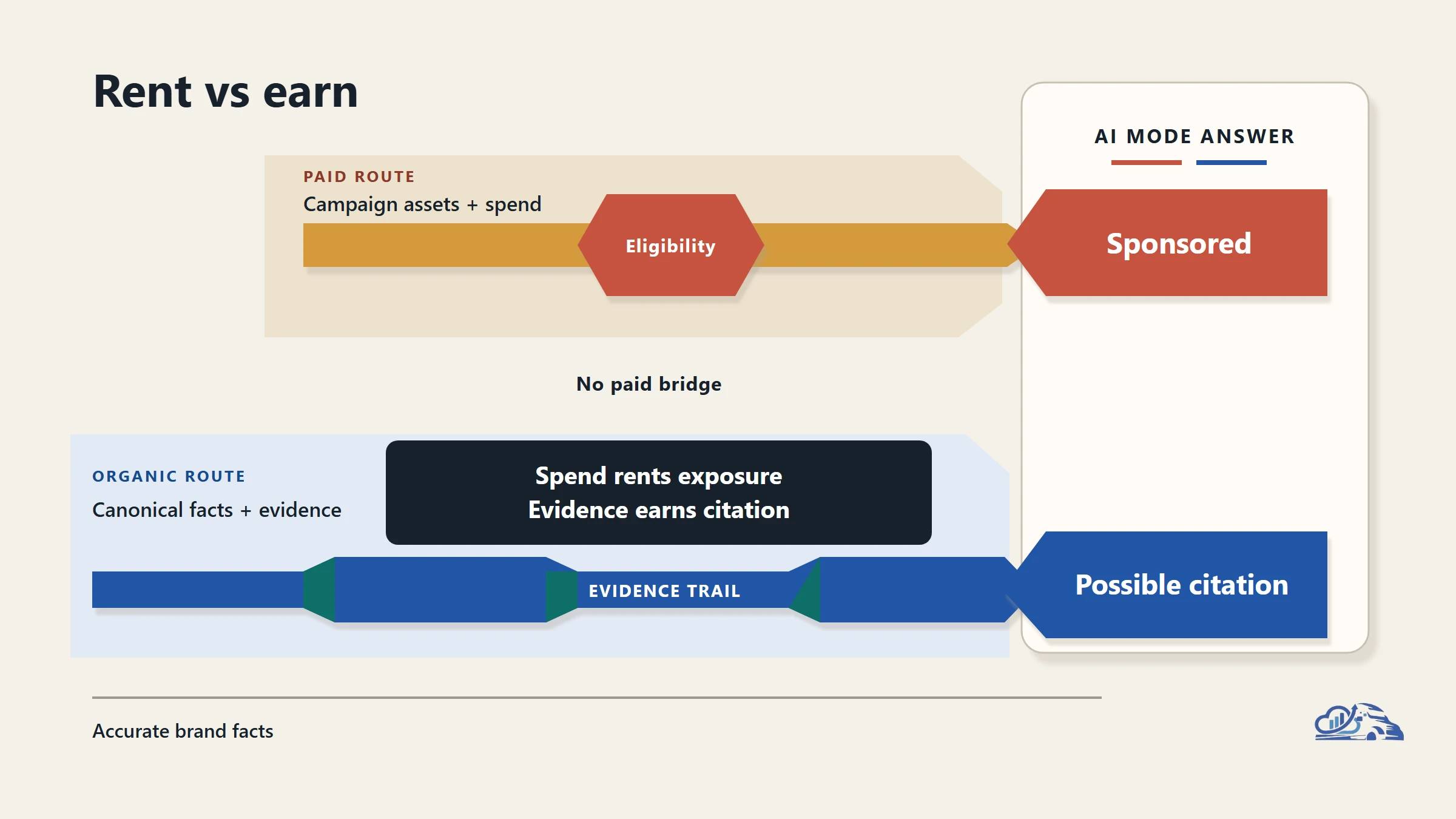
The following illustration summarizes two paths into the answer surface:
Figure 1. Paid media can create eligible Sponsored exposure in AI Mode, but it cannot purchase organic retrieval, citation, or recommendation.
An advertiser can purchase eligible Sponsored exposure, but no ad budget buys an organic citation or recommendation.
| Dimension | Paid conversational placement | Organic answer visibility |
|---|---|---|
| Entry mechanism | Campaign eligibility, Google's ad systems, approved assets, and media spend | Useful, accessible, indexable information that an answer system chooses to retrieve |
| Presentation | Clearly labeled Sponsored | Part of the generated answer or its cited sources, when selected |
| Core inputs | Creative, product feeds, landing pages, and website facts | Canonical facts, visible content, structured data, feeds, evidence, and entity consistency |
| Duration | Depends on budget, eligibility, availability, and campaign operation | Built from reusable content and data assets, but outcomes remain variable |
| Measurement | Ad-platform delivery and downstream campaign actions | Observed mentions and citations, search performance, site analytics, and explicit attribution limits |
For organic visibility, Google's Search documentation applies the same foundational SEO requirements used in Search and provides no special markup or payment path that secures inclusion. Structured data can clarify a page, but it is not a token that buys a recommendation.
The tracks can share accurate data without sharing causality. A current feed can support ads and organic product accuracy. Paid-query insights can expose customer language, but campaign activity does not prove improved organic selection.
Illustrative scenario: Priya leads search for a B2B software brand. She sees a Sponsored answer for a category question and later sees the same brand cited organically during a follow-up. The Sponsored observation belongs in paid reporting; the organic citation belongs in an organic visibility log. Combining them into a single "AI share" claim would conceal separate mechanisms.
What Answer Engine Optimization Means Now
Answer Engine Optimization is the practice of making useful content and verified brand facts easy for answer systems to understand, retrieve, cite, and recommend in context.
It extends SEO rather than replacing it. SEO supports discovery, indexing, quality, and ranking. AEO makes direct answers and evidence extractable. GEO shapes brand representation in generated responses. All depend on clarity, authority, accessibility, and factual consistency.
| Discipline | Primary job | Useful output |
|---|---|---|
| SEO | Make pages discoverable, understandable, and competitive in Search | Qualified organic visibility and visits |
| AEO | Make direct answers and evidence easy to retrieve without losing context | Accurate answer inclusion or citation when selected |
| GEO | Make brand representation in generated responses clear and supportable | Accurate descriptions, comparisons, and citations when selected |
The target is a reliable evidence package: a direct answer, conditions, proof, limitations, and a useful next step.
The answer-readiness operating stack
At Van Data Team, we start by freezing the claim surface before scaling content. If the official name, offer, audience, price, availability, or policy changes across owned pages, faster publishing only multiplies ambiguity.
| Layer | Required artifact | Acceptance test |
|---|---|---|
| Canonical brand facts | An owned register for names, descriptions, services, audiences, locations, policies, differentiators, and fact owners | Important claims agree across current owned sources |
| Commercial data | Visible prices, availability, specifications, eligibility, and product attributes, plus an accurate feed where relevant | Pages, feeds, and source systems do not contradict each other |
| Structured meaning | Relevant schema that matches visible page content | Markup validates and makes no unsupported claim |
| Answer modules | A direct response followed by evidence, constraints, comparisons, and next actions | A passage can be excerpted without changing its meaning |
| Distribution | Versioned publishing and syndication across approved channels | Updated facts propagate without leaving conflicting copies |
| Observation | A question panel, answer snapshots, citation records, and landing-page logs | Observed presence stays separate from verified traffic and conversion |
Google's organic guidance says site owners should maintain the usual technical Search foundations, keep important content available in text, use supported structured data that matches visible content, and keep Merchant Center or Business Profile information current where relevant. Those practices improve machine readability. They do not guarantee selection.
Illustrative scenario: Maya markets industrial components. Her commerce feed says an item is available, the product page says pre-order, and a downloadable specification is stale. Publishing another article would add noise. She first aligns the source system, visible page, feed, and Product markup, then publishes a direct fit-and-limitations comparison. The result is a coherent evidence package an answer system can evaluate, not a promised citation.
Build for Conversation Paths, Not Keyword Lists
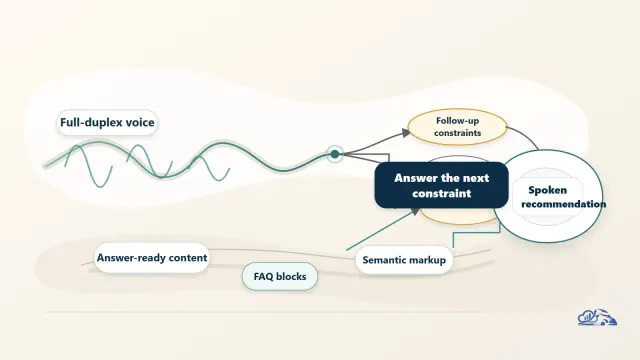
Conversational search changes content strategy because the user's next question depends on the answer just given.
A static keyword plan often covers the opening query and abandons the decision. AI Mode can carry context into questions about suitability, price, constraints, alternatives, implementation, and risk. The content architecture should follow that progression.
| Decision stage | User's likely question | Content module to provide |
|---|---|---|
| Initial need | What kind of solution fits this problem? | Direct category answer and qualification criteria |
| Constraint | Will it work for my business model, team, location, or stack? | Eligibility, prerequisites, specifications, and exclusions |
| Comparison | How does this option differ from an alternative? | Evidence-based comparison with explicit tradeoffs |
| Objection | What could fail, cost more, or require review? | Limitations, implementation requirements, and risk controls |
| Decision | What should I do next? | Action plan, expected inputs, and transparent offer |
Each module should state fit, exclusions, differentiators, and evidence. Vague "best" claims give an answer system little to compare.
Illustrative scenario: Daniel's automation consultancy has a strong definition page but no clear material on fit, integrations, governance, or rollout. A conversation map turns those missing follow-ups into a qualification page, comparison, implementation guide, and FAQ. The editorial outcome is a connected decision path, not near-duplicate pages for every phrasing.
Answer Formats: What Still Works in 2026
Answer engines quote passages, so the way an answer is laid out matters to readers and to the systems that excerpt it. Google decides which passage becomes a featured snippet: its documentation answers "How can I mark my page as a featured snippet?" with "You can't." What you control is whether the answer is easy to find, read and excerpt without losing its meaning.
| Question type | Format that serves it | What to keep in mind |
|---|---|---|
| Definition ("What is X?") | One or two sentences that answer directly, then conditions and evidence | There is no magic word count, and Google says there's no requirement to break content into tiny pieces for AI |
| Process ("How do I...?") | Numbered steps in an ordered list | HowTo rich results were removed in September 2023; the list still helps readers and excerpts |
| Comparison (X vs Y, pricing, specifications) | An HTML table with a header row | Keep the numbers identical to your product pages and feeds |
| Eligibility or yes/no | The answer first, then the exceptions in the same passage | An excerpt that drops the exceptions misleads, so keep them close |
Retired or overrated tactics
- FAQ rich results: limited in 2023 to well-known, authoritative government and health sites, then no longer shown in Google Search from May 7, 2026. FAQPage markup no longer earns a rich result.
- HowTo rich results: removed in September 2023, on desktop and mobile.
- Marking up a featured snippet: not possible, because Google's systems choose the passage.
- AI-only files: Google says "You don't need to create new machine readable files, AI text files, markup, or Markdown to appear in Google Search", and that an llms.txt file will neither harm nor help in Google Search.
What does help is access and intent: pages Googlebot can index that are eligible for a snippet, OAI-SearchBot allowed if you want to appear in ChatGPT search answers, and preview controls (nosnippet, data-nosnippet, max-snippet) used on purpose, because they also limit what Google can show from a page in its AI features. For the citation side of the same work, see What Is GEO and SEO vs GEO vs AEO.
Operate and Measure Paid and Organic Visibility Separately
Reliable measurement requires separate paid campaign records and organic observation logs, followed by a cautious connection to site outcomes.
Paid teams should identify the format and surface, then use the available campaign reporting for delivery and downstream actions. Organic teams should maintain a controlled panel of representative questions and follow-up paths. For each observation, record whether the brand appeared, how it was described, whether it was cited, which page was cited, and the relevant context.
| Evidence | What it can support | What it cannot prove alone |
|---|---|---|
| Ad-platform report | Sponsored delivery and attributed campaign actions | Organic recommendation |
| Answer snapshot or log | Observed brand presence, wording, and citation at that moment | Stable ranking, traffic, conversion, or cause |
| Search performance data | Owned organic queries, impressions, and clicks where reported | The complete reasoning behind an AI answer |
| Site analytics | Visits and actions that reached the site | Invisible influence from an answer that produced no click |
Prompt observations are directional because generated answers can vary. A credible visibility claim needs a documented query set, a baseline, preserved evidence, and a clear line between observation and verified traffic.
Production operations need the same honesty:
- Cost: Separate media spend from research, model use, editorial review, data maintenance, publishing, and monitoring.
- Latency and token budget: Set workflow budgets, but never trade away source freshness or required review merely to publish faster.
- Observability: Preserve source lineage, prompts, tool or model versions, content versions, validation results, and answer snapshots.
- Evaluation and review burden: Score factual consistency, extractability, citation quality, and brand accuracy; require human approval for sensitive commercial, legal, or policy claims.
- Failure recovery: Correct the canonical fact first, then update feeds, markup, content, and syndicated copies; revalidate and document the incident.
A Vanaxity audit can turn this into a concrete signal map, dashboard gap review, source-of-truth plan, review workflow, and staged implementation scope for the reader's site.
Where Vanaxity Fits
Vanaxity operationalizes the organic content system; it does not operate the Sponsored advertising track.
The agent researches questions and evidence, structures answer modules, writes and illustrates content, applies review gates, publishes to approved platforms, and syndicates consistent facts across channels. That workflow supports classic SEO, GEO, and AEO across Google AI Mode, AI Overviews, and other answer engines.
Vanaxity cannot guarantee a ranking, citation, recommendation, or Sponsored placement. No responsible organic platform can. Its value is a repeatable system for accessible evidence, consistent facts, structured pages, conversation coverage, controlled publication, and observable outcomes.
Failure modes to remove before scaling
The mistakes we see are usually classification and data failures, not a shortage of copy:
- Calling the announcement a global launch or describing it as happening "today."
- Placing every new format inside AI Overviews instead of AI Mode.
- Presenting a Sponsored placement as an organic citation.
- Suggesting ad spend improves organic eligibility.
- Treating schema or a product feed as a guaranteed AI ranking mechanism.
- Publishing conflicting prices, specifications, policies, or brand descriptions.
- Optimizing only the opening keyword and ignoring follow-up intent.
- Blending paid delivery and organic observations into one visibility claim.
How Van Data Team Makes This Operational
At Van Data Team, Answer Engine Optimization is a documented operating workflow, not a theory deck. We trace how each claim moves from its source system to a published page: who owns product specifications, prices, availability, and differentiators; which feeds and structured data expose them; who approves changes; and how the team recovers when facts conflict or automation fails.
That map keeps the two visibility tracks separate. Sponsored AI Mode formats belong to the paid media workflow and cannot purchase an organic citation. Vanaxity operates on the earned side: it researches follow-up intent, reconciles canonical brand facts, structures answer-first content, and publishes approved updates for retrieval across AI Mode, AI Overviews, and other answer engines.
The scoped delivery plan defines:
- which signals to collect, including citation observations, source freshness, crawl accessibility, and schema validity;
- which handoff or content gaps to close;
- which generated claims require human review; and
- which dashboard and runbook assign the next action.
The dashboard distinguishes verified organic mentions from Sponsored exposure and reports only what can be observed. The runbook assigns owners, review gates, rollback steps, and refresh triggers. This improves answer readiness without promising inclusion, attribution, or recommendation that Google does not guarantee.
Frequently asked questions
What is Answer Engine Optimization?
It is the practice of making useful answers, evidence, and brand facts easy for an answer system to understand and retrieve. It combines answer-first writing, technical accessibility, structured information, entity consistency, and clear limitations without promising inclusion.
Can a brand pay for organic inclusion in a Google AI answer?
No. An eligible advertiser can buy a clearly labeled Sponsored placement when a format is available, but organic retrieval or citation cannot be purchased. Buying an ad does not improve organic eligibility.
Are the new conversational ads in AI Overviews?
The announcement centers on AI Mode, Google's dedicated conversational Search experience. AI Overviews are summaries above conventional results, so teams should not claim that every announced format is live there.
Do structured data and product feeds guarantee a citation?
No. Accurate markup and feeds can make facts easier to interpret and reconcile, but they do not compel Google or another answer engine to retrieve, cite, or recommend a brand.
How are GEO and AEO different?
AEO emphasizes direct answer retrieval and citation. GEO emphasizes how a brand or source is represented inside a generated response. Teams usually implement them together on top of sound SEO and factual content operations.
Does FAQ schema still help with AEO?
Not as a rich result: Google stopped showing FAQ rich results on May 7, 2026. FAQPage markup that matches the visible questions is still valid schema, but what makes an answer usable is the visible answer itself, on a page that is indexed and eligible for a snippet.
Sources
- Google: New ad formats built with Gemini coming to Google Search
- Search Engine Land: Google tests new conversational ad formats in AI Mode and Search
- Google: Expanding AI Overviews and introducing AI Mode
- Google Search Central: AI features and your website
- Google Search Central: Guide to optimizing for generative AI features on Google Search
- Google Search Central: Featured snippets and your website
- Google Search Central: Latest documentation updates (FAQ and HowTo rich results)
- OpenAI: Overview of OpenAI crawlers (OAI-SearchBot)