Conversational Search Optimization After GPT-Live
Reported GPT-Live coverage shows why SEO teams need answer-ready content, structured brand data, and multi-turn intent maps for AI voice search.
Overview
OpenAI's GPT-Live release — full-duplex voice models that listen and speak at the same time, replacing the turn-based Advanced Voice Mode — moves conversational search optimization from a nice-to-have to an operating requirement. As buyers shift to fluid, voice-native dialogue with AI, their queries grow longer, more contextual, and fully conversational, and short-tail keyword indexing stops being enough to get a brand explained and recommended out loud.
Conversational search optimization is the practice of structuring a brand's content, entities, answers, proof, and next steps so AI systems can understand and recommend it during multi-turn dialogue. Reports about GPT-Live and live AI voice interfaces have made that discipline harder to ignore.
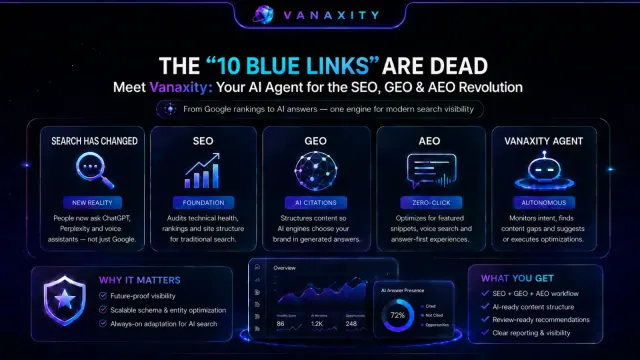
The buyer problem is simple: your content may rank, but still fail when an AI assistant has to explain, compare, and recommend you out loud in the middle of a live conversation. Traditional search results are no longer the only visibility game. Vanaxity, Van Data Team's AI SEO/GEO/AEO agent, exists for this exact shift: research, write, illustrate, publish, and syndicate content that can rank in Google and get cited by answer engines.
At Van Data Team, we start by turning search strategy into an operating system: entity data, answer-ready blocks, schema, review gates, publishing workflows, and reporting. This article translates the GPT-Live discussion into a practical model for B2B marketing, SEO, and content teams preparing for AI voice search without pretending OpenAI made marketing claims it did not make.
Where Conversational Search Shows Up
Do not treat conversational AI search as one channel. Answer-ready content now has to hold up across several surfaces buyers speak or type into — ChatGPT and GPT-Live voice, Google's AI Overviews and AI Mode, Perplexity, and Gemini, plus traditional voice assistants — and each one extracts, ranks, and reads back answers differently.
Structure your entities, answers, and proof once and cleanly so any of these surfaces can lift them, rather than optimizing for a single engine and hoping the rest follow.
Map your SEO, GEO and AEO workflow before you build.

Operational Budget
Before production rollout, score each candidate on accepted-output cost, latency, token budget, retry rate, reviewer minutes, failure recovery, and evaluation results. Vendor token pricing is only the starting point; the useful metric is cost per approved workflow result.
How Van Data Team Makes This Operational
At Van Data Team, we treat conversational search optimization as an operating workflow, not a theory section. We start by mapping the current handoff, source systems, decisions, review gates, dashboards, and recovery paths. The useful output is a scoped delivery plan: which signals to collect, which workflow gaps to close, which automation belongs behind a human review gate, and which dashboard or runbook lets the team act next.
Key Takeaways
- Reported GPT-Live coverage describes full-duplex voice models for more natural ChatGPT Voice conversations.
- Coverage has described GPT-Live-style voice access across mobile, desktop, and tiered product experiences, but marketing teams should verify official product details before citing plan availability.
- Vanaxity's analysis: as AI voice interfaces become more fluid, SEO teams should map multi-turn intent instead of relying on short-tail keyword coverage alone.
- Content built for GEO and AEO should make brand facts, fit criteria, comparisons, proof, limitations, and next steps easy for an AI system to extract and vocalize.
- The fastest practical move is to audit high-intent pages for answer-first structure, schema hygiene, FAQ quality, entity consistency, and unsupported claims.
What OpenAI Announced About GPT-Live
Public discussion around GPT-Live has centered on a ChatGPT Voice experience built around full-duplex conversation, not turn-by-turn voice exchange. Reported coverage describes more natural interruptions and pauses, plus the possibility of deeper work being handled by reasoning and tool-use systems behind the scenes.
| GPT-Live fact | What coverage says | Why SEO teams should care |
|---|---|---|
| Release | Reports described GPT-Live as a new live voice experience | Voice-native AI search is moving from novelty to mainstream interface design |
| Models | Coverage referenced full-duplex voice models under the GPT-Live name | Teams should expect different user tiers to experience live AI answers |
| Availability | Reports discussed access across mobile and web surfaces | Conversations can happen on mobile, desktop, and hands-free workflows |
| Plan defaults | Some coverage referenced tier-based access, but teams should confirm current plan details before citing them | Content may be interpreted by varied model experiences |
| Interaction model | Full-duplex voice systems can respond during a live exchange | Answers need to be concise enough to survive live interruption and follow-up |
| Deeper work | Voice assistants may delegate search, reasoning, or tool use to supporting systems | Structured, source-backed content becomes easier for AI systems to retrieve |
The important concept is full-duplex architecture: a system that can listen and speak during the same interaction.
That sentence matters because it changes the shape of the interaction. A typed search query is a frozen request. A live voice conversation is moving context. The user can interrupt, add constraints, ask for proof, change the category, or ask for a recommendation while the assistant is still speaking.
This is where news coverage from TechCrunch's GPT-Live report and VentureBeat's GPT-Live coverage is useful as SERP context: the market conversation is focused on more natural live dialogue. Vanaxity's concern is more operational: what happens when live dialogue becomes a search interface?
What Conversational Search Optimization Means
Conversational search optimization means making your brand understandable, verifiable, comparable, and recommendable inside a multi-turn AI dialogue. It overlaps with voice search optimization, GEO, and AEO, but it is not just "write longer keywords."
Traditional SEO often starts with a head term, then builds supporting content around related searches. That still matters. Short-tail keywords help define topical relevance, category association, and page hierarchy.
But in a live AI conversation, the user's real intent may not arrive in the first phrase. It may unfold like this:
- "What's the best SEO tool for a small SaaS team?"
- "Actually, we care more about AI Overviews than classic ranking reports."
- "Can it publish content too?"
- "What if we do not have an in-house writer?"
- "Give me the option that is fastest to operationalize."
A page that only targets "SEO tool" is thin in that conversation. A page that explains audience fit, workflow, outputs, limitations, proof, integrations, and next step is much stronger.
The mistake we see is treating answer engine optimization as a metadata chore. Add schema, add FAQs, move on. That is not enough. An AI assistant needs content that answers the real buyer question in language it can confidently summarize.
For Vanaxity, this is why automated SEO/GEO/AEO is not just content generation. The agent workflow turns research into structured, reviewable, answer-ready assets across search, generative engines, and answer surfaces.
Why Full-Duplex Voice Changes Search Intent
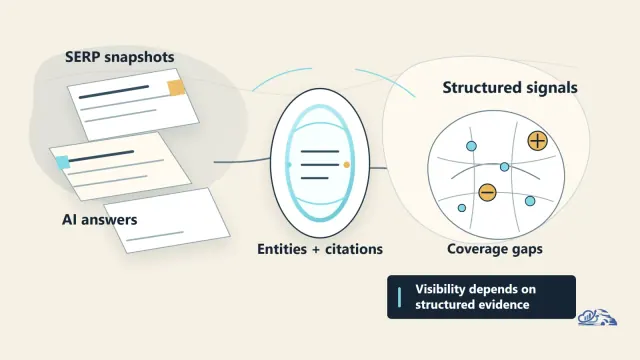
The following illustration summarizes intent moves while the answer forms:
Figure 1. Full-duplex voice search makes intent a live sequence of refinements, so content needs structured evidence that an AI assistant can use mid-conversation.
Full-duplex voice makes search intent more fluid because the user can refine the question while the answer is forming. That is Vanaxity's analysis, not an OpenAI claim. Reported interaction capabilities point to a practical marketing implication: content teams should prepare for messier, more contextual queries.
Imagine a founder asking an AI voice assistant during a commute:
"Find me a content system for a B2B startup. We need SEO, but we also need to show up in ChatGPT answers. Wait, not an agency. Something that can actually publish. And I do not want a giant setup project."
That is not a keyword. It is a compressed buying committee.
The assistant now needs to identify category, use case, budget sensitivity, workflow preference, likely objections, and decision criteria. If your content does not state those facts clearly, the assistant has to infer them. Inference is where brands disappear.
A better page gives the model direct extraction points:
- Who the product is for
- What problem it solves
- How the workflow runs
- What outputs the buyer receives
- What proof supports the claim
- Where the product is not a fit
- What to do next
Short-tail indexing still matters as the map label. But conversational keyword research should build the roads: follow-up questions, objections, constraints, comparisons, switching triggers, proof requests, and conversion actions.
How Keyword Strategy Should Change
Keyword strategy should move from isolated terms to intent clusters that reflect how buyers actually talk through a decision. The head term anchors the page; the supporting structure earns the recommendation.
A practical keyword brief for AI voice search should include:
| Layer | Traditional SEO question | Conversational search question |
|---|---|---|
| Category | What keyword defines the page? | What category should an AI place us in? |
| Buyer | Who searches this term? | Who should the assistant recommend us to? |
| Constraint | What modifiers have volume? | What budget, team, integration, or timing constraints change the answer? |
| Proof | What claim can we rank for? | What evidence can the assistant cite with confidence? |
| Objection | What related keyword should we target? | What follow-up would stop the buyer from choosing us? |
| Action | What CTA fits the page? | What next step should the assistant vocalize? |
For example, a generic page might say: "We help companies scale content."
An answer-ready page says: "Vanaxity is for founders and lean marketing teams that need SEO, GEO, and AEO content shipped without hiring a full content team. The agent researches, writes, illustrates, publishes, and syndicates content, with review gates before delivery."
That second version gives an AI system category, audience, workflow, output, and control model. It is better for humans too.
This is also where Vanaxity vs manual SEO becomes a strategic distinction. Manual SEO workflows often stop at keyword mapping and content briefs. Agentic workflows can maintain entity consistency, update pages, generate FAQ variants, enforce review gates, and produce reporting across a larger content surface.
How To Structure Content for AI Voice Answers
Content for AI voice answers should open each major section with a self-contained answer that can be lifted into a spoken response. That does not mean every page becomes robotic. It means the page gives AI systems clear answer units before expanding into nuance.
Use this structure on high-intent pages:
1. Direct answer block 2. Fit and non-fit criteria 3. Workflow or implementation steps 4. Comparison or decision table 5. Evidence and proof points 6. Limitations and risks 7. FAQ in buyer language 8. Clear next step
A service page, for example, should not start with atmospheric copy about transformation. It should answer:
- What is this?
- Who is it for?
- What does the buyer get?
- How does delivery work?
- What makes it credible?
- What should the buyer do next?
Here is a compact implementation artifact for a page rewrite:
bash git status --short python -m pytest -q git diff --check # ship only after review confirms the scoped change
The schema is not the strategy. It is the packaging layer. The strategy is the answer quality underneath it.
A B2B comparison page should state a qualified verdict near the top. A product page should define fit and non-fit. A pricing page should explain what changes between plans without forcing the AI to guess. A proof page should make outcomes easy to quote without inventing performance numbers.
When proof exists, connect it cleanly. When it does not, say what the product does instead of manufacturing metrics. AI systems are much more likely to cite a clear, modest claim than a vague superlative.
GEO and AEO Signals To Strengthen
GEO and AEO work best when brand facts are consistent across the site, not trapped in one polished landing page. If the homepage says one thing, the pricing page says another, and the blog uses loose category language, an AI system has to reconcile the mess.
Strengthen these signals first:
- Brand entity: name, category, ownership, audience, and core offer
- Product vocabulary: consistent naming for the agent, workflows, and deliverables
- Use cases: who should use it and when
- Comparison language: what it replaces, complements, or does not do
- Proof language: reviewed outputs, examples, results, or case outcomes
- Limitations: where the product is not a fit
- Next steps: audit, scan, demo, implementation scope, or plan review
For Vanaxity, the preferred language is specific: AI content agent for SEO, GEO, and AEO. Not "marketing magic." Not "growth engine." The assistant needs the category before it can recommend the product.
The same principle applies to your site. If you sell workflow automation for finance teams, do not hide behind "empowering modern operations." Say what you automate, for whom, in what systems, with what review controls.
This is where proof and results matter. A real AI recommendation needs more than positioning. It needs evidence. That evidence can be product examples, reviewed deliverables, customer outcomes, implementation artifacts, or transparent process documentation. Do not invent a number to look impressive. Make the real proof easier to parse.
Common Failure Modes
Most conversational search failures are not caused by missing keywords; they are caused by missing decision information. A page can rank and still be unusable to an AI assistant trying to answer a buyer's spoken question.
The common mistakes are predictable:
- Treating GPT-Live as only a voice UX story, instead of a signal that live dialogue is becoming a search behavior.
- Rewriting pages around long-tail keywords without improving answer structure.
- Adding FAQ schema while keeping vague, low-value answers.
- Using broad claims like "best-in-class" without proof, criteria, or context.
- Optimizing blog posts while leaving homepage, pricing, service, proof, and comparison pages semantically thin.
- Ignoring interruptions and follow-up questions in intent mapping.
- Publishing unsupported statistics that create review risk.
Consider a content lead named Maya preparing a new service page for an AI operations consultancy. The old page says the firm "helps teams unlock AI transformation." In a live voice search, that gives the assistant almost nothing.
Maya rewrites the page into answer blocks: AI workflow automation for compliance-heavy operations teams, delivered through scoped process mapping, model selection, human review gates, dashboarding, and post-launch monitoring. She adds a comparison table against internal builds and generic automation agencies. She adds an FAQ on security, review burden, handoff, and failure recovery.
The page is not just more optimized. It is more useful. That is the real point.
Implementation Checklist for Marketing Teams
Marketing teams should operationalize conversational AI visibility as a content systems project, not a one-time blog rewrite. The work touches research, information architecture, structured data, editorial review, reporting, and publishing.
Start with this runbook:
| Step | Action | Review question |
|---|---|---|
| Audit | Review homepage, services, pricing, comparison, proof, and top blog pages | Can an AI explain what we do in one clean sentence? |
| Map | Build multi-turn intent paths by persona and funnel stage | What would the buyer ask next? |
| Rewrite | Add answer-first blocks to high-intent pages | Can the answer stand alone if spoken aloud? |
| Structure | Add relevant schema only where the visible content supports it | Does markup reflect the page truth? |
| Compare | Add fit, non-fit, alternatives, and decision criteria | Can an assistant recommend us responsibly? |
| Prove | Link claims to real evidence or remove them | Would we defend this claim in sales? |
| Monitor | Track AI referrals, branded search, rankings, conversions, and qualitative mentions | Are visibility and pipeline moving together? |
Operational dimensions matter. Cost affects how much content you can maintain. Latency affects whether answer generation feels usable. Token budget affects how much of your page may be considered. Observability affects whether you know what is working. Review burden affects whether your team can keep quality high at scale. Failure recovery affects whether outdated or unsupported claims stay live.
That is why Vanaxity treats content as a pipeline. Research feeds briefs. Briefs feed drafts. Drafts pass review gates. Visuals and structured assets support the page. Publishing and syndication happen through a workflow. Reporting closes the loop.
If you want a concrete next step, request a Vanaxity content scan through Vanaxity pricing and plans. The useful output is not a generic call. It is a scoped review of your answer-readiness, entity gaps, schema opportunities, high-intent page structure, and an implementation plan for the pages most likely to influence AI recommendations.
Frequently asked questions
How is it different from voice search optimization?
Voice search optimization often focuses on spoken queries and local or question-based searches. Conversational optimization goes further. It accounts for follow-up questions, interruptions, context shifts, objections, comparisons, and recommendations inside a live AI conversation.
Does GPT-Live mean short-tail keywords no longer matter?
No. Short-tail keywords still help define topic, category, and page hierarchy. The change is that they are not enough on their own. Teams should use head terms as anchors, then build supporting content around buyer constraints, decision criteria, proof, comparisons, and next steps.
What content should teams update first?
Start with pages closest to revenue: homepage, service pages, pricing, comparison pages, proof pages, and high-intent articles. Blog volume matters less if the core brand pages cannot be confidently summarized by an AI assistant.
What schema helps with AI voice answers?
Useful schema depends on the page, but common candidates include Organization, WebSite, Article, FAQPage, BreadcrumbList, Product, and Service. The rule is simple: only mark up content that is visible, accurate, and supported on the page.
How should teams measure progress if AI voice referrals are hard to attribute?
Use a blended measurement model. Track branded search, organic conversions, referral patterns, assisted conversions, rankings, crawl behavior, AI answer mentions where observable, and sales-call language. Also review whether your pages are easier for humans to summarize. That is often the same structure machines need.