GEO and AEO Strategy: Win the Shift From Clicks to Conversations
Build a GEO and AEO strategy that earns AI citations, protects demand as clicks shift, and turns omnichannel authority into measurable pipeline.
Overview
GEO And AEO Strategy breaks down when source systems are scattered, reviews stay manual, handoffs are unclear, and risk is hard to prove. This guide is for operators who need a practical map, workflow, dashboard signal, review gate, and implementation plan. At Van Data Team, we start by tracing source systems, ownership, automation boundaries, and escalation paths before turning the review into production work.
A GEO and AEO strategy makes your brand easy for search engines and AI answer engines to understand, cite, and recommend. SEO helps pages rank, AEO makes answers clear, and GEO builds the authority signals that help generative engines name your brand inside conversational results.
The buyer problem is simple: your prospects can now form a shortlist before they ever click. They ask Google, Perplexity, ChatGPT-style tools, Reddit, or an AI Overview for the answer, and the brands named inside that answer get the first shot at trust. The ten blue links are not gone, but they are no longer the whole battlefield.
That is why Vanaxity exists. Vanaxity is Van Data Team's AI content agent for SEO, GEO, and AEO: it researches, writes, illustrates, publishes, and syndicates answer-ready content so your site can rank in Google and show up in AI-generated answers. At Van Data Team, we start by treating visibility as an operating system, not a blog calendar: research signals, citeable claims, review gates, publishing workflow, and reporting need to connect.
This guide gives founders, marketers, and operators a practical framework for building omnichannel search visibility when clicks are shifting into conversations.
How Van Data Team Makes This Operational
At Van Data Team, we treat GEO and AEO strategy as an operating workflow, not a theory section. We start by mapping the current handoff, source systems, decisions, review gates, dashboards, and recovery paths. The useful output is a scoped delivery plan: which signals to collect, which workflow gaps to close, which automation belongs behind a human review gate, and which dashboard or runbook lets the team act next.
Map your SEO, GEO and AEO workflow before you build.

Key Takeaways
- GEO, AEO, and SEO work together: SEO wins rank, AEO wins answer clarity, and GEO wins citation visibility across generative engines.
- AI Overviews change the click economy: supplied Seer Interactive data cited by Memeburn says organic CTR fell 61% on AI Overview queries, from 1.76% to 0.61%.
- Citations can recover attention upstream: supplied QuickSEO data says cited brands earn about 120% more organic clicks per impression than uncited brands on the same queries.
- Omnichannel authority matters because answer engines do not only read your website; Semrush says its AI citation study analyzed 230,000 prompts and over 100 million citations.
- The practical move is to build answer blocks, evidence layers, third-party corroboration, and citation monitoring into one repeatable publishing workflow.
What Is GEO and AEO Strategy?
GEO and AEO strategy is the practice of making a brand discoverable, understandable, and citeable across classic search, AI summaries, answer engines, and external authority sources.
Here is the compact operating model:
| Discipline | Main goal | Content format | Success signal | Review checkpoint |
|---|---|---|---|---|
| SEO | Rank for relevant queries | Search-optimized pages and articles | Rankings, impressions, qualified clicks | Search intent match and on-page completeness |
| AEO | Become the clearest answer | Direct answers, FAQs, schema-ready sections | Featured snippets, answer inclusion, low-friction extraction | Does the answer stand alone if lifted out of context? |
| GEO | Earn AI search citations | Evidence-backed explainers, entity-rich pages, external corroboration | AI search citations, brand mentions, answer inclusion | Is the claim citeable, sourced, and repeated across trusted channels? |
GEO, or generative engine optimization, focuses on being cited by generative search systems. It asks: when an AI engine summarizes the market, does it name your brand, quote your content, and treat you as a trustworthy source?
AEO, or answer engine optimization, focuses on clarity. It asks: can a machine extract a clean answer from your page without guessing what you mean?
SEO still matters. Pages need technical health, crawlability, intent match, internal links, and authority. But rank is now one layer of visibility. The goal is to be present on the page, inside the answer, and across the source ecosystem the answer engine trusts.
Your content has to be structured for search experiences that are increasingly conversational, comparative, and answer-oriented.
Why Clicks Are Turning Into Conversations
The following illustration summarizes influence moves before the click:
<img src="images/geo-and-aeo-strategy-agentic-visual-1.svg" alt="Comparison of classic search clicks versus AI answer conversations showing brand influence moving before the website visit." width="1200" height="675" loading="lazy" decoding="async" role="img"> Figure 1. AI search compresses the journey, so brands need to be cited and trusted inside the answer before buyers decide whether to click.
AI search changes demand capture because the answer now appears before the website visit.
The old journey was linear: search, scan results, click pages, compare, decide. The new journey is compressed: ask, receive a synthesized answer, refine the question, then click only if the answer creates enough confidence.
That compression changes how marketers should read AI Overviews CTR. A lower click rate does not automatically mean lower demand. It can mean the influence moved earlier, into the answer surface.
The supplied SERP data makes the shift concrete. Memeburn cites Seer Interactive research showing paid CTR fell 68% on queries with an AI Overview. The same source says organic CTR on AI Overview queries later recovered from about 1.3% in December 2025 to roughly 2.4% by February 2026, while the remaining AI Overview versus non-AI Overview gap stayed around 37%.
QuickSEO's supplied data points in the same direction. It says Pew Research found users clicked a result link on 8% of visits where an AI summary appeared versus 15% of visits without one.
The mistake we see is treating that as a reason to publish less. It is the opposite. If buyers are making decisions inside conversational answers, your job is to make your brand the cited source in those answers.
A practical example: a founder asks an answer engine, "What is the best way to automate SEO and AI search content for a small B2B team?" The winning brand may not be the page-one result with the broadest keyword footprint. It may be the brand with a clear service page, a citeable article, consistent terminology, proof points, third-party mentions, and a conversion path that fits the next click.
That is where automated SEO/GEO/AEO becomes operational. Van Data Team would turn the strategy into a workflow: query map, source collection, article brief, draft, claim validation, editorial review, visual layer, publishing, syndication, and measurement.
The New Visibility Model: Own the Answer, Not Just the Page
The new visibility model is built around answer ownership: the brand must be understandable as an entity, useful as a source, and credible beyond its own website.
Answer engines look for patterns. They need to know what the entity is, what it does, what claims are supported, and whether those claims appear consistently across the web. That means your owned content is necessary, but not sufficient.
Clear entities
Your brand, product, category, audience, and offer should be explicit. Do not make an AI system infer that you serve founders, marketers, and operators. Say it. Do not bury your category in poetic copy. Define it.
For Vanaxity, the entity statement is direct: it is an AI content agent for SEO, GEO, and AEO. That sentence gives search engines and answer engines a stable understanding of the product.
Extractable claims
A claim is extractable when it can stand alone. "We help teams grow" is not extractable. "Vanaxity researches, writes, illustrates, publishes, and syndicates search-optimized content" is much stronger because it names the workflow.
Each major section of a page should open with a complete answer sentence. This is good for readers and good for AI answer extraction.
Third-party corroboration
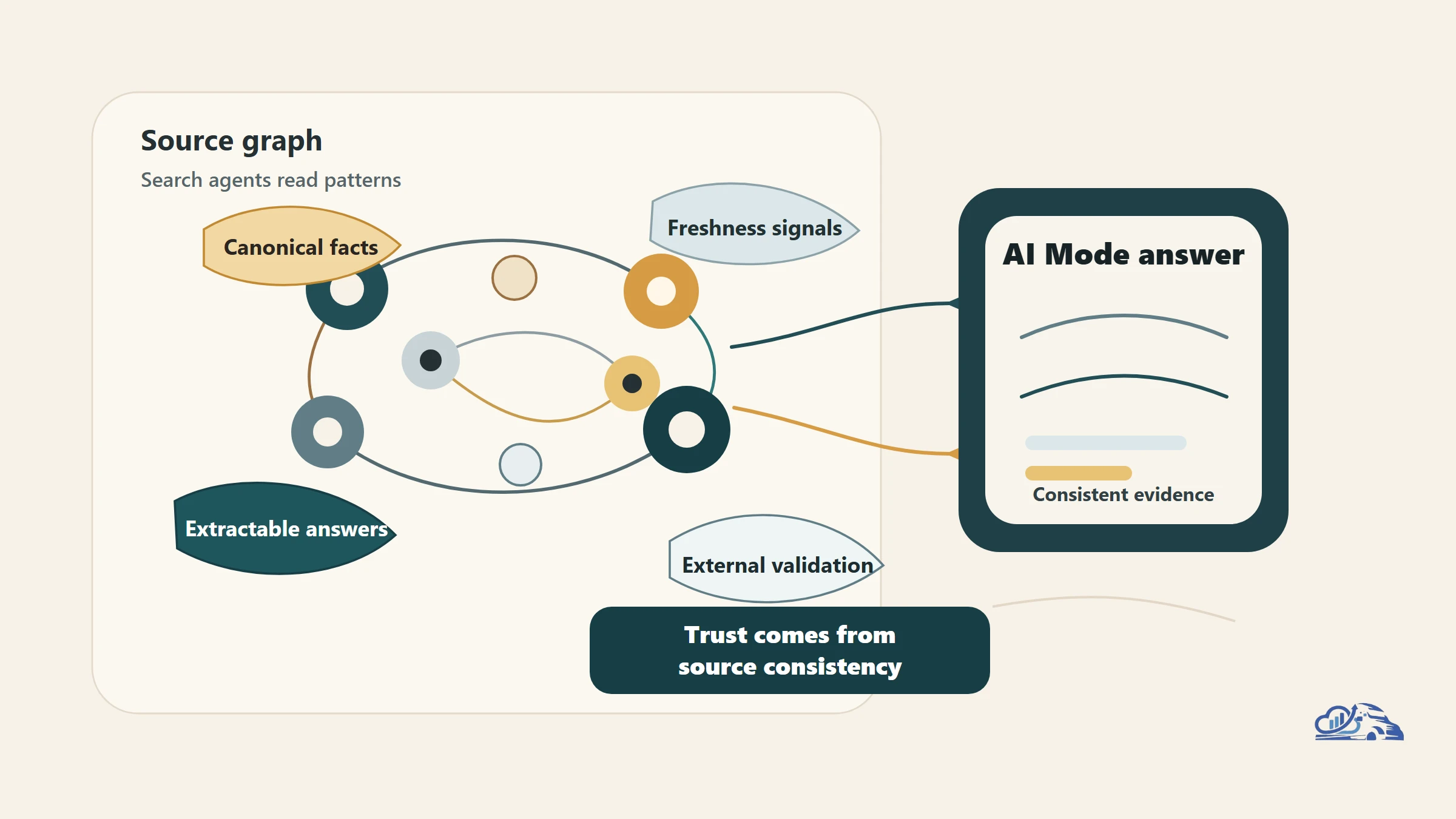
Omnichannel authority is the evidence layer around your website. It includes reputable mentions, social proof, community discussions, partner content, review platforms, podcasts, newsletters, and media coverage.
Semrush's supplied AI citation research shows why this matters: Reddit is described as a top-2 cited domain on ChatGPT and a top-5 source for Google AI Mode and Perplexity. That does not mean every brand should spam Reddit. It means answer engines are learning from places where people compare, question, complain, recommend, and validate.
Conversion paths after the answer
If the answer engine cites you, the next click must have somewhere useful to land. A cited article should connect to a clear offer, demo, audit, workflow, or proof page. Otherwise, you may earn visibility without turning it into pipeline.
This is the practical difference between traffic and demand. Traffic counts visits. Demand tracks whether the right buyer understood the right reason to trust you.
How to Build a GEO and AEO Strategy
A GEO and AEO strategy works when it turns buyer questions into answer-ready assets, then measures whether those assets are cited, trusted, and connected to conversion.
Here is the workflow we use conceptually at Van Data Team.
Map buyer questions by intent
Start with questions, not keywords. Keywords still matter, but conversational search begins with tasks:
- "How do I get my company cited in AI Overviews?"
- "What is the difference between GEO and AEO?"
- "How should a small team monitor AI search citations?"
- "Is SEO still worth investing in if AI answers reduce clicks?"
- "What content should we publish for answer engine optimization?"
Group those questions by intent: education, comparison, implementation, risk, vendor selection, and proof. Each group needs a different asset type.
Create direct-answer sections
Every important question needs a concise answer block. The answer should be specific enough for a human and structured enough for a machine.
Weak answer:
"AI search is changing marketing, and brands need to adapt."
Stronger answer:
"AI search citations are brand mentions or source links inside generated answers, and they matter because buyers may trust the answer before they visit a website."
That sentence can be extracted. It defines the term, explains the business value, and avoids filler.
Add citation-ready evidence
AEO makes the answer clear. GEO makes the answer citeable. That means every important claim needs a support layer: primary sources, named research, original data, diagrams, examples, or a transparent methodology.
Avoid bare claims like "AI Overviews are reducing traffic." Use sourced claims, such as the Memeburn-cited finding that organic CTR fell 61% on AI Overview queries, from 1.76% to 0.61%.
Seed authority across credible external channels
Your website should be the canonical source, but the market validates you elsewhere. Publish supporting views on channels that make sense for your audience: founder posts, partner articles, community answers, podcasts, newsletters, comparison mentions, and data-backed explainers.
The goal is not volume. The goal is consistency. Answer engines need repeated, corroborated signals that describe who you are, what you do, and why you are credible.
Monitor citations, not just rankings
Rank tracking is still useful, but it is incomplete. Add citation monitoring prompts, brand mention audits, AI answer screenshots, query coverage logs, and assisted conversion analysis.
For Vanaxity, this is where the agentic workflow matters. You can watch the publishing process as a pipeline rather than a one-off writing task: research, validation, review, improvement, visuals, publishing, and reporting.
Operational Runbook for AI Search Visibility
A production-grade AI search workflow needs owners, review gates, measurement loops, and failure recovery.
Use this runbook as a starting artifact:
| Stage | Operator task | Review gate | Failure mode | Recovery action |
|---|---|---|---|---|
| Question mapping | Cluster buyer questions by intent and funnel stage | Does each cluster map to a real buyer decision? | Content targets curiosity but not revenue | Add sales calls, support questions, and CRM objections |
| Answer drafting | Write direct-answer blocks for each core question | Can the answer stand alone out of context? | Vague phrasing blocks extraction | Rewrite with entity, action, audience, and outcome |
| Evidence layer | Add named sources, examples, and proof | Is each material claim supported? | Unsupported claims reduce trust | Replace opinion with sourced or original evidence |
| Distribution | Repurpose the canonical answer across credible channels | Is terminology consistent across channels? | Mixed messaging confuses entity understanding | Create a shared entity and message map |
| Monitoring | Track citations, mentions, rankings, and assisted demand | Are answer surfaces changing over time? | Team measures clicks only | Add citation logs and AI answer snapshots |
| Recovery | Refresh stale answers and repair weak pages | Did the page lose citations or relevance? | Old content gets outranked or ignored | Update source freshness, answer blocks, and internal links |
Cost, latency, and token budget matter in this workflow. If you ask an AI agent to research every possible query without constraints, review burden grows fast. If you overcompress the workflow, you publish thin content that cannot earn citations.
The pragmatic pattern is staged automation: let agents collect signals, draft, structure, illustrate, and prepare reports, then use human review gates for positioning, claims, risk, and final approval. That is the operator-first version of answer engine optimization.
Best Practices for AI Search Citations
AI search citations are earned when your content is clear, source-backed, entity-rich, and reinforced by credible signals beyond your site.
Start with concise answer blocks. Put the answer near the top of the section. Avoid long throat-clearing. If the user asks "What is answer engine optimization?" the first sentence should answer that question.
Make claims explicit. "Many brands are losing clicks" is weaker than "AI Overviews can reduce traditional click paths, which makes citation visibility a demand-capture metric." The second version gives an answer engine a more useful claim.
Use consistent terminology. If your homepage says "AI content agent," your service section says "SEO automation platform," and your articles say "GEO workflow system," you may be making entity recognition harder than necessary. Choose a primary category and support it with secondary terms.
Build community and media presence where answer engines already learn. The Semrush finding about Reddit's citation presence is a reminder that third-party conversations shape perceived authority. You do not control those spaces, but you can participate honestly, publish useful answers, and make your owned content worth referencing.
A composite example: Maya runs marketing for a niche SaaS company. Her team publishes a technically strong guide, but it never appears in AI answers. The issue is not article length. The page has no direct answer blocks, the product category is inconsistent, and the strongest claims have no sources. After restructuring the guide around buyer questions, adding evidence, and syndicating key insights through credible founder and community channels, the team has a better chance of being cited because the content is easier to parse and corroborate.
Common Mistakes That Kill Answer Visibility
Most GEO and AEO failures come from treating AI search as a formatting trick instead of an authority system.
The first mistake is chasing traffic only. If informational clicks fall, some teams stop investing in top-of-funnel content. That leaves the answer layer to competitors. The correction is to measure visibility before the click: citations, brand mentions, answer quality, and assisted demand.
The second mistake is publishing vague thought leadership. A page full of broad opinions gives answer engines little to extract. The correction is to write claim-first sections with definitions, comparisons, examples, and named evidence.
The third mistake is ignoring third-party sources. If your brand only exists on your own domain, you may lack the corroboration answer engines expect. The correction is to build omnichannel authority through credible mentions, partner content, founder expertise, and useful participation in the communities your buyers trust.
The fourth mistake is measuring only blue-link rank. Rank matters, but it does not tell you whether an AI answer named you, cited you, summarized you correctly, or sent better-informed visitors to your site. The correction is to add AI answer monitoring to your reporting stack.
The fifth mistake is failing to connect answer visibility to conversion. A cited guide should lead naturally to a scan, audit, demo, template, or implementation plan. For example, Van Data Team can deliver a scoped content visibility review that includes a query signal map, AI citation gap review, dashboard gap review, and implementation scope for the next publishing sprint.
Measurement Framework for Omnichannel Authority
Omnichannel authority should be measured by whether buyers and answer engines repeatedly encounter a consistent, credible version of your brand.
Use these measurement categories:
| Measurement area | What to inspect | Why it matters |
|---|---|---|
| Citation inclusion | Whether your brand or URL appears in AI-generated answers | Shows whether answer engines treat you as a source |
| Brand mention quality | Whether the answer describes your category and offer correctly | Prevents visibility with poor positioning |
| Query coverage | Which buyer questions include you, competitors, or neither | Reveals content and authority gaps |
| Click depth | What AI-informed visitors do after landing | Shows whether answer visibility creates useful sessions |
| Assisted conversion | Whether cited pages influence demos, audits, trials, or sales conversations | Connects GEO and AEO to pipeline |
| Source consistency | Whether owned and external mentions describe the same entity | Strengthens machine and human trust |
You do not need a perfect attribution model to begin. Start with repeatable observation. Run the same prompt set on a schedule. Capture screenshots. Log cited sources. Compare answer language against your positioning. Track whether cited pages lead to meaningful next actions.
Then improve the system. Refresh pages that are missing from answers. Clarify pages that are cited inaccurately. Strengthen pages that rank but do not get mentioned. Add internal links from broad educational assets to practical conversion paths such as Vanaxity results and proof.
This is also where reporting matters. A useful dashboard should not only show rankings. It should show answer visibility, source quality, content freshness, review status, and next recommended actions.
Practical Examples for Founders and Operators
A practical AI search program starts with the questions your buyers already ask.
Example for a founder-led SaaS company: the founder wants to be cited when buyers ask, "What is the best way to automate SEO content without hiring a full team?" The content plan should include a category definition, comparison guide, workflow explainer, proof page, and founder POV. The founder should also contribute useful answers in channels where buyers compare tools.
Example for a lean marketing team: the team sees fewer informational clicks, but sales calls mention that prospects "saw the brand in an AI answer." Instead of panicking over top-line traffic, the team adds assisted conversion notes to CRM, builds an AI citation query set, and improves the pages most likely to be cited.
Example for an agency operator: the team has strong SEO process but no AEO review gate. They add a simple check before publishing: does each H2 open with a direct answer, do claims include sources, are entities named consistently, and is there a next step after the answer? That small workflow change can make content more useful for both readers and machines.
For teams that want the workflow without building the whole machine internally, the Van Data Team behind Vanaxity can map the system: where your content is visible, where AI engines misunderstand you, which pages need answer blocks, and which authority signals are missing.
Frequently asked questions
What is the difference between GEO and AEO?
GEO focuses on getting cited by generative engines, while AEO focuses on making your content the clearest possible answer. In practice, AEO improves extractability and GEO improves citation-worthiness.
Is SEO still useful if AI Overviews reduce clicks?
Yes. SEO is still the foundation for crawlability, relevance, authority, and technical health. AI Overviews reduce the value of measuring success by clicks alone, but they increase the value of ranking pages that are structured well enough to be cited and summarized.
How do brands get cited in AI search?
Brands get cited in AI search by publishing clear, source-backed answers, using consistent entity language, earning credible third-party mentions, and monitoring which sources answer engines already trust for their category.
Why does omnichannel authority matter?
Omnichannel authority matters because answer engines synthesize information from more than your website. A brand that appears consistently across owned content, third-party sources, community discussions, and credible mentions gives AI systems more confidence in what the brand is and why it matters.
How should teams start measuring GEO and AEO?
Start with a fixed set of buyer questions, then record whether your brand appears, which sources are cited, how accurately the answer describes you, and whether cited pages create meaningful next actions. Add this to normal SEO reporting instead of replacing SEO metrics.
What should a small team do first?
A small team should begin with its highest-intent questions. Rewrite those pages so each major section opens with a direct answer, add source-backed claims, clarify the brand entity, and connect each article to a useful conversion path such as an audit or implementation review.