Google Search Agents: What AI Mode Changes for GEO and AEO
Google Search agents, AI Mode, and Generative UI now change how brands earn citations. Learn the SEO, GEO, and AEO operating model to use next.
Overview
Google Search agents are AI systems inside Google Search that can reason across web information, monitor changing topics, and return synthesized updates or generated interfaces instead of only showing a static list of links. For founders, marketers, and operators, the problem is immediate: your best page can still be invisible if AI Mode cannot verify, cite, or reassemble your claims.
Google says AI Mode has passed more than 1 billion monthly users, while AI Mode queries are more than doubling every quarter. That scale changes search from a rankings game into an information supply chain. Vanaxity, Van Data Team's AI SEO/GEO/AEO agent, is built for that shift: research, write, illustrate, publish, and syndicate content so brands can show up in Google, AI Overviews, ChatGPT, Gemini, and answer engines.
At Van Data Team, we start by asking a blunt operational question: if an AI agent had to explain your category, compare your product, and update a buyer when the market changes, what sources would it trust? This guide turns Google's announcement into a working model for search teams: what to publish, what to structure, what to syndicate, what to monitor, and what to stop treating as the only KPI.
Tooling And Landscape Fit
Do not evaluate the topic in isolation. Compare the main approach against adjacent frameworks, orchestration choices, and runtime controls so the reader can see when each option fits.
Review adjacent options such as LangGraph, LangChain, CrewAI, native function calling, MCP before choosing the implementation path.
Map your SEO, GEO and AEO workflow before you build.

Key Takeaways
- AI Mode is no longer experimental search theater: Google says it has surpassed more than 1 billion monthly users and its queries are more than doubling every quarter.
- Visibility now means being useful to generated answers, information agents, comparison tables, dashboards, and cited summaries, not only ranking as a blue link.
- Third-party validation matters because Semrush analyzed 230,000 prompts and over 100 million citations and found Reddit is a top-2 cited domain on ChatGPT and a top-5 source for Google AI Mode and Perplexity.
- AEO and GEO teams need claim review, source freshness, structured answers, community visibility, and citation monitoring inside the same workflow.
- The mistake we see most often is treating AI Mode as a new SERP feature instead of a new operating surface for content, data, reputation, and workflow automation.
| Search shift | What changed | Operator response |
|---|---|---|
| AI Mode scale | Google reports more than 1 billion monthly users | Treat AI answers as a primary distribution surface |
| Query behavior | AI Mode queries are more than doubling every quarter | Track cited presence, not only rank position |
| Model layer | Gemini 3.5 Flash became the default model globally in AI Mode | Make content extractable, current, and easy to synthesize |
| Source graph | Semrush reviewed 230,000 prompts and over 100 million citations | Build visibility across owned, earned, community, and media sources |
| Click impact | Organic CTR fell 61% on AI Overview queries, from 1.76% to 0.61% | Measure citations, assisted clicks, branded demand, and answer ownership |
What Are Google Search Agents?
Google Search agents are Search-native AI systems that help users move from asking a query to receiving monitored information, synthesized answers, and generated interfaces. They do not just retrieve pages. They interpret the task, scan relevant sources, keep track of changes, and return the most useful next view.
That makes them different from classic ranking systems. A traditional search result answers, "Which pages are relevant for this query right now?" An agentic search system asks, "What does this user need to know, what sources can support it, and what should be watched over time?"
In the Search announcement, Google describes information agents as systems that can keep track of changing information for users. The practical examples are buyer-shaped: monitoring product availability, tracking changing prices, watching events, following local options, or keeping up with a category.
For a B2B marketer, imagine a buyer asking AI Mode to monitor enterprise SEO platforms. The agent may watch product pages, review sites, community discussions, news posts, pricing pages, and social updates. If your website says one thing, your documentation says another, and third-party discussions do not confirm either, the agent has a weak source graph.
That is why the new search problem is not "How do we rank for this keyword?" It is "How do we become the most reliable source package for this task?"
"AI Mode queries are now more than doubling every quarter."
What AI Mode's Scale Changes
AI Mode's scale changes search visibility because users are training themselves to accept synthesized answers, generated layouts, and ongoing monitoring as the default search experience. Once users expect Search to do the work, fewer journeys begin with scanning links.
That does not mean clicks disappear. It means clicks become less complete as the only measurement layer. A user may see your brand inside an answer, generated comparison, source citation, product list, or agent update before they ever visit your site. Some of that visibility creates demand. Some creates trust. Some creates no-click education. Some leads to high-intent visits later.
Memeburn's summary of Seer Interactive research reports organic CTR fell 61% on AI Overview queries, from 1.76% to 0.61%. The same summary says brands cited in AI Overviews earn about 120% more organic clicks per impression than uncited brands. The direction is clear: being cited inside AI surfaces can matter as much as, and sometimes more than, the classic link position.
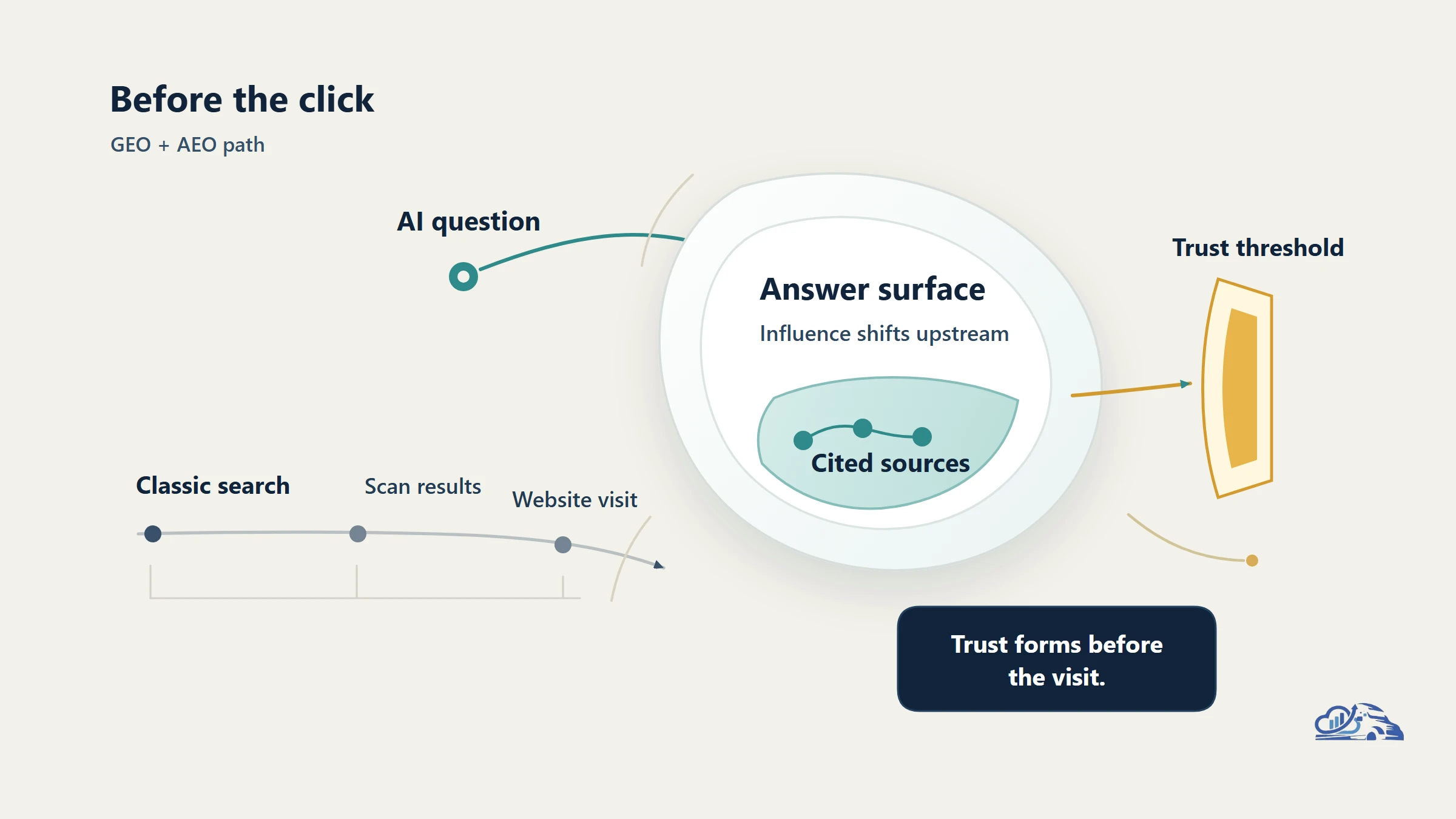
The old funnel was search query, ranked result, page visit, conversion. The new funnel can be query, AI answer, citation, generated table, agent follow-up, branded search, page visit, conversion. Analytics teams need to stop treating the missing click as missing influence.
A practical founder scenario makes this concrete. Maya runs a lean B2B workflow software company. Her product page ranks well, but a buyer asks AI Mode for "best tools for regulated content approval." AI Mode builds a comparison table. Her product is absent because her website never clearly states approval gates, audit logs, reviewer roles, or compliance workflows, and community discussions describe competitors more explicitly. The ranking existed. The agent-ready evidence did not.
This is the moment where how Vanaxity works becomes operational, not decorative. The content agent can turn positioning into extractable pages, FAQ answers, comparison sections, schema-ready summaries, visuals, and syndication targets that make the brand easier for AI systems to understand.
What Generative UI Means in Search
Generative UI means Search can create a custom interface for the user's question instead of returning the same generic results layout every time. The interface might be a visual comparison, a table, a graph, a tracker, a simulation, a dashboard, or a mini app assembled around the task.
This is bigger than a richer snippet. A generated interface changes the unit of visibility. Your brand may appear as a row in a table, a cited source in a generated explanation, a marker in a map-like experience, a datapoint in a chart, or a recommended next action. If your content is not structured enough to be safely transformed, it may be skipped.
Generative UI rewards content with clean entities, clear attributes, stable definitions, current facts, and concise answer blocks. It punishes vague positioning, buried details, outdated comparisons, and unsupported superlatives.
It is also important not to confuse Generative UI with Google Antigravity. Search's generated interface is part of the user-facing Search experience. Antigravity is a developer platform for building with autonomous coding agents, announced by Google as a separate agent-first development environment on November 18, 2025. They are adjacent in the agentic stack, but they solve different problems.
For SEO and content teams, the Generative UI question is simple: can your content be turned into a useful interface without a human editor fixing it first?
If the answer is no, your next work is not "write more blogs." It is content architecture.
Why GEO and AEO Move to the Center
GEO and AEO move to the center because agentic search needs sources it can synthesize and answers it can extract. SEO still matters, but it is no longer the whole visibility system.
SEO is the discipline of making pages discoverable, crawlable, relevant, and competitive in search rankings. GEO, or generative engine optimization, focuses on being represented accurately in AI-generated answers. AEO, or answer engine optimization, focuses on making facts, definitions, comparisons, and instructions easy for answer engines to retrieve and quote.
The overlap is where modern search work happens:
| Discipline | Main surface | What it optimizes | What teams should measure |
|---|---|---|---|
| SEO | Search results and organic pages | Rankings, indexability, relevance, authority | Rank, impressions, clicks, conversions |
| GEO | AI summaries and generated responses | Citability, source consistency, entity clarity | Mentions, citations, answer inclusion |
| AEO | Direct answers, snippets, assistants | Extractable answers and structured facts | Answer ownership, FAQ inclusion, schema quality |
The practical shift is that your website is only one input. Semrush's AI citation research found Reddit is a top-2 cited domain on ChatGPT and a top-5 source for Google AI Mode and Perplexity. That does not mean every brand should spam Reddit. It means answer engines value third-party discussions, communities, and source diversity.
A content team that only updates its blog may still lose the answer. A better program coordinates website content, documentation, community participation, earned media, review sites, partner pages, social posts, and product data.
The mistake we see is treating AEO as "add FAQ schema and move on." Schema helps, but it cannot rescue unclear claims. The stronger play is to make every important claim verifiable across your owned pages and the external places buyers already trust.
An Operating Model for Agent-Ready Visibility
Agent-ready visibility requires a workflow that connects research, source mapping, content production, review gates, structured data, syndication, and monitoring. This is where SEO becomes an operating system, not a monthly content calendar.
At Van Data Team, we start by building a signal map. It answers four questions:
- What does the buyer ask before they know your brand?
- What does the agent need to verify before citing you?
- Which sources are likely to influence the answer?
- Which claims need review before publication?
Then we build the content system around those signals.
The agent-readiness architecture
Agent-ready visibility comes from making claims consistent, extractable, current, and supported across the sources AI Mode is likely to inspect.
A practical architecture has five layers.
First, create canonical pages for the facts you want agents to understand. These include product pages, category pages, comparison pages, pricing pages, support pages, documentation, glossary entries, and FAQ hubs.
Second, make answers extractable. Put direct answer paragraphs near the top of sections. Use clear headings. Add tables when attributes matter. Avoid hiding important claims inside decorative copy.
Third, keep source freshness visible. Update comparison pages when the category changes. Refresh pricing and feature claims. Maintain changelog-style pages when product behavior matters. Agents are more likely to trust current, consistent information than stale marketing copy.
Fourth, syndicate and validate. Earn mentions in community, expert, media, partner, and review sources. Do not fabricate social proof. Make it easy for third parties to describe your product accurately.
Fifth, monitor agent output. Track when your brand is cited, omitted, mischaracterized, or framed by competitors' language. Feed those findings back into content and source updates.
A practical runbook checklist
| Step | Output | Owner | Evaluation question |
|---|---|---|---|
| Map buyer tasks | Query and prompt inventory | SEO or growth lead | Are we covering what buyers actually ask AI systems? |
| Map sources | Owned, earned, community, media, docs | Content strategist | Which sources would an agent trust for this answer? |
| Build canonical pages | Product, comparison, FAQ, glossary, docs | Content and product marketing | Can a generated answer quote us without rewriting the claim? |
| Add review gates | Claim, source, compliance, freshness checks | Editor or operator | Are facts current and supported before publication? |
| Structure answers | Tables, direct answers, schema-ready blocks | SEO lead | Can the page be lifted into a snippet or generated UI? |
| Monitor AI surfaces | Citation and omission report | Analytics or ops | Where are we cited, missing, or misrepresented? |
| Improve distribution | Community, partner, social, PR updates | Growth team | Are third-party sources confirming our core claims? |
This runbook has cost and latency implications. More review gates can slow publishing. More monitoring can increase tool spend. More distribution requires human judgment. But the alternative is worse: publishing fast into surfaces that cannot verify you.
A lean team should start with the highest-value category and buying-intent prompts. Then expand to the pages and sources that influence those answers. Vanaxity can make that repeatable by turning research, writing, illustration, review, publishing, and syndication into one content workflow, with proof and case outcomes tied back to measurable visibility.
Failure Modes That Hurt Agentic Search
The biggest failure mode is assuming AI Mode is just another SERP feature. It is a broader interaction layer that can synthesize, monitor, and generate interfaces. If you only optimize title tags, you miss the deeper source problem.
Another failure mode is unsupported claims. "Best," "most secure," "fastest," and "enterprise-grade" are weak unless the page explains what they mean and where the evidence lives. Agents need grounded facts, not adjectives.
A third failure mode is content drift. Product pages, pricing pages, help docs, sales decks, social posts, and comparison pages often tell slightly different stories. Humans forgive that. Agents may treat it as inconsistency.
A fourth is ignoring third-party sources. If review pages, community threads, media mentions, and partner listings contradict your positioning, your own site will not fully control the answer.
A fifth is measuring only rank. Rank still matters. But a page can rank and still lose the generated comparison, the AI citation, the answer box, or the agent update. Your dashboard needs room for cited presence, branded prompts, source inclusion, answer accuracy, and correction workflows.
Here is the decision lens we use:
| If the issue is... | Do this first | Do not start with... |
|---|---|---|
| AI answers omit the brand | Audit source coverage and extractable claims | Publishing more generic blogs |
| AI answers misstate the product | Fix canonical pages and third-party descriptions | Blaming the model only |
| Competitors dominate comparisons | Build factual comparison and category pages | Thin "us vs them" copy |
| Content is not cited | Improve answer structure and source authority | Keyword stuffing |
| Generated interfaces skip key attributes | Add clear attributes, tables, and definitions | Decorative copy blocks |
The practical goal is not to "trick" an AI answer engine. It is to make the truth about your brand easier to find, verify, synthesize, and cite.
How to Evaluate Readiness
Agent-readiness evaluation should combine content quality, source quality, technical structure, and operational resilience. The dashboard should not be a vanity report. It should tell the team what to fix next.
Use these criteria:
- Crawlability: Can search systems access the important pages, assets, and structured content?
- Extractability: Can a short answer be pulled from each major section without losing context?
- Citation strength: Are claims supported by authoritative owned and third-party sources?
- Freshness: Are product, pricing, comparison, and support facts current?
- Consistency: Do the website, docs, social profiles, review pages, and community mentions say the same thing?
- Observability: Can the team see when AI answers cite, omit, or misrepresent the brand?
- Review burden: Are risky claims reviewed before publication?
- Failure recovery: Is there a workflow to correct stale pages, bad source descriptions, or answer-engine errors?
This is also where token budget and latency enter the strategy. Long, unfocused pages are harder for AI systems and humans to use. A better page is modular: concise definitions, scannable sections, tables for attributes, FAQ answers for direct retrieval, and deeper context where a buyer needs it.
Do not treat every page equally. Prioritize the surfaces that influence revenue: category pages, comparison pages, integration pages, pricing explanations, industry pages, and support content tied to objections.
If you want a concrete starting point, request a Van Data Team content scan. The useful output is not a vague audit. It should include a signal map, agent-readiness gaps, citation-risk notes, dashboard gaps, review-gate recommendations, and an implementation scope for the next publishing cycle.
Practical Examples for Operators
A B2B software category page may stop functioning as a simple landing page and start functioning as source material for generated comparison tables. That page needs clean criteria, transparent fit statements, supported differentiators, and clear limitations. If it reads like a billboard, it is less useful to an agent.
A local services query may trigger an agentic workflow where Search helps the user compare options or initiate a task. The business page needs current hours, service areas, booking details, reviews, pricing context, and structured answers. The less a user needs to click around, the more important source clarity becomes.
A content operator may update a product page and assume the job is done. But if old partner pages, stale review profiles, and community answers still describe the previous product, AI systems can inherit the older story. The workflow needs external source cleanup, not just CMS publishing.
A founder running a small team should not try to monitor every AI surface manually. Start with priority prompts, buyer objections, category comparisons, and high-intent use cases. Then build a recurring review: what changed in the market, what did AI answers cite, what did they miss, and what content should be updated?
That is the operator mindset. Search is no longer a static shelf. It is a living source graph.
Frequently asked questions
Are information agents available to everyone?
Information agents are being rolled out in stages, with Google's Search announcement describing subscriber-first availability for AI Pro and Ultra users. Teams should prepare now without assuming every user has the same feature access at the same time.
What is Generative UI in Google Search?
Generative UI is Search's ability to build a custom interface for the user's task. Instead of only showing links, Search can generate tables, visual layouts, trackers, dashboards, or other task-specific views using available information.
Is Google Antigravity the same as Generative UI?
No. Google Antigravity is a developer platform for autonomous coding agents, while Generative UI is part of the Search experience. The distinction matters because SEO teams optimize for Search surfaces, not developer IDE behavior.
How should SEO teams adapt to AI Mode?
SEO teams should keep core technical SEO, but add GEO and AEO workflows: direct answer blocks, structured comparisons, source freshness, third-party validation, citation monitoring, and review gates for factual claims.
What is the difference between GEO and AEO?
GEO focuses on being represented accurately in generative engines. AEO focuses on making specific answers easy for answer engines to extract. In practice, both require clear entities, supported claims, structured information, and credible source coverage.