OpenAI Rule-Based Rewards for Brand-Safety Governance
OpenAI's Rule-Based Rewards train models for safer behavior. Explore Vanaxity's proposed rule-grading analogy for brand governance with human review.
Overview
Marketing teams adopting OpenAI Rule-Based Rewards as a governance model risk confusing a 2024 model-training technique for safety behavior with a tool that checks brand compliance or factual accuracy. Left unaddressed, that confusion shows up as slow, manual brand reviews that still miss off-brand or non-compliant copy as AI content scales. This article explains what RBR actually does, then translates its rule-and-grader pattern into a practical pre-publish gate with separate human review and fact-checking controls. At Van Data Team, we approach that work by turning policy into testable rules, logged decisions, and clear escalation paths.
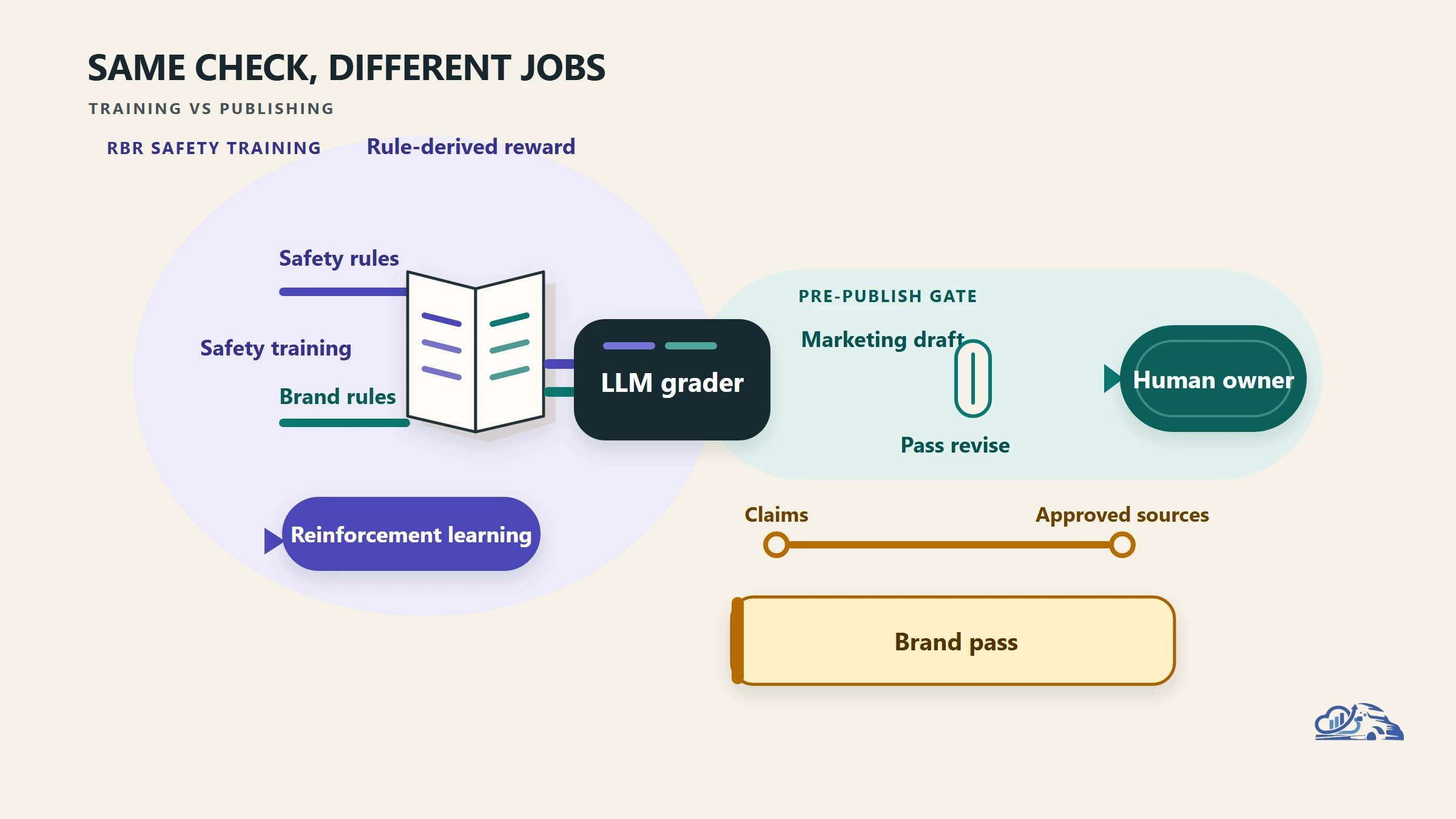
OpenAI Rule-Based Rewards are a 2024 safety-training method that turns natural-language safety rules into LLM-grader scores used as reinforcement-learning rewards, while retaining human oversight. For B2B marketing teams scaling AI copy and customer engagement, industry-standard practice does not present this analogy as model training. It expresses policy as checkable rules, grades drafts before release, routes failures, and keeps factual verification under separate control.
That distinction matters because brand-compliant content can still be false. Vanaxity, Van Data Team's AI content agent for SEO, GEO, and AEO, researches, writes, illustrates, publishes, and syndicates answer-ready content. The team behind Vanaxity makes governance operational through policy-aware data pipelines, automated review gates, source mapping, human escalation, and decision reporting.
This guide explains what RBR actually is, where the marketing analogy stops, and how an industry-standard implementation structures an auditable brand-safety gate without pretending automation eliminates risk.
Key Takeaways
RBR is a safety-training method. The industry-standard marketing implementation is an evaluation pattern with separate human and factuality controls.
- RBR uses explicit rules and an LLM grader to shape model safety behavior during reinforcement-learning fine-tuning.
- Marketing teams generally should not run RBR; they should adapt the rule-based evaluation pattern before publication.
- A brand-rule pass confirms policy compliance, not factual accuracy or source support.
- Ambiguous, contextual, legal, and high-risk decisions still require an accountable human owner.
- Production governance needs versioned rules, evidence-backed grader decisions, evaluation sets, and decision logs.
Need to turn policy documents into an executable review process? Explore how Vanaxity works across content generation, automated checks, source verification, approval, and distribution.
Map your SEO, GEO and AEO workflow before you build.

What Are OpenAI Rule-Based Rewards?
OpenAI's RBR method converts explicit safety policy into a reward signal that helps control how a model responds during reinforcement-learning fine-tuning.
OpenAI's accompanying paper, "Rule Based Rewards for Language Model Safety", describes a model-training approach. Desired or undesired aspects of an output become natural-language propositions. Rules combine those propositions into evaluations of appropriate behavior, and a fixed language-model grader scores candidate outputs.
OpenAI says RBR "aligns models to behave safely without extensive human data collection" in its method overview.
In plain English, the reported RBR workflow looks like this:
- A safety policy defines the response behavior the model should exhibit.
- Natural-language propositions identify relevant properties of a response.
- Rules specify which combinations represent ideal, weaker, or unacceptable behavior.
- An LLM grader evaluates outputs against those rules.
- The resulting scores contribute an additional reward signal during reinforcement-learning fine-tuning.
The reward changes model training. It is not merely a content-review label attached after generation.
| Dimension | RBR | RLHF | Marketing rule grading | Factuality verification |
|---|---|---|---|---|
| Operating stage | Reinforcement-learning fine-tuning | Model training | Before publication or delivery | Before publication or delivery |
| Main objective | Control safety behavior | Learn from human preferences | Enforce brand, legal, and compliance policy | Test claims against approved evidence |
| Evaluation input | Explicit safety propositions and rules | Human feedback | Testable marketing rules | Claims, sources, and supporting passages |
| Output | Training reward signal | Reward-model signal | Pass, revise, block, or human review | Verified, unsupported, disputed, or review |
| Human role | Policy design and oversight | Feedback and oversight | Policy ownership, exceptions, and approval | Source approval and disputed-claim resolution |
The RLHF problem RBR addresses
Human feedback remains important, but repeatedly collecting preference labels can make routine safety-policy updates slow and burdensome. Existing labels may also stop reflecting the intended behavior after a policy changes.
According to OpenAI, rules can be modified or added when safety policy changes, reducing the need for extensive new human data collection. This gives safety teams a more direct way to express fine-grained behavior while keeping human oversight in the system.
RBR therefore complements RLHF. It does not prove that all model judgment can or should be automated.
The behavior RBR is designed to control
RBR focuses on safety behavior: whether the model should refuse, respond safely, or comply. OpenAI distinguishes between hard refusal, soft refusal, and compliance as response types, depending on the request and governing safety policy.
The rules can reward a concise refusal where refusal is appropriate, a more empathetic safe response where context calls for it, or useful compliance with a benign request. They can also discourage disallowed content, judgmental wording, and excessive caution.
None of those functions establishes whether an answer is factually correct.
A Training Technique Is Not a Marketing Product
RBR operates inside model training, while marketing governance normally operates on generated content before that content reaches a customer or publication channel.
Reported fact—OpenAI: RBR uses rule-derived scores as reinforcement-learning rewards to shape model safety behavior.
Vanaxity analysis: Industry-standard marketing governance borrows the policy-as-rules and LLM-grading pattern without claiming to run RBR. Its grader evaluates an asset and triggers a workflow action. It does not update the model through reinforcement learning.
If a content operation adds a rule grader to its publishing workflow, it should call the system a rule-based evaluation gate, policy grader, or LLM-as-judge governance layer. Calling it RBR would blur the difference between training and evaluation.
In an industry-standard framework, these control lanes remain distinct:
- Model safety governs whether the underlying model responds appropriately to safe and unsafe requests.
- Marketing brand safety governs claims, tone, prohibited language, confidentiality, approvals, and campaign-specific policy.
- Factuality tests whether externally verifiable claims are supported by approved evidence.
A draft can pass one lane and fail another. The practical decision is not simply automated checks versus manual review; it is deciding what machines can evaluate consistently and where accountable human judgment belongs.
Vanaxity Analysis: Turn Policy Into a Brand-Safety Gate
Industry-standard practice adapts the rule-based evaluation pattern by converting policy documents into atomic tests and attaching an explicit workflow action to every result.
At Van Data Team, we start by separating policy from prose prompts. The mistake we see is treating a long brand guide as if placing it in a prompt automatically creates reliable governance. A usable rule must tell the grader what to inspect, what evidence to return, and what happens when the answer is uncertain.
Each rule should define:
- The content types, channels, and audiences it covers.
- The behavior or wording that passes.
- The condition that fails or creates uncertainty.
- The evidence span the grader must cite from the draft.
- The resulting action and responsible human owner.
- The policy version that authorized the rule.
Illustrative policy-as-rules artifact
The following is a Vanaxity analysis artifact, not part of OpenAI's RBR implementation.
| Rule key | Testable rule | Passing condition | Failure or uncertainty action |
|---|---|---|---|
| BRAND-ABSOLUTE | Do not make an absolute outcome promise unless its exact wording is approved | No prohibited promise appears, or approved wording is identified | Revise or block |
| BRAND-VOICE | Follow the supplied audience, tone, and prohibited-language guidance | The draft matches the relevant policy and the grader cites evidence | Revise or request human review |
| POLICY-BOUNDARY | Team-defined high-risk content requires owner approval | Required approval is attached | Human review |
| PRIVACY-CONTENT | Do not expose material prohibited by privacy or confidentiality policy | No prohibited material appears | Block |
| CLAIM-SOURCE | Every externally verifiable claim must map to an approved source | A source identifier and supporting passage are attached | Send to the factuality gate |
| CONTEXT-MISSING | Do not infer a pass when required campaign context is absent | Required audience, channel, offer, and policy context are present | Human review |
The keys are less important than the precision. "Sound professional" is difficult to test. "Do not use insults, ridicule, slang, or unapproved competitor comparisons" gives the grader observable conditions.
How the gate handles real content
Hypothetical landing page: A generated hero section promises a guaranteed business result. The absolute-claim rule identifies the sentence and sends the draft for revision or blocks it if the wording is prohibited.
Hypothetical email: The message matches the approved voice but includes an unsupported product claim. The brand grader passes the tone. The separate factuality gate blocks the claim until approved evidence is attached.
Hypothetical social post: The copy satisfies the written language rules but uses humor that may be inappropriate for the campaign context. The grader returns human review instead of forcing a false pass or failure.
In this design, these decisions are explainable because the gate returns a rule, evidence, rationale, and action rather than an unexplained quality score.
Implementation: Build an Auditable Pre-Publish Workflow
A production-ready evaluation gate needs calibrated examples, evidence-backed outputs, deterministic routing, human escalation, and observable decision records.
Start with policy ownership
Identify which documents govern brand voice, legal claims, privacy, regulated topics, customer communications, and channel-specific requirements. Assign an owner to each policy and record the active version.
Resolve contradictions before automating. A grader cannot reliably reconcile two policies that authorize different outcomes without an explicit precedence rule.
Convert policies into atomic rules
Keep each rule focused on one behavior. Define pass, fail, and uncertainty conditions. Include required context, accepted exceptions, evidence requirements, severity, and the person or team responsible for ambiguous cases.
Rules should describe the policy's intent as well as its literal wording. Otherwise, generated copy may satisfy the text of a rule while violating its purpose.
Build a human-reviewed evaluation set
Create a compact reference set containing clearly acceptable, clearly unacceptable, and genuinely ambiguous examples. Add expected decisions and short rationales.
Include adversarial examples that use euphemisms, implied promises, missing context, or technically compliant language. The goal is to discover where the grader misunderstands a rule before the gate controls live publishing.
Require structured grader output
An illustrative output contract could look like this:
{
  "content_id": "email-campaign-03",
  "policy_version": "brand-claims-v3",
  "rule_results": [
    {
      "rule_id": "no-guaranteed-outcomes",
      "result": "fail",
      "severity": "high",
      "evidence": "\"guaranteed to double your pipeline\"",
      "rationale": "Promises an outcome the claims policy does not allow."
    },
    {
      "rule_id": "approved-product-names",
      "result": "pass",
      "severity": "low",
      "evidence": null,
      "rationale": "Every product name matches the approved list."
    }
  ],
  "overall_action": "revise",
  "factuality_status": "unchecked",
  "escalation_owner": null
}
The allowed overall actions are pass, revise, block, and human_review. A brand-grader pass must never automatically set factuality_status to verified.
Route each result explicitly
The workflow should send a clear rule failure to revision or blocking. Uncertainty, missing context, policy conflicts, and high-risk categories should reach a named human owner.
After brand and compliance grading, a separate process should extract factual claims, map them to approved sources, and compare each claim with its supporting passage. Required human approval then happens before publication, customer delivery, or syndication.
Log every material decision
Record the content version, policy version, rule results, evidence spans, rationale, human overrides, factual sources, and final disposition. Logs make recurring failures visible and help governance teams decide whether prompts, rules, context, or reviewer guidance need to change.
Production planning should also cover the following operational dimensions:
| Dimension | Production question |
|---|---|
| Cost | What do grader calls, fact checks, and escalated reviews cost per asset? |
| Latency | How much time do evaluation calls and human queues add before release? |
| Token budget | Can the grader receive the relevant policy and campaign context without truncation? |
| Observability | Can operators trace each decision to a content and policy version? |
| Review burden | Which rules create unnecessary escalation or repeated overrides? |
| Evaluation | Where do grader labels disagree with the human-reviewed reference set? |
| Failure recovery | Can failed content be quarantined, corrected, re-evaluated, and safely released? |
A useful implementation scope should include a policy-to-rule map, annotated sample decisions, a factuality-gap review, escalation ownership, logging requirements, and a delivery plan. That is more actionable than a generic AI governance workshop.
Results
OpenAI's cited evidence quantifies safety-training outcomes, not brand-compliance workflow performance. The RBR paper reports an F1 score of 97.1 for the balance between safety and usefulness, compared with 91.7 for a human-feedback baseline.
The paper also reports that a grader's accuracy at applying the rules improves substantially as the grader model gets larger, measured against a human-labeled Gold set, and that agreement between the automated grader and human labels was high — though not perfect — across the comply, hard-refuse, and soft-refuse categories. The transferable lesson is the shape, not the exact figures: grader choice matters, and any brand grader must be validated on your own labeled examples.
| Measure | Source-supported result | Brand-compliance interpretation |
|---|---|---|
| LLM proposition-grader accuracy | Improves substantially with larger grader models | Model choice can materially affect rule-grading performance; a brand grader requires local validation |
| Human-to-automated label agreement | High but imperfect across three safety response types | Automated and human labels can disagree even on explicit rules |
| Human-labeled calibration set | 518 completions | A relatively compact human-reviewed set supported grader-prompt tuning in the RBR experiment |
| RBR versus human-feedback outcome | 97.1 F1 versus 91.7 F1 | This is a model-training result, not evaluator accuracy or a brand-compliance benchmark |
| Human-agent brand-compliance accuracy | Not reported | The cited research does not provide a separate human-reviewer accuracy range for marketing tasks |
| Marketing manual-review time reduction | Not reported | The evidence does not support claiming that the gate reduces review time by a specific percentage |
These safety-domain figures must not be relabeled as brand-compliance results. The cited research does not establish model-grader accuracy, human-agent accuracy, or manual-review-time reduction for marketing governance tasks.
As a rule of thumb for choosing an approach: RBR-style training is best for the model builders who shape safety behavior; a rule-based evaluation gate is the stronger fit for marketing teams, who should choose the evaluation pattern over retraining; and you should still use human review when a decision is ambiguous, legal, brand-sensitive, or high-risk. First test the gate on a labeled sample before you route live content through it, and verify grader behavior against your own examples rather than trusting the official safety-paper figures as brand benchmarks.
A brand-compliance pilot should therefore measure both model and human performance against the same adjudicated reference set. It should report grader accuracy by rule, human-agent agreement, false-pass and false-block rates, escalation rate, median review minutes per asset, and the percentage change from the pre-automation baseline. Until those measurements exist, claiming that the workflow “reduces manual review time by X%” would be unsupported.
Limits and Failure Modes
In production use, rule-based grading does not eliminate contextual judgment, grader error, policy gaps, or unsupported facts.
| Failure mode | Why it matters | Operational response |
|---|---|---|
| Ambiguous judgment | Humor, tone, sensitivity, and audience fit resist binary rules | Return human review with the disputed evidence |
| Missing context | The grader cannot apply campaign exceptions it never received | Block automatic approval until required context is present |
| Literal rule gaming | Copy can satisfy wording while violating intent | Test adversarial examples and require policy-grounded rationale |
| Stale rules | Brand, product, legal, and channel policies evolve | Version rules and review them whenever governing policy changes |
| Grader inconsistency | LLM judgments can vary or inherit model biases | Calibrate against human labels and monitor overrides |
| Factuality gaps | Policy-compliant copy can still contain false claims | Run separate claim extraction, sourcing, and verification |
| Automation complacency | A pass label may be mistaken for a guarantee | Preserve accountable owners and risk-based approval |
False passes and false blocks have different consequences. A false pass can release prohibited or misleading content. A false block wastes reviewer time and slows distribution. Teams should inspect both patterns by rule instead of relying on one aggregate score.
High-risk assets should remain subject to human approval even when automated checks pass. Examples include sensitive customer communications, unapproved performance claims, privacy-sensitive material, and content governed by a team-defined legal or regulatory policy.
Future-Proofing
Future-proofing a 2026-era GEO workflow requires governance that survives multi-agent handoffs, model changes, policy updates, and new publishing channels.
Multi-agent orchestration can separate research, drafting, brand-policy grading, factuality verification, visual production, approval, and publishing into specialized agents. The orchestrator must treat each agent as a bounded workflow component, not as an independent final approver.
Industry-standard orchestration should enforce these controls:
- Every agent receives the same asset identifier, active policy version, audience, channel, and campaign context.
- Research agents return approved source identifiers and supporting passages instead of untraceable summaries.
- Writing agents preserve claim-to-source mappings when drafting or revising content.
- Brand and compliance agents grade atomic policy rules without setting factuality status.
- Factuality agents verify external claims without overriding brand, legal, or privacy decisions.
- The orchestrator blocks publication until every required control lane returns an acceptable status.
- Ambiguity, policy conflicts, missing context, and high-risk material route to a named human owner.
- Model, prompt, rule, or policy changes trigger replay against the human-reviewed evaluation set.
- Decision logs preserve agent outputs, evidence, overrides, and final approval across the full content lifecycle.
That is multi-agent orchestration's role in 2026-era GEO standards: preserving provenance, policy consistency, and accountable approval while multiple systems create and transform answer-ready content. Multi-agent architecture does not guarantee citation by an answer engine. It makes claim-source relationships easier to inspect, update, and defend without allowing one automated pass to override another control lane.
How Van Data Team Makes This Operational
At Van Data Team, we turn the transferable idea behind OpenAI Rule-Based Rewards into an operating workflow. We do not treat it as marketing model training. We map the current handoffs, source systems, policy decisions, review gates, dashboards, and recovery paths before recommending automation.
The resulting artifact is a scoped control plan:
- Signals: content risk, policy version, approved-source status, grader rationale, and factuality-check result.
- Gates: return correctable failures, permit defined low-risk cases, and route ambiguous, legal, or high-risk content to an accountable reviewer.
- Controls: grade brand and compliance rules separately from factual claims and citations; log failures, overrides, and approvals.
- Operations: use a dashboard for queues and recurring violations, plus a runbook for escalation, correction, rollback, and rule updates.
This separation is essential. Passing a brand-safety rule does not prove that a claim is true, and an LLM grader can miss context or be gamed. Human approval therefore remains part of high-risk workflows.
Delivery also includes a small evaluation set of good and bad examples, versioned rules, named owners, and a review cadence. When policy changes, the team updates the rules, reruns the evaluations, and promotes the change only after reviewing results and exception paths.
Frequently asked questions
How do RBRs differ from RLHF?
RLHF learns from human feedback during model training. RBR supplements the training process with scores derived from explicit rules and an LLM grader. Human oversight remains important, but policy updates can be expressed more directly through revised rules.
Can marketing teams use RBR directly?
Usually not. Most marketing teams generate content with existing models rather than running reinforcement-learning fine-tuning. Industry-standard practice instead uses an analogous evaluation layer that grades completed drafts and controls what happens next.
Do Rule-Based Rewards reduce hallucinations?
That is not their stated purpose. RBR controls safety behavior such as appropriate refusals and safe completions. Hallucinations and unsupported marketing claims require a separate factuality process based on claim extraction, source mapping, and verification.
What should an LLM-as-judge gate return?
It should return a decision for every applicable rule, the evidence span that triggered the decision, a policy-grounded rationale, and an overall workflow action. Unexplained scores are difficult to audit and improve.
When should a person approve the content?
Human approval should apply when context is missing, the policy is ambiguous, rules conflict, the grader is uncertain, or the content falls into a team-defined high-risk category. People should also resolve disputed factual claims and policy exceptions.
How should teams test their rules?
Compare grader decisions with a human-reviewed set of passing, failing, ambiguous, and adversarial examples. Monitor disagreement, false passes, false blocks, escalations, overrides, and recurring missing-context cases. Additional AI governance insights can help teams refine this operating model over time.