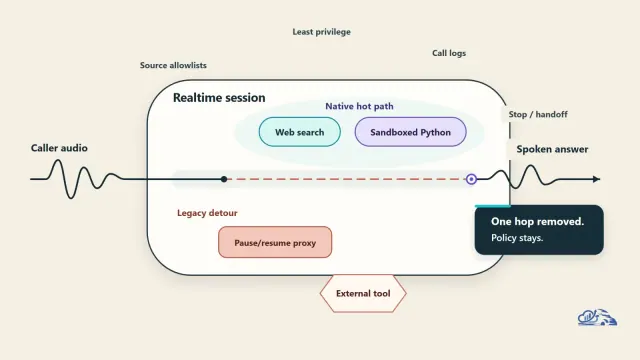
Salesforce Autonomous AI Agents: What Agentforce Changes
Salesforce autonomous AI agents move beyond copilots. Learn how Agentforce SDR and Campaign Agent work, plus the controls revenue teams need to deploy.
Overview
Salesforce autonomous AI agents mark a real shift from prompt-by-prompt assistance to goal-directed action inside human-defined boundaries. Salesforce says Agentforce SDR can engage inbound prospects 24/7, while Marketing Cloud Next extends autonomous action into campaign assembly, performance optimization, and personalization. This is not a single brand-new launch. It is a maturing set of Agentforce capabilities.
For B2B marketing, RevOps, and sales leaders, the buyer problem is no longer whether AI can draft another email. It is whether an agent can replace slow, manual execution without creating bad pipeline, missed follow-ups, unsafe claims, wasted spend, or an audit gap. Vanaxity, Van Data Team's separate AI content agent for SEO, GEO, and AEO, faces the same operating challenge across research, writing, illustration, publishing, and syndication: autonomy needs trusted inputs, explicit permissions, review gates, and measurable outcomes.
This guide separates Salesforce's reported capabilities from Vanaxity's analysis, then gives you a governance artifact you can adapt. Van Data Team makes agentic work operational through data pipelines, workflow automation, reporting, and risk-based review gates. You can see how controlled agent delivery is structured before mapping the same principles to revenue operations.
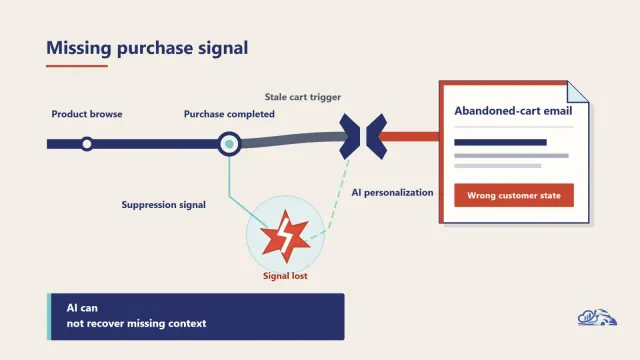
Before autonomy is safe, the data underneath it has to be trustworthy — and that is a data-engineering problem, not just a CRM setting. An Agentforce SDR personalizing outreach, or a Campaign Agent shifting budget, is only as reliable as the CRM, behavioral, and performance data feeding it, so the same disciplines apply: enforce data quality and schema checks on the pipelines that assemble it (whether those are dbt models, Airflow jobs, or streaming ingestion through Kafka), and hold the tables an agent reads to explicit freshness, lineage, and SLA guarantees. A wrong or stale field does not just produce a bad answer; it triggers a bad action — a mistargeted email or a budget move — before anyone reviews it. Watch especially for schema drift and late-arriving or backfilled records, because an agent acts on them immediately rather than waiting for a human to notice.
Key Takeaways
Salesforce's move is meaningful because its agents can pursue defined outcomes and take permitted actions, but people still set the operating envelope.
- Agentforce SDR handles inbound sales-development work around the clock, but approved knowledge, routing, claims, and escalation rules remain human responsibilities.
- Marketing Cloud Next's paid-media capability can pause underperforming ads and recommend targeting and spend improvements; Salesforce does not establish autonomous budget reallocation or live bid-level control.
- Better autonomy shifts work upstream into goal design, data quality, attribution, permissions, observability, and exception handling.
- Brand guidelines guide output, while approval policy determines whether risky external actions may proceed.
- Teams should expand autonomy only after the agent behaves reliably against a trusted business metric.
Map your SEO, GEO and AEO workflow before you build.

Salesforce Is Moving Beyond the Copilot Model
A copilot helps with a requested task, while a bounded agent receives a goal and can take approved actions toward it without waiting for a new prompt at every step.
| Operating model | Starting point | Action rights | Human responsibility |
|---|---|---|---|
| Passive copilot | A user prompt or task | Produces assistance for a person to review or execute | Prompt, inspect, decide, and act |
| Bounded agent | A business goal plus context | Selects and performs permitted actions, then observes results | Define policy, limits, approvals, and stop conditions |
| Agentforce SDR | An eligible inbound prospect and sales-development goal | Nurture, answer, personalize from approved data, handle supported objections, and schedule | Control knowledge, contact eligibility, claims, routing, and escalation |
| Marketing Goals Agent | A marketing goal and approved campaign scope | Create, execute, optimize, and select content, channels, audiences, and timing | Control budget, brand rules, autonomy limits, attribution, and approvals |
The table is Vanaxity's decision-rights framework. The product capabilities are attributed to Salesforce; the operating controls are our recommendations.
Salesforce captures the change in its agentic marketing announcement:
"Instead of managing workflows, marketers manage agents."
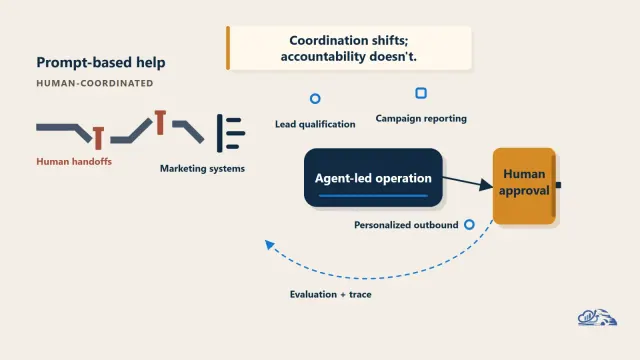
That is a useful headline, but management does not disappear. It moves from repeatedly performing tasks to designing the system that performs them. The same distinction appears in Vanaxity's comparison of agent-led and manual workflows: the valuable automation is not the draft itself, but the controlled loop from goal to action to evidence.
What Salesforce Reports Its Sales and Marketing Agents Can Do
Salesforce reports a bounded sales-and-marketing operating model anchored by its sales-development agent and the Marketing Goals Agent, with each agent acting inside a distinct workflow.
Agentforce SDR is a maturing inbound sales agent
Reported by Salesforce: Salesforce introduced Einstein SDR in 2024 and later renamed it Agentforce SDR. Salesforce now calls the capability Agentforce Lead Nurturing. It nurtures inbound prospects, answers product questions, handles objections, personalizes outreach from approved data, and schedules meetings.
Those capabilities form a connected inbound workflow. They do not mean the agent can make any sales decision, access any data, or operate without oversight. The deployment team still determines what knowledge is approved, which prospects are eligible, what claims are permitted, and when a human must intervene.
Illustrative scenario, not a customer case: Maya, a RevOps manager, permits the sales-development agent to answer from approved product material and schedule meetings under normal routing rules. A prospect then asks for a novel security commitment. The agent logs the request and escalates it instead of improvising. The useful outcome is not maximum automation. It is fast handling of routine work with a clean handoff at the policy boundary.
Campaign Agent brings bounded action into marketing
Those capabilities cover campaign execution and optimization, not unsupported live advertising bid management. Salesforce separately says Marketing Cloud Next's Paid Media Optimization can pause underperforming ads and recommend improvements to targeting and spend; it does not establish unlimited control across ad platforms or fully unsupervised campaign operations.
Salesforce describes brand safety through governance controls and brand guidelines. Vanaxity's recommendation is to treat those as separate controls: guidelines define acceptable expression, while governance defines permissions, approval thresholds, audit requirements, and who can stop the workflow.
What Autonomous Actually Means for Revenue Teams
For revenue teams, autonomy means delegating defined decisions, not surrendering judgment.
Vanaxity analysis: At Van Data Team, we start by writing the operating contract before configuring the agent. The contract names the business goal, accepted success metric, approved data, permitted actions, approval-required actions, blocked actions, stop conditions, escalation owner, and rollback path. If those elements are vague, the agent will optimize inside ambiguity.
The honest limits follow directly from that contract:
- Signal quality: Budget reallocation is only as sound as the event data and attribution behind the selected metric. A fast-moving proxy can reward activity that never becomes accepted pipeline or revenue.
- Brand safety: A tone guide cannot decide whether a novel claim, sensitive audience, legal topic, or difficult-to-reverse action should be published. Those cases need explicit rules and human review.
- Human overhead: "Near-zero overhead" remains aspirational. Less manual execution does not mean hands-off operation. Setup, testing, governance, monitoring, exception handling, and outcome review become the new work.
- Authority drift: New data sources, actions, or channel connections can silently widen the agent's effective scope unless permissions and policies are versioned and reviewed.
Illustrative scenario, not a customer case: Jordan, a demand-generation lead, allows Marketing Goals Agent to optimize channel mix within an approved campaign. The dashboard later shows conflicting conversion signals from the ad platform and CRM. A sound policy pauses further optimization and routes the discrepancy to the metric owner. Without that stop condition, autonomy would amplify the measurement problem.
How to Deploy Salesforce Autonomous AI Agents Safely
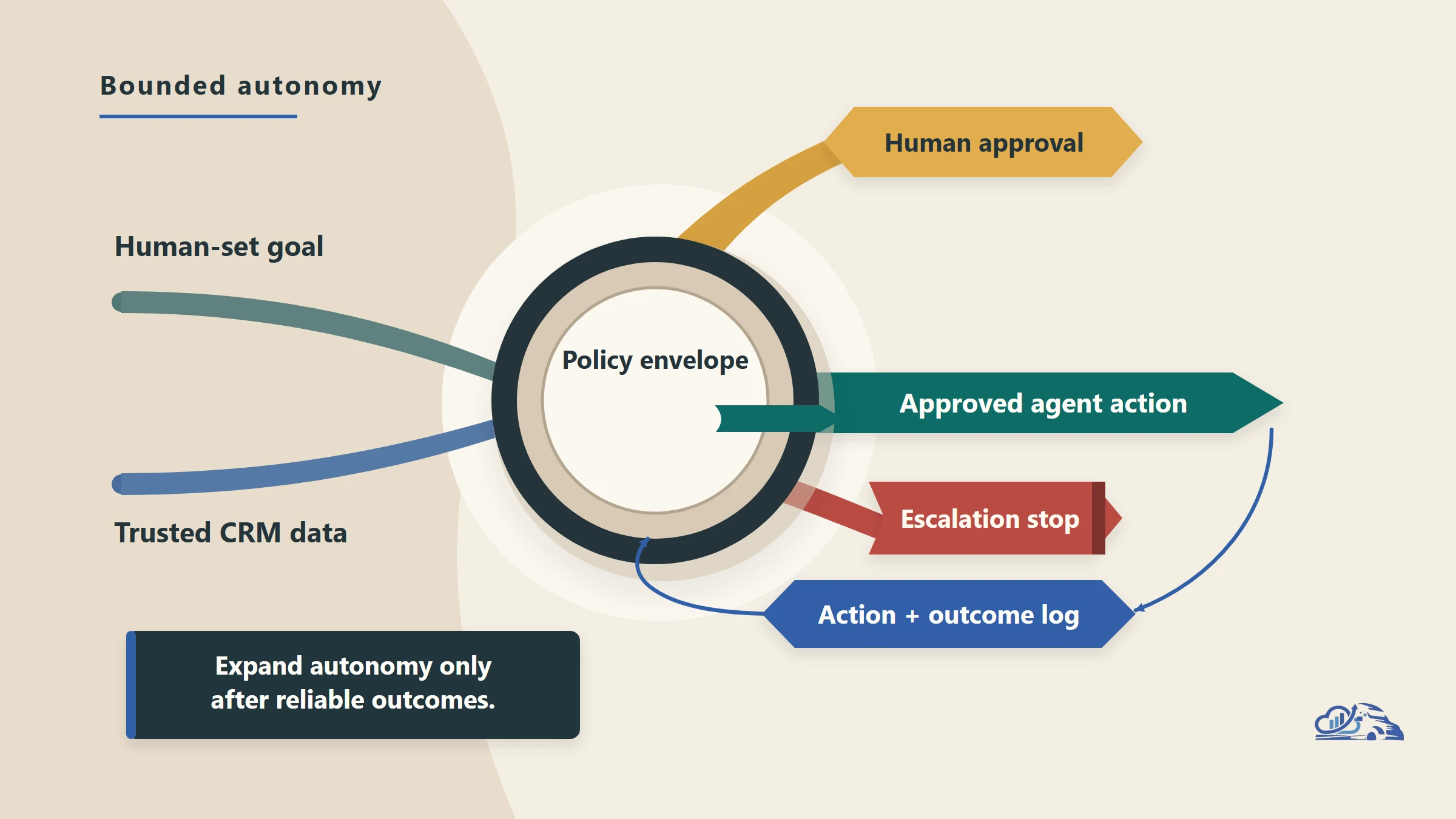
Teams can deploy Salesforce autonomous AI agents safely by pairing a trusted data layer with a policy layer, an action gate, complete logs, and accountable human owners.
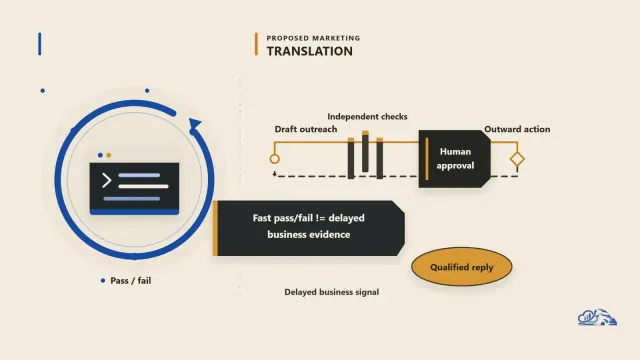
A practical implementation architecture is simple to describe. A business owner defines the goal and metric. Approved CRM, behavioral, and product data provide context. Policy narrows the available actions. An action gate sends sensitive or irreversible decisions for review. Execution writes only to approved systems. Observability records the input context, governing rule, action, approval state, outcome, and any rollback.
Before enabling autonomous action, check the following:
- The goal is specific, owned, and paired with pause conditions.
- Contact identity, account ownership, consent, and eligibility are current.
- Duplicate and stale records cannot trigger conflicting outreach.
- Behavioral events have clear definitions, update timing, and source lineage.
- Product knowledge, objection guidance, and brand rules are approved and versioned.
- The success metric has an owner, calculation method, attribution assumptions, and known failure modes.
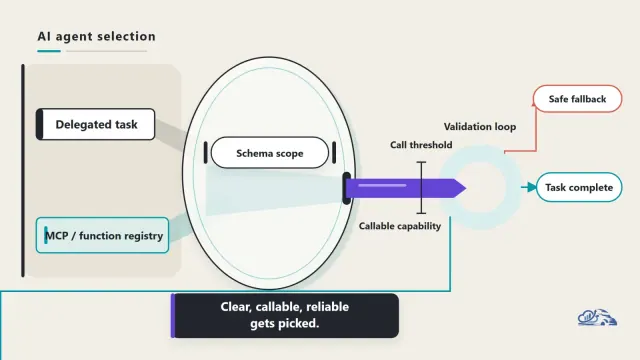
- Agent permissions follow least privilege across data, channels, audiences, and spend.
- Outward-facing, sensitive, novel, or difficult-to-reverse actions have approval gates.
- Every action is auditable, and a named owner can pause and recover the workflow.
For a concrete view of the control loop, see the agent workflow. Then adapt the gates to sales and marketing risk instead of copying a generic automation template.
Implementation Artifact: Agent Action-Rights Matrix
An action-rights matrix turns "use guardrails" into an enforceable operating policy that sales, marketing, RevOps, brand, and legal owners can review together.
Vanaxity analysis: Treat this matrix as a starting point, not a description of Salesforce's default configuration.
| Decision area | Autonomous inside approved scope | Human approval recommended | Block or escalate |
|---|---|---|---|
| Inbound research | Use approved CRM and behavioral data | Introduce an uncertain data source | Identity, consent, or ownership conflict |
| Product response | Answer from approved knowledge | Make a novel, sensitive, or exceptional claim | Use unsupported or contradictory information |
| Objection handling | Apply approved positioning | Depart from the response library | Encounter legal, compliance, or unresolved risk |
| Personalization | Use approved fields and brand rules | Use ambiguous context | Use sensitive data without permission |
| Meeting scheduling | Follow routing and calendar policy | Override territory or ownership | Proceed despite conflicting ownership |
| Campaign creation | Use approved goals, audiences, and brand rules | Introduce new positioning or sensitive creative | Launch without required policy or consent |
| Campaign optimization | Use the accepted success metric | Act when attribution is uncertain | Continue after metric failure or signal conflict |
| Budget allocation | Recommend changes within approved boundaries | Approve or execute a reallocation | Act without spend control or a trusted signal |
| Ad status | Pause an eligible underperformer under approved thresholds | Affect a protected strategic initiative | Act on unclear performance evidence |
| Logging | Record the decision, rule, approval, and result | Amend with reviewer attribution | Allow an unauditable action |
The important column is often the middle one. Mature agent design is not a binary choice between manual work and autonomy. It is a deliberate allocation of decision rights based on consequence, reversibility, evidence quality, and accountability.
Evaluate Outcomes, Control, and Operating Burden
An autonomous revenue agent should be judged on business outcomes and controlled behavior, not on how much activity it produces.
Use an evaluation scorecard that covers:
- Outcome quality: Did accepted meetings, qualified progression, or the chosen campaign outcome improve against the team's current process?
- Control compliance: Did the agent stay within permissions, approvals, budget boundaries, and brand policy?
- Data reliability: How often did missing identity, stale records, or attribution conflicts affect a decision?
- Cost: Track platform consumption, data operations, human review, monitoring, and incident recovery together. Do not assess software cost in isolation.
- Latency: Measure the full path from trigger to permitted action, escalation, and resolution. Fast action with a slow exception queue is not a fast system.
- Token or consumption budget: Where model usage is metered, set a ceiling and compare consumption with successful outcomes instead of raw activity.
- Observability: Confirm that reviewers can reconstruct what the agent knew, which rule it applied, what it changed, and whether the change was reversed.
- Review burden and recovery: Measure approval backlog, repeated false escalations, pause reliability, rollback quality, and time to restore safe operation.
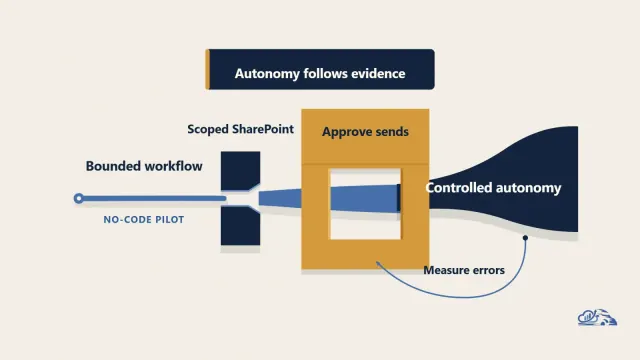
Roll out by risk. Begin in observe-only mode, move to approval-required execution, and grant bounded autonomy only for actions with stable data, clear rules, and reversible consequences. Keep a current-process baseline so claimed gains are measured rather than assumed.
The same production questions apply beyond CRM. Vanaxity's agentic workflow insights examine how evidence, review gates, and distribution controls affect SEO, GEO, and AEO operations.
Frequently asked questions
Is Agentforce SDR the same product formerly called Einstein SDR?
Yes. Salesforce introduced it under Einstein SDR and later said Einstein SDR became Agentforce SDR. Salesforce has since renamed Agentforce SDR to Agentforce Lead Nurturing. Treat it as a maturing capability, not a newly launched product.
How is an Agentforce agent different from a copilot?
A copilot generally responds to a task-level prompt. An agent can pursue a goal, choose among permitted actions, observe results, and continue within policy. The team still owns the goal, permissions, review gates, and stop conditions.
Can Campaign Agent move campaign budget?
The cited Salesforce sources do not establish that Campaign Agent autonomously moves campaign budget. Salesforce says Marketing Goals Agent operates within defined budgets, while Paid Media Optimization can pause underperforming ads and recommend targeting and spend improvements. Teams should require a trusted metric and pause the workflow when attribution becomes unstable.
Does Campaign Agent manage live advertising bids?
Salesforce's announcement does not establish bid-level control or real-time bid management. The supported framing is campaign optimization within goals, budgets, guardrails, and autonomy limits, with separate paid-media capabilities for pausing ads and recommending spend improvements.
Is Agentforce fully unsupervised?
No. The accurate model is bounded autonomy. Governance determines what the agent may do without review, what needs approval, and what must be blocked or escalated.
What data should be cleaned before deployment?
Prioritize identity resolution, duplicates, ownership, consent, contact eligibility, product-knowledge freshness, event definitions, campaign taxonomy, conversion quality, attribution assumptions, update timing, lineage, and access permissions.