Claude Opus 5 on Google Cloud: Adoption Guide
A practical framework for adopting Claude Opus 5 on Google Cloud with data controls, least privilege, safety fallback, observability, and evals in production.
Overview
Claude Opus 5 is now available on Google Cloud's Agent Platform for engineering, platform, and growth teams building production AI agents. Adopting a frontier, long-running agent model without governance—data controls, least privilege, safety fallback, and evaluation—creates security and reliability risk. This guide is an adoption and governance checklist for running Claude Opus 5 agents safely, using the same review-gate discipline Vanaxity applies to its own AI content agents.
Key Takeaways
- Google Cloud now offers Anthropic's most advanced Opus model for long-running agents, coding, and professional work.
- Zero Data Retention (ZDR) limits retention at the covered model-serving layer. Identity and Access Management (IAM) controls who and what can access it.
- Google Cloud's reported security fallback is a defensive routing control, not permission to automate consequential security actions.
- Production multi-agent orchestration still needs bounded tools, durable state, approval gates, stop conditions, tracing, and recovery logic.
- Adopt autonomy in stages. Expand it only when held-out evaluations prove quality, cost, latency, and policy performance.
Engineering, platform, AI-builder, and growth teams adopting Claude Opus 5 for hours-long multi-agent workflows face a concrete problem. Model capability alone doesn’t provide data controls, least-privilege tool access, safety fallback, or evaluations, creating security, compliance, cost, and reliability risk. This guide gives them an adoption and governance checklist for production agents, reflecting the review-gate discipline Van Data Team applies to its own AI content agents.
Claude Opus 5 gives engineering, platform, AI-builder, and growth teams a strong foundation for long-running production agents, but the model isn't the production system. Without data controls, least privilege, safety routing, observability, and evaluations, greater autonomy creates security, compliance, cost, and reliability risk. This guide provides an adoption and governance checklist. Vanaxity applies the same review-gate discipline to autonomous SEO, GEO, and AEO content operations.
Map your SEO, GEO and AEO workflow before you build.

What Google Cloud Shipped With Claude Opus 5
Google Cloud's release makes Anthropic's frontier Opus model a managed option for production agents, not merely a stronger chat endpoint.
Google Cloud lists July 24, 2026 as the model's release date. Its release announcement says the model is available through Gemini Enterprise Agent Platform, while the official model documentation links to Model Garden and calls it Anthropic's most advanced Opus model. The same page lists it as generally available under model ID claude-opus-5.
Why it matters: July 24, 2026 creates a precise change-control boundary between Claude Opus 5 and previous model iterations. Teams can evaluate the generally available claude-opus-5 endpoint as a distinct production candidate instead of carrying forward results associated only with an earlier Opus model. The concrete contrast is operational, not an unsupported speed or cost claim: Google positions Opus 5 for long-running agent workflows, while certain high-risk security workflows may be routed to the more constrained Opus 4.8. The release date therefore marks a new model to qualify, not permission to reuse earlier evaluations or relax existing controls.
Google positions the model for long-running agent workflows. It can plan work, coordinate tools and subagents, preserve context across handoffs, and adapt when a step fails. That makes it relevant to agentic coding, research, operations, and other work where a single prompt is too shallow.
The model card lists a maximum 1,000,000-token input and 128,000-token output. Those limits create room for long traces and large artifacts. They don't remove the need for memory design, compression, or runtime budgets.
The rollout is cross-cloud. Anthropic lists availability through AWS and Microsoft Foundry, while AWS separately confirmed its release on July 24, 2026. The durable decision isn't which logo hosts the model. It is whether the complete deployment meets your operating controls.
Performance Benchmarks
The cited sources don't establish a controlled, like-for-like latency or token-cost result for Claude Opus 5 versus Opus 4.8. A citation-safe comparison must therefore identify the controlled test conditions and leave unsupported results unclaimed.
| Controlled benchmark | Claude Opus 5 | Opus 4.8 | Fixed test conditions |
|---|---|---|---|
| End-to-end latency | No result is established by the cited sources. Measure from receipt of the bounded objective through the accepted outcome. | No result is established by the cited sources. Measure over the identical workflow boundary. | Use the same held-out tasks, region, concurrency, orchestration graph, tools, retries, approval handling, and acceptance rubric. |
| Total token use | Sum input and output tokens across the coordinator, subagents, retries, and fallback calls. No comparative result is established here. | Apply the same accounting across every call in the run. No comparative result is established here. | Hold the initial context, tool responses, memory policy, compression rules, and retry limits constant. |
| Token cost per accepted outcome | Apply the applicable input and output rates to measured run-wide token use. No supported cost figure is supplied here. | Apply the same pricing basis to measured run-wide token use. No supported cost figure is supplied here. | Count only outcomes that pass the same quality, policy, traceability, and human-review gates. |
| Benchmark conclusion | Promote only when the controlled results justify the observed quality, latency, and token cost. | Retain or route work here only when the same controlled evaluation supports that decision or the safety policy requires fallback. | Retain traces, token records, tool calls, approvals, failures, and scoring results for every comparison. |
Until that controlled evaluation is run, the available evidence supports no numerical claim that Claude Opus 5 is faster, slower, cheaper, or more expensive than Opus 4.8 under like-for-like conditions.
The Adoption and Governance Control Matrix
A production agent is ready only when each model call sits inside explicit data, identity, action, safety, and evaluation controls.
The reported release ends here; Van Data Team's analysis starts with the matrix below. This is the same operating logic Vanaxity uses for its research, writing, illustration, publishing, and syndication workflow. Van Data Team makes it operational through scoped data pipelines, agent workflows, review gates, and runtime dashboards.
A free readiness scan can turn the matrix into a data-flow map, permission inventory, evaluation plan, and staged delivery scope for your environment.
| Control area | Minimum production gate | Evidence to retain |
|---|---|---|
| Data control | Confirm ZDR compatibility and approve retention across models, logs, retrieval, tools, and outputs. | Data-flow map, configuration review, and approved terms |
| Identity | Give each workflow class a dedicated service identity with least-privilege IAM. | IAM policy snapshot and access review |
| Tool access | Separate read from write access and deny unneeded actions by default. | Tool registry, scopes, and destination allowlist |
| Safety fallback | Verify refusal and routing behavior with an approved defensive test set. | Fallback policy, test report, and named owner |
| Human approval | Gate publishing, deployment, external communication, and irreversible changes. | Approval policy and decision log |
| Stop conditions | Limit loops, retries, runtime, spend, and policy events. | Runtime policy and tested kill switch |
| Observability | Trace model calls, tool calls, handoffs, state changes, failures, and approvals. | Reconstructable end-to-end trace |
| Evaluation | Test held-out work and failure cases against predeclared acceptance gates. | Versioned evaluation set and results |
| Operations | Budget cost, latency, and tokens per accepted outcome. | Dashboard, alerts, and incident ownership |
Treat a missing row as a deployment blocker, not a backlog item. Model access is an input to production readiness. It isn't evidence of production readiness.
Long-Running Multi-Agent Orchestration Needs a Control Plane
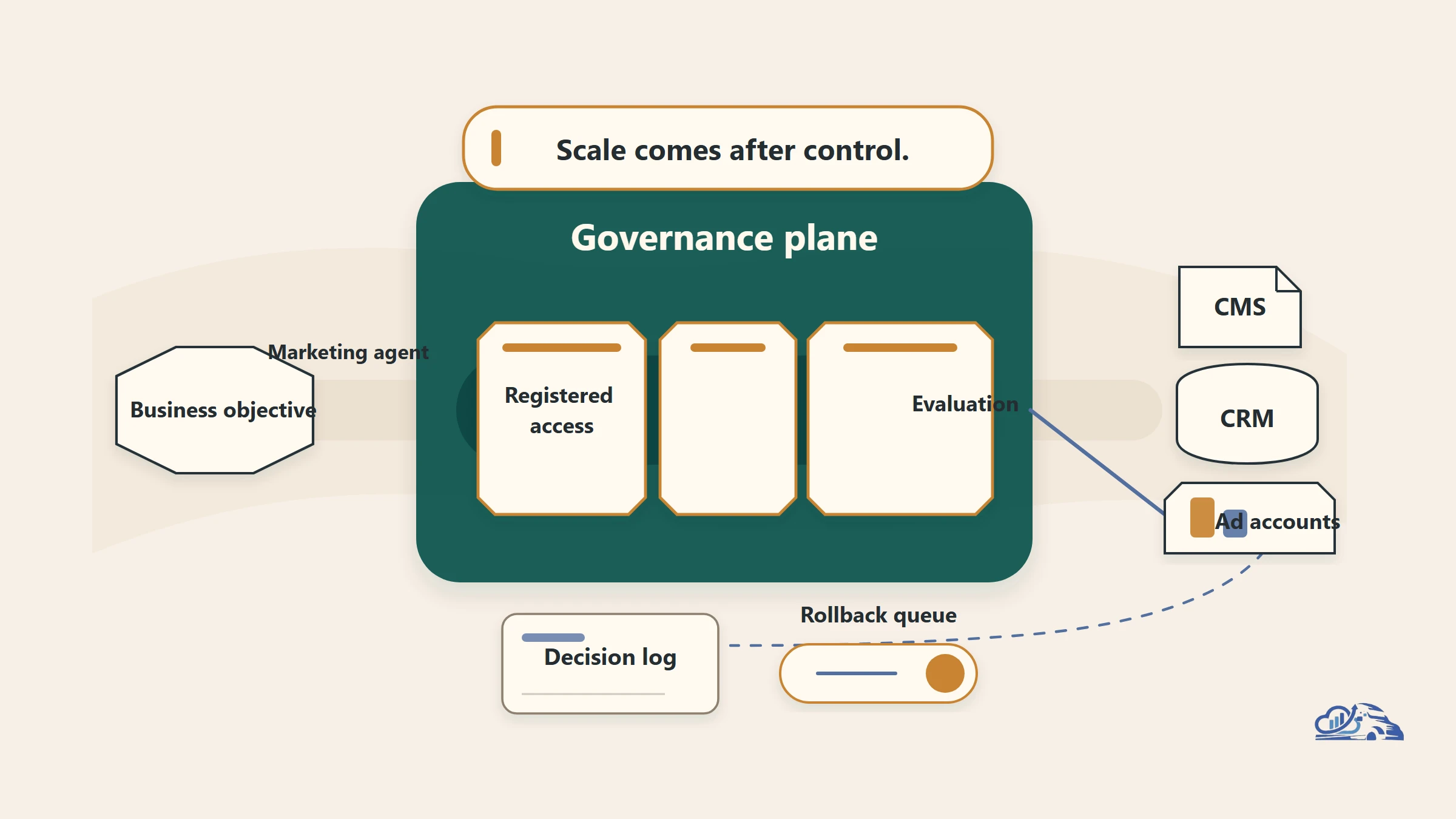
The following illustration summarizes the governed agent control plane:
Figure 1. Claude Opus 5 can coordinate long-running work, while the surrounding control plane limits data access, tools, permissions, and consequential actions.
Long-running multi-agent work succeeds when the orchestration layer controls plans, state, permissions, recovery, and review while the model handles reasoning.
A practical architecture starts at a policy gateway. A coordinator receives a bounded objective and delegates narrow jobs. Subagents use only approved tools. A state store records artifacts, decisions, and handoffs. Every consequential action passes through a policy check, while tracing records what happened.
The core components are straightforward:
- A coordinator owns the plan, delegates work, and decides when to escalate.
- Specialist subagents receive narrow roles, inputs, tools, and completion criteria.
- Durable state preserves facts and artifacts across model calls without trusting conversation history alone.
- Recovery logic handles missing tools, stale context, permission denials, and incomplete work.
- Stop conditions halt loops, repeated failures, excessive spend, or policy events.
- Human checkpoints protect deployments, publishing, messages, payments, and other consequential actions.
Example: LangGraph state definition
The following illustrative state makes the plan, artifacts, approval status, retries, token budget, policy events, and stop path explicit:
`python from typing import Literal, TypedDict
class AgentState(TypedDict): objective: str plan: list[str] artifacts: list[str] approval_status: Literal["pending", "approved", "rejected"] retry_count: int token_budget_remaining: int policy_events: list[str] next_step: Literal["delegate", "review", "stop"] `
A graph node can read this state, propose a bounded action, and return an update. External policy code should still enforce approvals, budgets, permissions, and stop conditions; declaring fields doesn't create those controls by itself.
Opus can fit several roles. It may coordinate a complex run, solve a demanding specialist task, or handle escalation after a smaller model fails. The orchestration layer should still own identity, policy, retries, and logs.
LangGraph and LangChain can structure stateful flows and tool calls. CrewAI can organize role-based agents. Native function calling may be enough for a narrow workflow. MCP can expose approved tools and context through consistent interfaces. A Plan-and-Execute design separates planning from bounded execution. None is universally best.
Use the frontier model where held-out tasks show a meaningful outcome advantage. Route simpler work to a faster or less costly approved model when results are equivalent. A model swap must never bypass tool policies, approval gates, logging, or stop conditions.
Enterprise Governance Starts With Data Boundaries
Enterprise AI governance begins by controlling what data enters the agent, where it moves, who can access it, and what the workflow may change.
Zero Data Retention means covered request data isn't retained by the model-serving layer under the applicable configuration and terms. Identity and Access Management maps people and service identities to allowed resources and actions.
Google Cloud's release announcement says the model is ZDR-compatible. Teams should confirm where covered data is processed, use IAM to control access, and verify the applicable model-training terms before treating those controls as suitable for sensitive or regulated workloads that couldn't pass a data review through a consumer interface.
They aren't a blanket compliance certificate. ZDR at the endpoint doesn't automatically govern application logs, tracing sinks, retrieval stores, browser sessions, connected tools, or exported files. Review every system that can copy, cache, transform, or forward data.
At Van Data Team, we start with data and identity maps before prompt tuning. Give each workflow a dedicated service identity. Separate read and write roles. Allowlist external destinations. Use short-lived credentials where supported. Review access after tool, model, and team changes. Never let an agent inherit a broad human account for convenience.
The real enterprise unlock isn't autonomy alone. It is autonomy inside a provable boundary.
Treat Security Fallback as Routing, Not Permission
The automated security fallback is a defensive governance control that constrains some high-risk automated work; it is not authorization to attack systems.
Google Cloud reports that certain high-risk security workflows, such as penetration testing or exploit generation, may notify the operator and route execution to the more constrained Opus 4.8.
Google Cloud says the model "will notify you and fall back to Opus 4.8."
This builds on Anthropic's refusal and fallback mechanism. A safety classifier can decline a request, after which a configured fallback may transparently re-serve it through another model. Surface details vary by platform and may change.
Treat routing as one layer in a defensive control stack. Require human approval before consequential security actions. Log classifier, refusal, notification, and routing events. Define stop conditions and an escalation owner. Test only with approved defensive cases. Before deployment, verify the exact scope and current behavior in Google Cloud and Anthropic documentation.
A fallback can reduce risk. It cannot decide whether the workflow was authorized, whether the target was in scope, or whether an action should proceed.
Evaluate the Whole Run Before Trusting Autonomy
A long-running agent earns production trust through held-out task results and complete traces, not fluent demos.
Build an evaluation set that wasn't used during prompt development. Include normal work, ambiguous requests, missing context, stale data, unavailable tools, permission denials, tool failures, and situations that require escalation. Score the final outcome and the path used to reach it.
Measure what operators actually carry:
- Accepted outcomes, not polished prose alone.
- Human correction time and review burden.
- Cost per accepted outcome across every model and tool call.
- End-to-end latency, including queues, retries, and approvals.
- Token budget across the coordinator and all subagents.
- Tool errors, retry patterns, and failure recovery.
- Policy violations, refusals, and stop-condition triggers.
- Observability, including complete traces for decisions, state, and actions.
Set acceptance thresholds before examining results. Otherwise, teams tend to explain away failures after seeing an impressive answer.
Run the same tasks across approved models and orchestration patterns. Keep tools, permissions, data, and scoring rules constant. This isolates the model's contribution from workflow changes. Promote Opus to coordinator or specialist only where its outcome advantage justifies the cost, latency, and token use.
A model-quality win doesn't qualify if traceability, policy compliance, or recovery fails. Likewise, a cheaper run isn't a win if human correction erases the savings. The unit of evaluation is the completed, governed workflow.
Start With Bounded Work, Then Expand Evidence
The safest adoption path expands task scope and permissions only after the prior stage passes its evaluation and governance gates.
Use this sequence:
- Begin with bounded, reversible, read-oriented work.
- Keep publishing, deployment, outbound communication, and irreversible actions behind human approval.
- Run held-out evaluations and inspect complete traces.
- Add narrow write access only after quality and control gates pass.
- Expand task scope before expanding permission scope.
- Re-evaluate after any model, prompt, tool, policy, or orchestration change.
Hypothetical engineering workflow
An engineering team can use Opus as a coordinator for repository inventory, change-plan drafting, test planning, and documentation updates. Specialist agents may read code and test results, but they can't merge, deploy, or rotate secrets. If a tool returns stale state, the run stops and asks an operator to resolve it. Existing code review and deployment controls remain authoritative.
Hypothetical growth workflow
A growth team can use an agent to research a topic, build a brief, draft content, create illustrations, and prepare channel assets. Vanaxity applies that flow across search engine optimization, generative engine optimization, and answer engine optimization.
It prepares content for Google rankings, AI Overviews, LLM citations in ChatGPT and Gemini, featured snippets, structured-data inputs, and multichannel distribution. Blue-link-only visibility is dead. Publishing and outbound messages stay locked until evidence, brand, compliance, and editorial gates pass. The model can prepare the work; the workflow decides whether it ships.
For a concrete starting point, request a free adoption audit from the team behind Vanaxity. You receive a scoped workflow review, data and tool map, governance gaps, evaluation design, risk-review workflow, dashboard requirements, and phased implementation scope.
Failure modes to block before launch
- Treating model access as readiness. Require evidence for the whole workflow.
- Giving the coordinator broad human credentials. Use dedicated service identities.
- Assuming ZDR covers every connected system. Map each retention path.
- Testing first on live customer work. Use held-out, reversible tasks.
- Scoring quality without cost, latency, token use, or trace completeness.
- Allowing open-ended retries. Set runtime, spend, and policy stops.
- Treating fallback as the only security control. Keep approval and oversight.
- Expanding permissions before evaluations pass. Increase autonomy through gates.
- Publishing unsupported benchmark, pricing, capacity, or customer claims. Keep an evidence ledger.
How Van Data Team Makes This Operational
At Van Data Team, we treat Claude Opus 5 as an operating workflow, not a theory section or simple model swap. We start by mapping the current handoff from request to outcome. That map covers source systems, coordinator and subagent roles, tool permissions, decisions, review gates, dashboards, failure states, and recovery paths.
We then trace one real task through the proposed agent workflow. For a growth operation, that might span research, drafting, compliance review, publishing approval, and performance reporting. Each consequential action receives a named owner, an approval rule, a stop condition, and an evidence record. Automation stays behind human review until held-out evaluations show reliable results within agreed cost, latency, and token budgets.
The output is a scoped delivery plan, not a generic architecture diagram. It identifies which runtime and business signals to collect, which workflow gaps to close, and which actions require human approval. It also specifies the dashboard or runbook operators will use when quality drops, a tool fails, or a policy event occurs. Teams can then expand autonomy from bounded, reversible work based on evidence rather than model reputation.
Frequently asked questions
What is Claude Opus 5 on Google Cloud's Agent Platform?
It is Anthropic's most advanced Opus model delivered through Google's managed agent platform and Model Garden. Google positions it for long-running agents, coding, and professional work. Teams can use it as a coordinator, specialist, or escalation model inside a governed orchestration layer.
Does Claude Opus 5 on Agent Platform train on my data?
Google Cloud's release announcement says the model is ZDR-compatible, but ZDR and model-training terms are distinct. Teams should verify whether customer data is used to train models under their applicable configuration and terms, then review IAM, logs, retrieval stores, tools, and output destinations.
What does Zero Data Retention mean for an AI agent?
ZDR means covered data isn't retained at the model-serving layer under the applicable terms and configuration. It reduces a major data-governance barrier, but it doesn't certify the whole application. Connected tools, trace storage, caches, vector databases, and exported outputs need separate retention controls.
How does the Opus security fallback work?
Google Cloud says certain high-risk automated security requests may trigger a notice and route to Opus 4.8. Treat this as defensive safety routing. Keep human approval and stop conditions for consequential actions, then verify the current fallback scope in official vendor documentation before release.
Which orchestration frameworks can teams use?
Teams can place the model behind LangGraph, LangChain, CrewAI, native function calling, MCP, or a Plan-and-Execute pattern. Choose based on state control, permission enforcement, tracing, recovery, and testability. The framework should own governance even when the model owns planning.
How should teams evaluate a long-running agent?
Run held-out tasks that cover normal work and realistic failure modes. Track accepted outcomes, human correction, cost per outcome, end-to-end latency, token budget, tool errors, policy events, stop triggers, and trace completeness. Expand autonomy only after the workflow passes predeclared gates.