Salesforce Agentforce Commerce: The GEO Playbook for AI Shopping
Salesforce brings catalog selling to ChatGPT now. See what is live, what comes next, and how to make ecommerce product data answer-ready for AI shopping.
Overview
Salesforce Agentforce Commerce now lets retailers connect product catalogs directly to ChatGPT, while Google Search, including AI Mode, and the Gemini app remain scheduled for later this summer, according to Salesforce's June 24, 2026 release announcement. Three commerce agents reached general availability, and ChatGPT catalog selling is GA in July 2026.
The operator problem is bigger than distribution. A synchronized catalog is not automatically accurate, citable, or recommendable. Vanaxity, Van Data Team's content agent, approaches that gap across SEO, GEO, and AEO: create structured content, validate claims, publish it across channels, and monitor how search and answer engines represent it.
At Van Data Team, we start by mapping product sources, field ownership, and review gates. We then make automated SEO, GEO, and AEO operational through data pipelines, agent workflows, structured content, reporting, and failure recovery. This guide gives ecommerce teams the same practical framework.
Want to see how research, validation, content production, and review fit together? See the agent in action.
Key Takeaways
The release is arriving in defined stages, and catalog readiness should follow the same discipline.
- Shopper Agent, Buyer Agent, and Merchant Agent are generally available.
- ChatGPT catalog selling is GA in July 2026; Google Search, AI Mode, and Gemini are coming later this summer.
- Agentic Commerce Search uses inferred intent and is designed for Salesforce and non-Salesforce storefronts.
- Direct catalog synchronization removes middleware, not the need for product-data governance.
- Brands should test recommendation accuracy, evidence quality, and variant availability before treating AI visibility as a win.
Map your SEO, GEO and AEO workflow before you build.

What Salesforce Agentforce Commerce Released
Salesforce's release combines generally available commerce agents, intent-based product discovery, and a direct path into external AI shopping channels.
| Capability or channel | Salesforce-reported status | What operators should understand |
|---|---|---|
| Shopper Agent | Generally available | One of the commerce agents included in the release |
| Buyer Agent | Generally available | The generally available agent aimed at buyer workflows |
| Merchant Agent | Generally available | The generally available agent aimed at merchant workflows |
| Agentic Commerce Search | Targets GA in July 2026 | Uses inferred shopper intent and supports Salesforce and non-Salesforce storefronts |
| ChatGPT integration | GA in July 2026 | Catalogs sync from Business Manager without third-party middleware |
| Google Search, including AI Mode | Coming later this summer | Prepare data and tests now, but do not describe the integration as GA |
| Gemini app | Coming later this summer | Remains on the preparation track until Salesforce confirms availability |
Agentic Commerce Search goes beyond keyword matching
Salesforce says Agentic Commerce Search comes from its Cimulate acquisition, targets GA in July 2026, and surfaces products from inferred shopper intent. It is also designed to run on non-Salesforce storefronts as well as Salesforce-hosted properties.
That specification matters because a shopper may express a problem, compatibility constraint, or desired outcome without using the retailer's preferred product name. It does not mean every search system has abandoned keywords. It means product attributes and supporting content must explain why an item fits a need.
ChatGPT is live before Google and Gemini
Retailers can synchronize their catalogs from Business Manager to ChatGPT without extra software or third-party middleware. Google Search, including AI Mode, and the Gemini app are due later this summer. They should not be presented as available now.
Salesforce captures the underlying data problem clearly in its Agentforce Commerce announcement:
An agent that can't see your inventory can't promise a delivery date.
Technical availability therefore answers only whether a catalog can reach a channel. It does not prove that the correct product will appear, that the right variant will be available, or that an assistant's explanation will match approved evidence.
Why AI-Native Buying Changes Product Discovery
AI-native buying moves product consideration into assistants and agents, where a brand may be evaluated before the shopper visits its storefront.
The following is Vanaxity's analysis, not a claim about the internal ranking systems used by Salesforce, OpenAI, or Google. Different surfaces can retrieve, summarize, and recommend products differently. The practical response is to improve the evidence every surface can access.
| Discovery pattern | Typical customer behavior | Brand control | Operational priority |
|---|---|---|---|
| Conventional search | Uses categories, product names, and keyword queries | Strong control over owned pages | Indexable pages, titles, categories, internal links, and on-page relevance |
| Intent-based storefront search | Describes a use case, constraint, or desired outcome | Strong control over catalog and storefront data | Normalized attributes, compatibility fields, and relevance testing |
| Third-party AI assistant | Asks for a recommendation inside an external interface | Limited control over presentation | Feed accuracy, evidence-backed claims, entity consistency, and answer testing |
Classic SEO ranks pages. GEO and AEO also ask whether a product can be selected, summarized, cited, and recommended correctly. Those are related outcomes, but they are not interchangeable.
A brand can rank well for a category term while remaining difficult for an agent to evaluate. The product page may omit compatibility details, bury important attributes in prose, or contradict the commerce feed. An assistant cannot reliably resolve ambiguity that the source systems have failed to resolve.
Hypothetical DTC scenario
A shopper asks for a travel rain shell suitable for hot, humid weather. A keyword-heavy description might repeatedly mention "waterproof jacket" but say nothing structured about breathability, climate suitability, sizing, or current color availability.
An answer-ready record connects the need to documented attributes and approved explanatory content. If the product is unsuitable for that climate, the correct outcome is exclusion, not a forced recommendation.
Hypothetical B2B scenario
A procurement manager describes a compatibility requirement instead of naming a part. The supplier's catalog contains the correct component, but its compatibility data lives only in a PDF while the product feed uses an outdated model name.
The fix is not another paragraph of optimized copy. The team must normalize the component entity, expose the approved compatibility field, align the supporting document, and test whether need-based queries return the correct item.
Intent-based discovery is additive to keyword SEO. Brands still need clear product names, categories, indexable information, and internal linking. They also need machine-readable evidence for the questions buyers ask when they do not know the product name.
How to Make a Product Catalog Answer-Ready
An answer-ready catalog gives agents enough current, consistent, and verifiable evidence to match products to customer needs without inventing details.
This is a Vanaxity operating recommendation. Salesforce's release creates new distribution and discovery capabilities; it does not guarantee that a retailer's source data is complete or that every external assistant will recommend a product.
Establish a governed source of truth
The mistake we see is treating the product description as the source of truth. Descriptions are outputs. The authoritative record should sit upstream and define:
- Canonical product and variant identifiers
- Brand, manufacturer, and category names
- Parent, variant, bundle, and accessory relationships
- Technical specifications and compatibility
- Availability and offer information
- Approved claims and supporting evidence
- Canonical product URLs and documentation references
- Ownership and approval status for critical fields
Each field needs an owner. Merchandising may own product naming, operations may own availability, and a technical team may own compatibility. What matters is that conflicts have an explicit resolution path.
Keep every product representation consistent
Compare the authoritative catalog with the commerce feed, product page, structured product data, support documentation, reviews, and Q&A. A critical conflict should block distribution until the correct value is established.
Common conflicts include a product page showing an available variant while the feed marks it unavailable, different measurements across documents, duplicate product entities, or a generated description adding an unsupported specification.
Entity consistency is equally important. A manufacturer, product family, model, and variant should use stable names across channels. Otherwise, an answer engine may merge separate products or split one product into inconsistent representations.
Build content around buying decisions
Answer-ready content should explain more than what a product is. It should cover:
- Who the product is designed for
- Which problem or use case it addresses
- Relevant constraints and compatibility requirements
- Differences between variants or packages
- Evidence behind performance and quality claims
- Common pre-purchase questions
- Conditions where the product is not a suitable choice
Reviews and Q&A can expose customer language, objections, and real usage context. Treat them as useful evidence inputs, not guaranteed ranking or recommendation factors.
Generated content must stay inside approved facts. Unsupported superlatives, inferred specifications, and fabricated comparisons create recommendation risk. Technical, regulated, safety-sensitive, or contractual claims should pass through the appropriate human review gate.
The Operational Catalog Readiness Workflow
A safe rollout treats AI commerce as a governed data and evaluation pipeline, not a one-time channel switch.
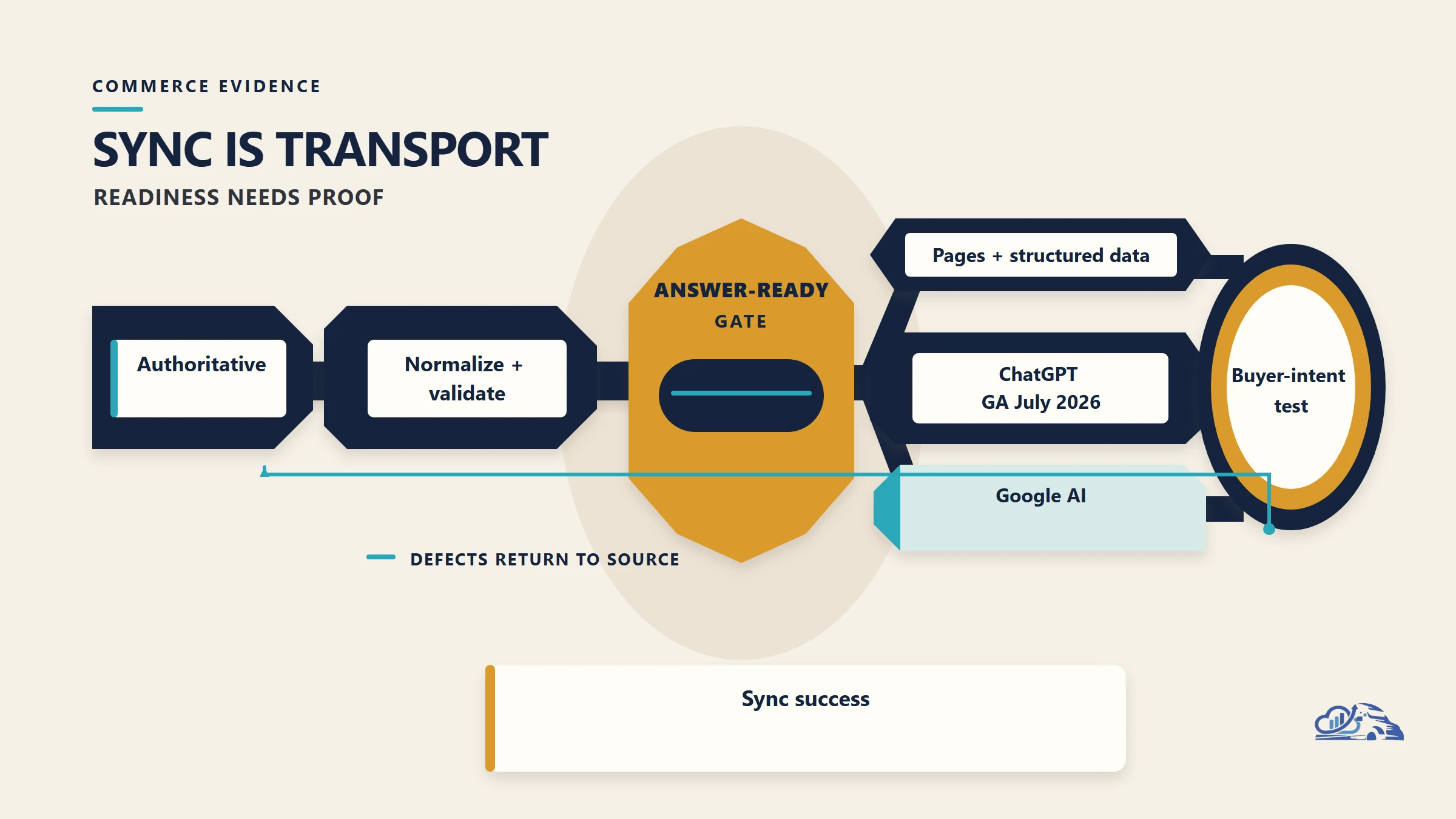
The implementation architecture is straightforward: authoritative product systems feed a normalization layer; validated data flows into pages, structured data, and channel feeds; a test harness evaluates representative intents; monitoring sends defects back to the responsible source owner.
Apply a release gate before distribution
Use this runbook before synchronizing a product record:
- Inventory every catalog, feed, page template, documentation source, and structured-data output.
- Assign an authoritative owner to each critical field.
- Detect missing, duplicated, contradictory, or stale values.
- Normalize product entities, categories, attributes, and variant relationships.
- Align customer-facing pages with catalog and feed data.
- Trace every factual claim to an approved record or document.
- Validate product and variant availability.
- Block records whose critical fields remain in conflict.
- Test realistic shopper and buyer intents.
- Correct defects at the source, then repeat the affected tests.
The release rule should be simple: no critical product record moves downstream while the catalog, page, feed, or structured data disagrees about identity, compatibility, specification, or availability.
Test the ChatGPT integration as a recommendation system
Technical synchronization is only the beginning. Confirm that the intended Business Manager catalog is selected and that identifiers, variants, attributes, and availability survive the channel handoff.
Build queries from real customer needs rather than product-name searches alone. For every test, record the requested intent, surfaced product, selected variant, supporting evidence, detected defect, correction owner, and retest status.
| Test record field | What to capture |
|---|---|
| Shopper or buyer intent | The natural-language need, constraint, or compatibility request |
| Expected evidence | Approved attributes, documentation, or availability data |
| Surfaced product | Product and variant returned by the channel |
| Match assessment | Correct, questionable, unsupported, or unavailable |
| Explanation assessment | Whether the answer stays within approved evidence |
| Corrective action | Source field, page, feed, or documentation change required |
| Retest status | Whether the corrected record now produces an acceptable result |
Do not infer guaranteed placement, recommendation frequency, or commercial performance from successful synchronization. Google Search, AI Mode, and Gemini testing should remain in a preparation track until their integrations become available.
A Vanaxity automated readiness review can turn this into a concrete delivery package: a source-of-truth map, catalog conflict report, representative intent set, claim-review workflow, measurement plan, and implementation scope.
How to Measure Quality and Recover From Failures
AI commerce should be measured by recommendation quality and correction speed, not traffic alone.
Recommended operational measures include synchronization errors, rejected records, product-match accuracy, variant accuracy, availability mismatches, unsupported claims, citation accuracy when citations appear, referral traffic when exposed, and assisted outcomes when attribution is available.
Production decisions also require broader controls:
- Cost: Track feed operations, model usage, testing effort, and human review burden.
- Latency: Measure how quickly catalog, availability, and policy changes reach each surface.
- Token budget: Keep supporting evidence concise, canonical, and retrievable instead of duplicating long descriptions.
- Observability: Log test intent, product output, variant, evidence, defect class, owner, and resolution.
- Evaluation: Maintain representative DTC and B2B query sets, including negative and exclusion cases.
- Review burden: Route only ambiguous, sensitive, or high-risk claims to specialist reviewers.
- Failure recovery: Fix the authoritative source and reprocess every downstream representation affected by the defect.
Static SEO audits are not enough when availability and catalog evidence keep changing. The operational difference between Vanaxity and manual SEO is continuous research, validation, review, publishing, monitoring, and correction.
Watch for predictable failures: treating catalog sync as a recommendation guarantee, abandoning keyword SEO, hiding critical attributes in prose, confusing parent and variant availability, allowing duplicate entities, publishing generated specifications without evidence, or counting visibility without checking accuracy.
A recommendation that cannot be traced to current product evidence is a QA failure, even when it gives the brand exposure.
How Van Data Team Makes This Operational
Salesforce reports that Salesforce Agentforce Commerce now has three GA agents: Shopper Agent, Buyer Agent, and Merchant Agent. ChatGPT catalog selling becomes GA in July 2026 through Business Manager without third-party middleware. Google Search, including AI Mode, and Gemini are coming later this summer, not live today. Salesforce also says its Cimulate-derived Agentic Commerce Search targets July GA, uses inferred intent, and supports Salesforce and non-Salesforce storefronts.
For Van Data Team, this turns GEO/AEO into an operating workflow. We map the handoff from product and inventory systems through feed generation, approval, channel delivery, monitoring, and recovery. We document field ownership, workflow decisions, and where humans must review claims, substitutions, availability, or exceptions.
The resulting delivery plan covers:
- Signals: catalog freshness, rejected records, missing attributes, recommendation accuracy, and unsupported responses.
- Readiness: stable identifiers, complete variant and compatibility data, accurate specifications and availability, review and Q&A evidence, and consistent entities.
- Controls: validation rules, evidence requirements, human review gates, retry paths, and escalation owners.
- Action: a dashboard and runbook showing what failed, why it matters, and what happens next.
That is how brands become answer-ready on AI surfaces they do not own: by making recommendations traceable to current, approved product evidence.
Frequently asked questions
What is Salesforce Agentforce Commerce?
It is Salesforce's commerce offering for agent-supported shopping, buying, merchandising, discovery, and external AI channels. The current release includes generally available agents, Agentic Commerce Search, and staged integrations with AI shopping surfaces.
Which Agentforce Commerce agents are generally available?
Shopper Agent, Buyer Agent, and Merchant Agent reached general availability. Teams should evaluate each against its intended workflow rather than assuming that availability removes implementation or governance work.
Is the Salesforce ChatGPT commerce integration generally available?
Yes. Salesforce reports that the ChatGPT integration is generally available in July 2026. Retailers can synchronize their catalog directly from Business Manager.
Are Google AI Mode and Gemini integrations live now?
No. Salesforce describes Google Search, including AI Mode, and the Gemini app as coming later this summer. They should remain in planning and data-preparation workflows until availability is officially confirmed.
What is Agentic Commerce Search?
Agentic Commerce Search is the intent-based discovery capability created from Salesforce's Cimulate acquisition. It is designed to infer what a shopper wants beyond literal keyword matching.
Does Agentic Commerce Search work on non-Salesforce storefronts?
Salesforce says it is designed to run on non-Salesforce storefronts as well as Salesforce-hosted sites. That expands its potential implementation scope without proving that every external search or recommendation surface behaves the same way.