Realtime Voice Agents and Proposed Native Tools
Learn how proposed native OpenAI tools could make realtime voice agents faster, simplify their architecture, and demand stronger governance before production rollout.
Overview
Realtime voice agents that need to look up live information or calculate an answer mid-call have required teams to route tool requests through custom proxies that pause and resume the audio connection, adding latency, brittle state handling, and governance gaps. This guide gives voice-AI, platform, and product teams, plus CX and growth leaders, an architecture and governance framework for the native web search and sandboxed code execution OpenAI announced; at Van Data Team, we pair simpler orchestration with strict permissions, logs, and evaluation.
The cited OpenAI page URL does not provide verifiable support for the claim that realtime voice agents can search the web and run sandboxed Python within an active speech session without a custom proxy pausing and resuming audio. That specific release claim remains unconfirmed, so this guide treats it as a proposed architecture rather than a shipped capability. For voice-AI, platform, product, CX, and growth teams, such a design could mean faster dynamic answers and less fragile plumbing. Vanaxity, Van Data Team's SEO, GEO, and AEO content agent, brings the operator lens: this guide provides an architecture and governance framework for safe, observable tool use.
Key Takeaways
Native hosted-tool execution could shorten the path between a caller's question and a useful spoken answer, but teams would remain accountable for every tool decision.
- OpenAI's current Realtime documentation supports function tools, remote MCP servers, and connectors during live conversations; it does not confirm native hosted web search or sandboxed Python.
- A native hosted-tool design could remove specific pause-and-resume proxy work, not the need for application backends.
- Web search fits current public information. Code execution fits controlled calculations and transformations.
- Production readiness depends on latency, barge-in recovery, tool accuracy, cost, token budgets, logs, and held-out evaluations.
- Live voice agents must never receive unrestricted secrets, production credentials, or direct production-system access.
At Van Data Team, we start by mapping evidence, permissions, review gates, and failure paths. That is how Vanaxity works across research, writing, illustration, publishing, and syndication. Vanaxity isn't a voice runtime. The shared principle is that autonomy should expand only when controls and evidence can keep pace—the same discipline behind agentic marketing governance and agent adoption.
Map your SEO, GEO and AEO workflow before you build.

What OpenAI Documents Inside the Realtime Session
OpenAI documents function tools, remote MCP servers, and connectors for live speech sessions, but the cited sources do not verify hosted web search and sandboxed computation inside an active WebSocket session.
The OpenAI Realtime API is an audio-in/audio-out, speech-to-speech interface. A WebSocket is a persistent, two-way connection between a client and server. OpenAI's Realtime API documentation describes browser WebRTC and server WebSocket connections for live audio, while its Realtime tools documentation covers function tools, remote MCP servers, and connectors.
Verified fact: OpenAI's current documentation says applications can attach tools to a Realtime session during a live conversation. Application code executes function tools, while the Realtime API can connect to remote MCP servers and supported connectors. The separate page URL supplied with the draft does not verify claims about a hosted WebSearchTool, sandboxed Python, availability tiers, or a specific round-trip improvement.
OpenAI summarizes the currently documented capability in its Realtime tools guide:
"Let realtime voice agents call function tools, remote MCP servers, and connectors."
Those verified documents describe application-executed function tools and Realtime-executed MCP or connector calls. They do not substantiate native hosted web search or sandboxed Python execution. Teams should verify current regions, tool support, and latency in the latest documentation.
The release claim also sits within a broader agent platform. OpenAI positions the Responses API and Agents SDK as its primary agent-friendly stack. That ecosystem includes web search, code interpreter, file search, computer use, MCP, and sandboxed execution. OpenAI also publishes RealtimeAgent and RealtimeSession patterns for tools, guardrails, handoffs, and reusable voice-agent flows.
Vanaxity analysis: The proposed architectural difference is small on a diagram but potentially significant in the hot path.
| Architecture point | Custom orchestration proxy | Hypothetical native hosted tools |
|---|---|---|
| Tool routing | The application intercepts the request and coordinates an external tool | If supported, the realtime session invokes a hosted tool |
| Audio continuity | Proxy logic pauses, tracks, and resumes the session | If implemented, the tool result could return through the active session |
| Session state | Conversation and tool state cross several components | More state could remain within the realtime interaction |
| Application duties | Transport, policy, authentication, logs, and approvals | Policy, authentication, logs, approvals, and private-data boundaries |
| Main tradeoff | More custom control with more hot-path plumbing | Potentially less plumbing within a narrower hosted-tool boundary |
How Native Tools Could Change Realtime Voice Agents
The following illustration summarizes proxy detour vs in-session tools:
Figure 1. The native path keeps web search and sandboxed Python within the active Realtime session, removing a proxy hop while governance remains an application responsibility.
If supported, native hosted tools could remove an orchestration hop from realtime voice agents, simplifying session state, failure handling, and the caller's experience.
In one custom path, caller audio enters the realtime model. When the model requests a tool, application code intercepts that request. A proxy may pause the audio session, call an external service, inject the result, and resume the conversation.
Every handoff creates another place for state to drift. The caller could interrupt while the proxy believed the session was paused. A timeout could leave the model waiting for a result that would never arrive. Developers would have to reconcile audio state, conversation state, and tool state.
A hypothetical native path would be shorter. Caller audio would enter the realtime session, the session would invoke a supported hosted tool, and the result would return within that interaction. The model could then continue speaking without application code rebuilding the conversational handoff.
That wouldn't make the backend obsolete. It would change what the backend should do.
Authentication, private account data, business rules, consequential actions, and audit records still need controlled application boundaries. A support agent may search public documentation through a controlled function or MCP tool. It should still call a protected service for a customer's order status.
The same applies to latency. Any claimed gain would be a reason to test the proposed path, not a universal production guarantee. Network location, prompts, search time, code complexity, audio buffering, and interruption logic could still shape the result.
Teams should compare any native execution option with their current baseline using real call conditions. Measure the complete spoken interaction, not an isolated model request.
Choose Web Search or Code Execution
Web search should retrieve current public evidence, while sandboxed code should perform bounded calculations or transformations.
Use web search for dynamic public information
Web search helps when model knowledge may be stale. Good uses include current public policies, documentation, operating information, product details, or regulatory guidance from approved sources.
Search needs a trust boundary. Define trusted domains, retain source URLs, log the query and result, and require grounded answers. If reliable evidence is missing or conflicting, the agent should stop and say it can't verify the answer.
Hypothetical support lookup: A caller asks whether a published return policy has changed. The agent searches only the approved help center. It retains the matched page and answers from that evidence. If two pages conflict, it offers a human handoff instead of guessing.
Public search should never substitute for private account data. A web result can't confirm a caller's transaction, identity, entitlement, or contract terms.
Use sandboxed code for bounded computation
Code execution helps with arithmetic, comparison, data transformation, and structured analysis. It can turn approved caller inputs into an immediate spoken result without relying on mental math from the model.
Hypothetical sales calculation: A prospect provides approved usage variables. The agent runs a sandboxed calculation, checks the output format, and explains the result. It doesn't access internal billing records, customer contracts, or production credentials.
A sandbox reduces exposure, but it doesn't make generated code automatically safe or correct. Teams still need validated inputs, bounded resources, output inspection, timeouts, logs, and safe failure behavior.
Don't add a tool because it looks impressive in a demo. Add it when live retrieval or computation produces a clearer answer than the model could provide alone.
Governance Is Still an Application Responsibility
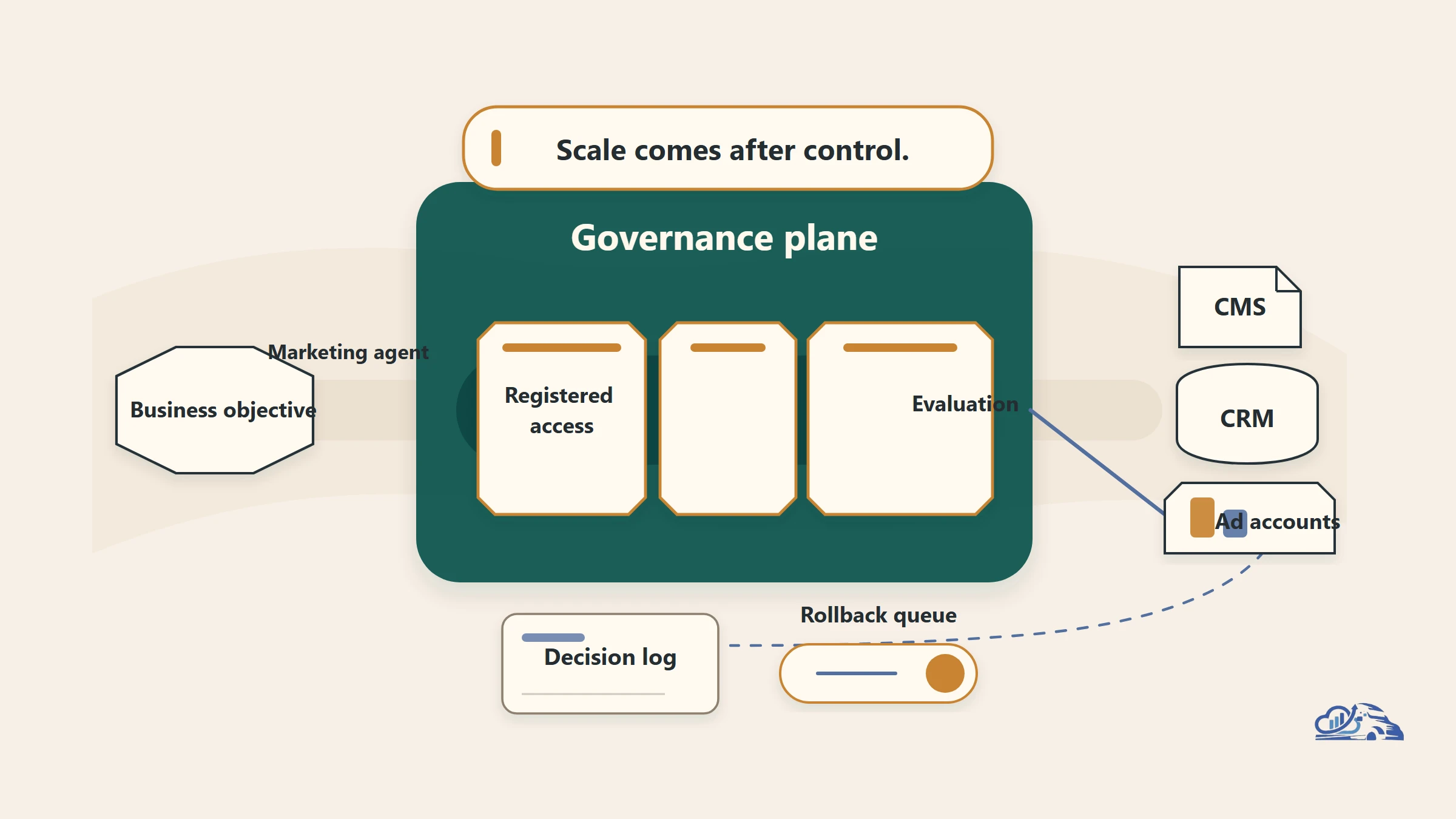
Whether execution is native or external, your application must still decide what a tool may access, return, and trigger.
The core rule is simple: no proxy is not no governance. Removing transport plumbing wouldn't remove policy enforcement, authorization, auditability, or human accountability.
Tool-governance checklist
| Decision point | Safe default | Required controls | Stop or handoff condition |
|---|---|---|---|
| Does the answer require current public information? | Search only when static knowledge is insufficient | Trusted-source allowlist, grounding, retained URLs, query and result logs | No trustworthy source or conflicting evidence |
| Does the request require calculation or transformation? | Use sandboxed code with validated inputs | Isolated runtime, least privilege, bounded resources, code and output logs | Invalid input, denied resource, or unverifiable output |
| Does the tool need private data? | Deny by default | Narrow data scope, authentication outside the voice model, redaction, audit trail | Sensitive data can't be safely isolated |
| Could the result trigger a consequential action? | Require confirmation | Explicit approval, action allowlist, and a reversible workflow where possible | Missing confirmation or policy conflict |
| Can the caller interrupt the agent? | Support immediate stop and barge-in | Cancellation handling, session recovery, and suppression of unsupported claims | The tool continues after cancellation or state becomes uncertain |
| Is production access required? | Keep the live voice agent separated | Scoped service boundary and policy enforcement | The request requires secrets, unrestricted credentials, or direct production access |
| Is the behavior ready for customers? | Keep autonomy narrow | Held-out evaluations, transcripts, tool logs, failure review, and an escalation path | A critical failure remains unexplained or unobservable |
A live voice agent should never receive unrestricted secrets, production credentials, or direct production-system access. If production data is required, place a narrow service between the agent and the system. That service should validate identity, scope every request, redact sensitive fields, and log the outcome.
Consequential actions need another boundary. Calculating appointment options is different from booking one. Explaining an estimated price is different from modifying a contract. Require explicit confirmation before any external state changes.
Stop controls matter because callers interrupt. Barge-in means the caller starts speaking while the agent is talking. Cancellation must reach both the speech layer and any active tool. If tool state becomes uncertain, the system should avoid claiming success and offer a handoff.
Evaluate Latency, Cost, and Trust
A production evaluation must measure the entire call, including tool selection, interruption recovery, cost, evidence, and safe failure.
Capture these signals for each evaluated interaction:
- Latency: User speech end, tool-call start, tool completion, and first resumed audio.
- Interruption behavior: Barge-in detection, cancellation delivery, state recovery, and repeated speech.
- Tool quality: Successful calls, wrong-tool choices, unnecessary calls, invalid arguments, and unusable results.
- Cost and capacity: Cost per call, token budget per call, tool usage, and retry overhead.
- Observability: Complete transcripts, arguments, outputs, retained sources, errors, and handoff reasons.
- Trust: Grounded answers, permission compliance, honest uncertainty, and confirmed external actions.
- Evaluation: Performance on held-out scenarios that weren't used while tuning prompts or policies.
Don't invent a universal latency threshold. A sales qualification call and an urgent support line have different tolerance for silence. Start from current customer telemetry, then define an acceptable budget for each stage.
Test failure paths as deliberately as the happy path. Deny a required permission. Return conflicting search evidence. Make code execution fail. Interrupt the agent while a tool is running. Confirm that it stops, explains the limitation, and hands off cleanly.
The mistake we see is evaluating whether an agent can complete a task while ignoring whether operators can explain its failure. If you're formalizing an agent workflow, see Vanaxity's review process in action. A free audit can then map your workflow, signal sources, dashboard gaps, review gates, and implementation scope into a delivery plan.
Where Native Tools Fit in the Agent Stack
The proposed native realtime tools would be an execution capability, not a replacement for every orchestration framework or application service.
Realtime function calling remains useful when your application owns the tool and its authorization. MCP provides a standard way to connect models with compatible tools and context. LangChain and LangGraph can manage stateful or durable workflows. CrewAI can coordinate role-based agents. Plan-and-Execute patterns can separate task planning from controlled execution.
Those approaches may still help with multi-agent routing, approval gates, long-running work, cross-channel memory, and failure recovery. The key is placement. Avoid inserting durable orchestration into the live audio path unless the task genuinely requires it.
The OpenAI Responses API can handle broader asynchronous agent work, while Realtime handles the low-latency speech session. RealtimeAgent, RealtimeSession, and the Agents SDK offer reusable patterns around that boundary.
Teams should also evaluate OpenAI Realtime beside Nova Sonic and other voice stacks without assuming feature parity. Compare each option on the operating dimensions that affect production:
- Cost and billing predictability
- End-to-end latency and interruption behavior
- Token-budget controls
- Transcript and tool-call observability
- Evaluation and regression-testing support
- Security, data residency, and governance fit
- Recovery when a tool, model, or network dependency fails
The product opportunity is practical, not theatrical.
A support agent can search an allowlisted help center for the current policy. A sales agent can calculate an approved scenario without opening internal billing systems. A scheduling agent can compute valid time windows, read them back, and request confirmation before booking.
A growth agent can answer dynamic product questions while retaining sources and tool logs. That creates a better conversation only when the answer is reliable, traceable, and easy to correct.
For CX and growth leaders, novelty isn't the adoption metric. Trust is. Customers won't care where the tool executed. They'll notice whether the agent answered quickly, respected interruptions, protected their data, and admitted when it couldn't verify something.
How Van Data Team Makes This Operational
At Van Data Team, we turn realtime voice agents into an operating workflow. We first map the live call path: audio transport, session state, tool requests, source systems, and downstream actions. We document who owns each handoff, which decisions are automatic, and where a person must approve, stop, or recover the interaction.
Next, we test where mid-call web search or computation creates real value. Each tool gets defined inputs, trusted sources, permission limits, timeouts, fallback responses, and audit logs. Consequential actions stay behind human review gates. Secrets and production credentials remain outside the live agent’s reach.
The practical output is a scoped delivery plan. It identifies the latency, interruption, tool-success, cost, token-budget, and evaluation signals to collect. It also names workflow gaps, automation candidates, and required controls. Finally, we specify the dashboard and runbook operators need to detect failures, inspect transcripts and tool calls, restore service, and improve the next release. This turns architecture and governance into work the team can assign, test, and operate.
Operational Budget
Before production rollout, compare candidates by cost per approved workflow result, not advertised token price. For each realtime voice agent, total model and tool charges, search or compute usage, retries, reviewer labor, and recovery work. Divide that spend by results that pass the acceptance rubric. A cheap call that fails twice or needs manual correction can cost more than a pricier call approved on the first attempt.
Use one scorecard across native tools, function calling, MCP, LangGraph, LangChain, or CrewAI implementations. Record end-to-end latency, time added by each tool, token consumption against budget, retry rate, reviewer minutes, and held-out evaluation results. Track typical and tail latency because rare delays can still damage a live conversation. Segment results by workflow, since a support lookup and a multi-step calculation have different risk profiles.
Set rollout limits before testing. Reject candidates that exceed budget, lose conversational state after a timeout, mishandle interruptions, or succeed only on familiar examples. Price the fallback path too: retrying, answering without the tool, transferring to a person, or ending safely.
This scorecard turns vendor comparisons into an operating decision. The winning system is the one that produces reliable, reviewable answers within the team’s latency, cost, and risk limits.
Tooling And Landscape Fit
A native-tool design fits the conversation’s hot path: a caller asks for a current fact or calculation, and the result returns before the exchange loses rhythm. For realtime voice agents, that’s a better fit than routing every lookup through a general workflow engine. Native function calling or MCP still makes sense when an agent needs proprietary data or business systems through a governed interface. These options add a hop but preserve application control.
LangGraph and LangChain fit longer workflows that need durable state, branching, retries, or human approval. Keep them behind the voice loop as a control plane. CrewAI and Plan-and-Execute suit delegated research or multi-agent work. Their extra model calls can raise latency, cost, and token use, so they’re usually better before or after a call. The Responses API fits richer asynchronous work, while the Realtime API serves live audio. The Agents SDK can connect both patterns. The same choices apply to other voice runtimes, including Nova Sonic.
Choose by workload, not framework popularity. Set limits for tool count, execution time, and token budget. Cancel tools on barge-in and log every decision for observability. Use held-out evaluation to measure answer quality, interruption recovery, tool success, cost, latency, and policy compliance. Native execution simplifies transport; it doesn’t replace runtime control.
Frequently asked questions
Can realtime voice agents search without ending the call?
A realtime voice agent can search during a call through an application-owned function tool or an MCP server. OpenAI's current Realtime tools documentation supports those patterns. The page URL cited in the draft does not verify that OpenAI-hosted web search runs natively without interrupting an active WebSocket session. Teams should retain the sources used for each answer.
Can a voice agent run code without dropping the call?
A voice agent can request code execution through an application-owned function tool while the Realtime session remains active. The cited materials do not verify native sandboxed Python execution inside the session. Sandboxing limits exposure, but it doesn't replace input validation, bounded permissions, output checks, logging, cancellation, or safe failure behavior.
Does native tool calling remove the need for a backend?
No. If a supported native tool replaces a custom proxy, it may remove specific plumbing for that tool. Production systems still need controlled authentication, private-data access, business rules, audit logs, approval policies, and human handoffs.
How should teams secure web search and code execution?
Allowlist trusted search sources, retain grounding evidence, isolate code, validate inputs, and deny secrets or production credentials. Stop when evidence or permissions are insufficient. Consequential actions should require explicit confirmation or human review.
What should teams measure before production?
Measure end-to-end latency, barge-in recovery, tool success, wrong-tool selection, cost, token use, log completeness, grounded answers, safe failures, and handoff quality. Test held-out cases before granting broader autonomy.
How do Realtime, the Responses API, the Agents SDK, and MCP relate?
Realtime manages low-latency speech sessions and tool calls. The Responses API supports broader agent workflows and built-in tools. The Agents SDK provides reusable agent, handoff, and sandbox patterns. MCP connects models with compatible external tools and context.