AI Marketing Platform: WPP's Data-Engineering Blueprint
Learn how WPP's governed data backbone turns siloed AI pilots into reliable analytics, predictive targeting, and generative marketing at enterprise scale.
Overview
An AI marketing platform reaches production when enterprise marketing, martech, growth, RevOps, and data-platform leaders give models a shared, governed data backbone. Scattered customer data makes pilots slow, manual, and siloed; each use case becomes a one-off. Vanaxity, Van Data Team's autonomous content agent, applies that same discipline through research, writing, illustration, publishing, and syndication for SEO, GEO, and AEO. This guide turns WPP's Google Cloud design into a vendor-neutral architecture, adoption framework, and readiness checklist.
Key Takeaways
Production AI marketing depends on a reusable data system with enforceable controls, not a collection of model demos.
- WPP's documented pattern combines shared data projects, separated processing compute, canonical audience definitions, and orchestrated pipelines.
- Centralize identity, consent, lineage, and common cohort rules. Let domain teams own context-rich data products under shared standards.
- Measure freshness, pipeline reliability, retry safety, lineage, cost, and service-level compliance before celebrating model performance.
- Add governed analytics first, predictive targeting next, and generative asset workflows after review and safety controls work.
- Choose a customer data platform (CDP), warehouse-native design, or hybrid by workload, not by category label.
Before buying another AI tool, use Vanaxity's governed process to request a free content and workflow scan. The output is a source map, review-gate assessment, dashboard gaps, and a scoped delivery plan.
Map your SEO, GEO and AEO workflow before you build.

Why Do AI Marketing Pilots Stall Before Production?
AI marketing pilots stall because fragmented data forces every use case to rebuild inputs, audience logic, permissions, and approvals.
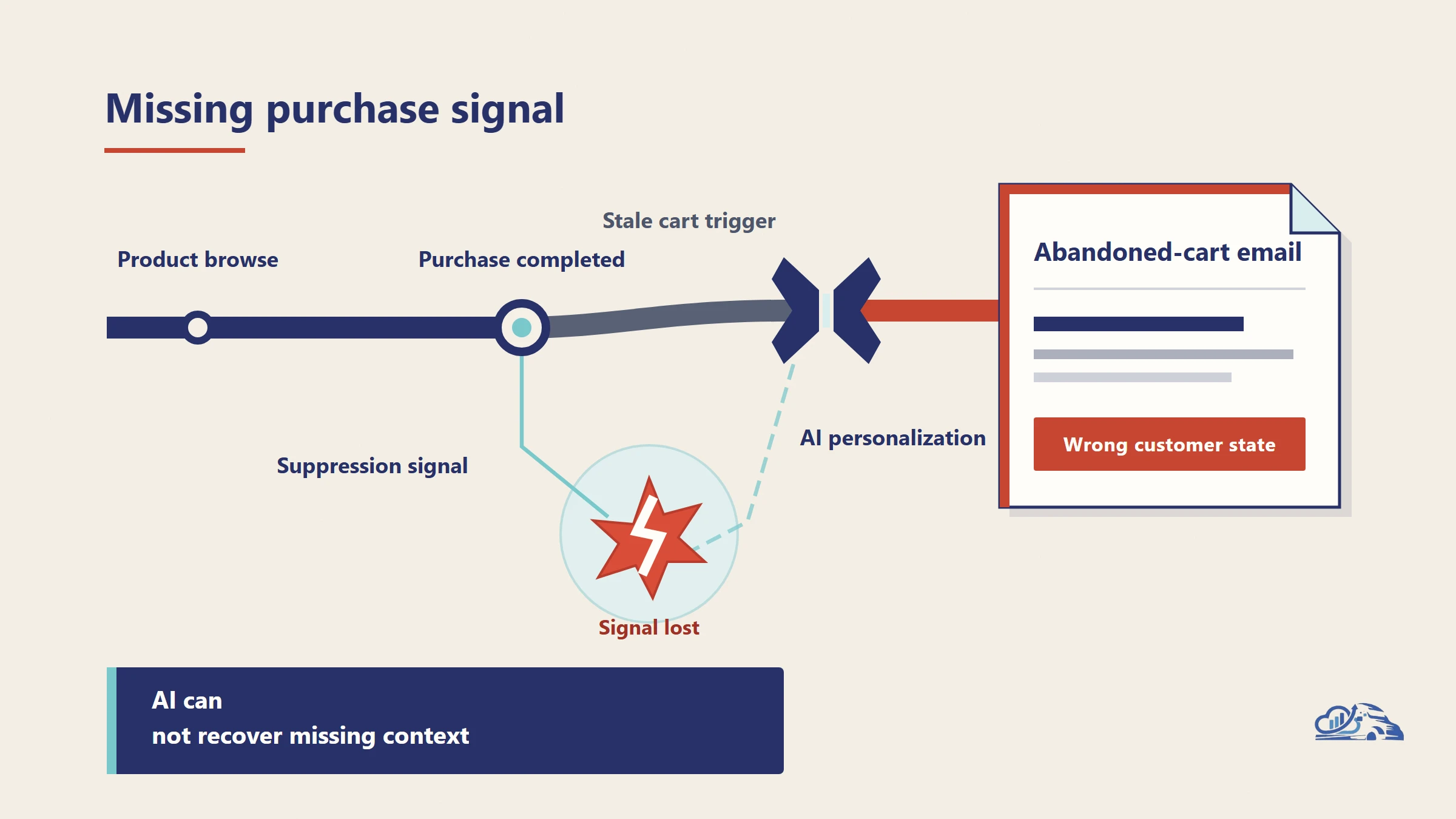
This diagnosis is Vanaxity analysis, not a reported finding about every WPP program. A campaign demo can survive copied files and manual checks. A production system cannot. Once several teams use different identity rules or consent logic, no model has a stable operating context. Adding another model or activation tool only adds another dependency.
The mistake we see at Van Data Team is starting with the visible output. Teams choose a model, connect a sample dataset, and optimize a campaign. They haven't agreed on who owns the source, how fresh it must be, or which audience definition is authoritative. Success stays trapped inside the pilot.
Consider an illustrative regional rollout. A growth lead asks for a "high-value customer" audience. Commerce uses recent spend, CRM uses account tier, and media uses engagement. Each model runs, but the outputs disagree. A canonical cohort definition, owned and versioned once, makes the audience reusable. It also makes disagreements visible before activation.
The practical fix is a governed marketing data platform. It should provide shared customer and campaign data, reusable transformation logic, and clear release gates. Models then consume approved data products instead of inventing their own local truth.
What WPP Built: The AI Marketing Platform Backbone
The following illustration summarizes one governed backbone, three workloads:
Figure 1. WPP's documented pattern separates shared, governed data from processing compute so trusted cohorts can support analytics, predictive targeting, and generative workflows.
WPP built a shared data backbone that separates governed storage from processing, standardizes cohorts, and feeds analytics and AI workloads.
On August 10, 2026, Google Cloud published its WPP case study. It describes WPP as a global advertising and marketing group. WPP centralizes Google Cloud Storage and BigQuery in shared data projects. It places compute in separate processing projects, giving consumers a common source of truth.
The same case study reports that Managed Service for Apache Spark runs Scala and Spark jobs to cleanse, normalize, and canonicalize data. Those jobs produce standardized cohort definitions. Kubeflow provides serverless pipeline orchestration. Trusted data then supports BigQuery and Vertex AI workloads for real-time marketing analytics, predictive audience targeting, and custom asset generation.
The broader stack extends beyond that case study. WPP's Google partnership page names BigQuery, Looker, Spanner, Open Intelligence, InfoSum Bunkers, DeepMind access, Gemini, Imagen, and Veo. It frames InfoSum as a privacy-first collaboration layer. BigDataWire's WPP Open coverage describes WPP Open as an agentic marketing platform supporting analytics, audience modeling, and generative workflows.
The primary case study distills the shared-data goal into a useful phrase:
"a unified source of truth"
Vanaxity analysis begins where the reported architecture ends. The transferable lesson isn't that every enterprise should copy WPP's Google Cloud services. Shared data and separated compute are the durable pattern. This separation improves reuse, workload isolation, access control, and cost attribution. Exact products should follow workload needs, existing skills, and current service options. Verify Google Cloud names and capabilities in current documentation before implementation.
Centralize the AI Marketing Platform or Federate It?
Centralize shared definitions and controls, but federate ownership where business context changes the meaning of data.
A data mesh is an operating approach in which domains own reusable data products under common governance and quality standards. It isn't a required product or rigid network design. Marketing, commerce, sales, and regional teams can keep domain expertise without creating separate truths.
Centralize identity resolution, consent status, canonical cohorts, lineage, access rules, and shared campaign measures. Federate ownership when a domain must maintain source meaning or local policy. The decision rule is simple: centralize a data product when several teams need the same definition and controls. Federate its ownership when domain knowledge is essential, while enforcing shared contracts.
The comparison below is Vanaxity analysis informed by the documented WPP platform pattern.
| Decision area | Isolated pilots | Shared, governed platform |
|---|---|---|
| Data access | Each use case copies source data | Reusable data products provide a common source |
| Compute | Tied to individual models and datasets | Processing workloads are separated from shared data |
| Audience logic | Definitions vary by team | Canonical cohort definitions are versioned and reused |
| Pipeline operations | Manual jobs and hidden failures | Orchestration supports monitoring, retry, and backfill |
| Governance | Reviewed after outputs exist | Consent, access, and lineage are applied by design |
| AI consumption | Point demonstrations | Analytics, targeting, and asset generation share controls |
| Cost | Hard to attribute by workload | Processing cost is visible by consumer or workload |
This design doesn't remove local autonomy. It creates a contract for safe reuse. Teams can innovate above the contract without rebuilding identity, consent, and audience logic for every model.
Which Data Quality Controls Matter in Production?
Freshness, lineage, retry safety, cost, and service-level compliance decide whether marketing AI is dependable in production.
A data pipeline is the automated flow that extracts, transforms, and loads data, called ETL. It may instead extract, load, and then transform data, called ELT. Either pattern needs observable controls:
- Freshness and completeness: Confirm that required sources arrived on time and contain the expected records before a model runs.
- Lineage: Trace source records through transformations, features, cohorts, models, audiences, and generated assets.
- Schema drift: Detect when an upstream field, type, or structure changes and could break downstream logic.
- Retry and backfill: Make retries idempotent, so repeating a job doesn't duplicate activation. A backfill reprocesses historical data after a correction or logic change.
- Cost and SLA: Attribute storage, compute, model, and token-budget use by workload. A service-level agreement, or SLA, defines expected freshness, availability, and recovery.
- Consent and brand safety: Enforce permitted purposes before targeting. Check generated assets against brand rules before publication.
Data observability asks whether inputs and pipelines are healthy. Model evaluation and observability ask whether predictive or generative behavior remains useful, safe, and consistent. Teams need both. A healthy pipeline can still feed a weak model. A strong model score can't excuse stale or ungoverned inputs.
In an illustrative incident, a CRM renames a consent field. The contract detects schema drift and quarantines affected records. Engineers repair the mapping, run a controlled backfill, and evaluate downstream audiences before activation resumes. That workflow turns governance into an operating control, as described in Vanaxity's guide to AI marketing governance.
The release checkpoint should be explicit: don't activate an audience or publish a generated asset unless freshness, consent, lineage, data quality, and model checks pass.
How Should Leaders Sequence Adoption?
Leaders should build trusted data and governance first, prove analytics next, and add predictive and generative workloads in controlled stages.
A practical sequence looks like this:
- Name the outcome and owners. Give each use case a business owner, technical owner, approved output, and release decision.
- Map the foundation. Inventory sources, identity rules, consent, transformations, destinations, and existing failure points.
- Publish shared data products. Version customer, campaign, content, and cohort definitions that several teams can reuse.
- Install operating controls. Add contracts, lineage, quality tests, safe retry, backfill procedures, access rules, cost reporting, and SLAs.
- Prove governed analytics. Use dashboards and real-time analysis to test whether the same data stays trustworthy across consumers.
- Add predictive targeting. Promote models only when input reliability and downstream activation controls remain stable.
- Add generative workflows. Connect generative models after brand safety, human review, evaluation, and rollback are working.
- Expand through reuse. Scale only when new use cases can use the same governed components instead of copying them.
Measure data reliability before model wins. Track freshness failures, pipeline success, retry outcomes, lineage coverage, consent blocks, SLA breaches, and cost by workload. Then measure prediction quality, asset quality, and business impact.
At Van Data Team, we start by mapping signals, decisions, and review gates. Vanaxity uses this discipline to move from research to writing, illustration, publishing, and syndication. The same separation between trusted context, agent execution, evaluation, and human approval also shapes effective agentic AI in marketing.
CDP, Warehouse, or Hybrid?
Choose a CDP, warehouse-native platform, or hybrid according to activation speed, modeling depth, governance, and operating ownership.
A customer data platform, or CDP, is software that unifies customer data and helps marketers build and activate audiences. It fits when marketer-led segmentation and destination activation are the main jobs. Buyers should still test identity, consent, portability, latency, and failure recovery.
A warehouse-native design fits when reusable data products, custom analytics, and custom models drive the program. BigQuery is WPP's documented warehouse layer, but the pattern is vendor-neutral. This route offers engineering flexibility, yet it demands stronger data-platform skills and clear self-service interfaces.
A hybrid keeps the warehouse as the governed foundation while a CDP handles audience building and activation. It can balance control and usability, but it adds synchronization, integration, and cost-management work. Teams must define which system owns each identity, consent state, cohort, and activation event.
Build versus buy is also a workload decision. Compare latency needs, consent complexity, data portability, integration burden, internal skills, review load, recovery paths, and total operating cost. Choose the smallest architecture that meets governance, reuse, latency, and service requirements. Category labels should not make the decision.
AI Marketing Platform Readiness Checklist
A platform is ready for production only when its data, model, governance, and recovery controls work together.
- [ ] Every use case has a business owner, technical owner, and defined output.
- [ ] Source systems, identity rules, and consent requirements are documented.
- [ ] Shared-data and processing-compute boundaries are explicit.
- [ ] Canonical customer and cohort definitions are versioned.
- [ ] Data contracts name the schema, owner, quality rules, freshness target, and SLA.
- [ ] Schema drift triggers an alert or quarantine before model consumption.
- [ ] Retry logic is safe and cannot duplicate activation or outputs.
- [ ] Backfills reproduce approved cohort and transformation logic.
- [ ] Lineage connects source records to features, models, audiences, and assets.
- [ ] Access controls limit data and model use by role and purpose.
- [ ] Pipeline and model costs are visible by workload.
- [ ] Freshness and SLA failures have named escalation paths.
- [ ] Predictive models have evaluation and observability controls.
- [ ] Generative assets have brand-safety and human-review gates.
- [ ] Rollback and incident-response procedures are tested.
- [ ] Promotion from pilot to production requires every critical control to pass.
Want this checklist scored against your current stack? Ask Van Data Team for a free audit through Vanaxity's platform services. You receive a signal map, pipeline and dashboard gap review, control risks, and an implementation scope.
Frequently asked questions
Do we need a CDP or a data warehouse for AI marketing?
Use workload fit, not category labels. A CDP suits marketer-led audience activation. A warehouse-native design suits reusable data products, custom analytics, and custom models. A hybrid can preserve warehouse governance while using a CDP for activation. Decide after mapping latency, consent, identity, portability, cost, and ownership.
Why separate shared data from processing compute?
Separation lets teams reuse governed data while workloads scale, fail, and incur cost independently. WPP's documented implementation uses this pattern. Vanaxity recommends preserving the principle even when another cloud or data stack implements it differently.
Is data mesh required for an AI marketing platform?
No. Data mesh is an operating approach, not a required product or topology. Domain teams can own useful data products under shared contracts, access rules, and quality standards. The goal is trusted reuse and consistent meaning, not compliance with an architecture label.
How should teams handle schema drift and backfills?
Detect schema changes before they reach models or activation tools. Version data contracts, quarantine incompatible records, and make retries safe. Backfills should reproduce approved canonical logic and preserve lineage. Re-run downstream evaluation before restoring targeting or asset-generation workflows.
What should leaders measure before model performance?
Start with data reliability: freshness, pipeline success, retry behavior, lineage coverage, SLA compliance, consent enforcement, and cost. Then assess predictive or generated-asset quality. Strong model output built on stale or ungoverned data doesn't create a dependable system.
Where do Vertex AI and generative models fit?
They sit above the governed data and pipeline layer. In WPP's Google Cloud implementation, BigQuery and standardized cohort data support Vertex AI and Google generative models. Other enterprises can use different platforms while preserving the boundaries among trusted data, model execution, evaluation, and activation.