Agentic Loops in Marketing: What Microsoft's C++ Demo Teaches
Microsoft showed agentic loops on real C++ projects. Vanaxity explains the signals, guardrails, and review gates marketing teams need for safe autonomy.
Overview
Marketing and RevOps teams cannot safely deploy autonomous agents until they can define the equivalent of a passing C++ build: a trustworthy signal that tells the agent whether a campaign or outbound sequence worked, failed, or must stop. This article separates Microsoft’s engineering demonstration from Vanaxity’s marketing analysis and provides a readiness framework for agentic loops in marketing, covering feedback signals, guardrails, action logs, stop conditions, and human approval gates—at Van Data Team, we map signal and authority before choosing a model.
Your AI agent is not autonomous just because it can call tools. Agentic loops in marketing are useful only when an agent can act against a trustworthy success signal, verify the result, and stop safely when that signal fails. At Pure Virtual C++ 2026 on July 21, 2026, Microsoft's C++ team demonstrated that pattern against real engineering projects: inspect state, change code or configuration, build, test, evaluate, and continue.
The boundary matters. Microsoft demonstrated software development workflows, not marketing, sales, ad bidding, or AI SDR infrastructure. For B2B marketing, RevOps, and sales teams, the useful lesson is the loop architecture. It is also the operating principle behind the Vanaxity agent: research, write, illustrate, publish, and syndicate content while combining SEO, GEO, and AEO checks with review gates.
At Van Data Team, we start by mapping the signal and the authority before choosing the model. A scoped review can produce a feedback-signal map, permission boundary, approval matrix, dashboard gap list, and pilot delivery plan. See how Vanaxity works if you want to make that assessment concrete.
Key Takeaways
- Microsoft showed agentic loops working on C++ modernization, CMake builds and tests, MSVC upgrades, and build-performance optimization.
- Microsoft did not demonstrate or endorse marketing agents, AI SDRs, or autonomous bidding.
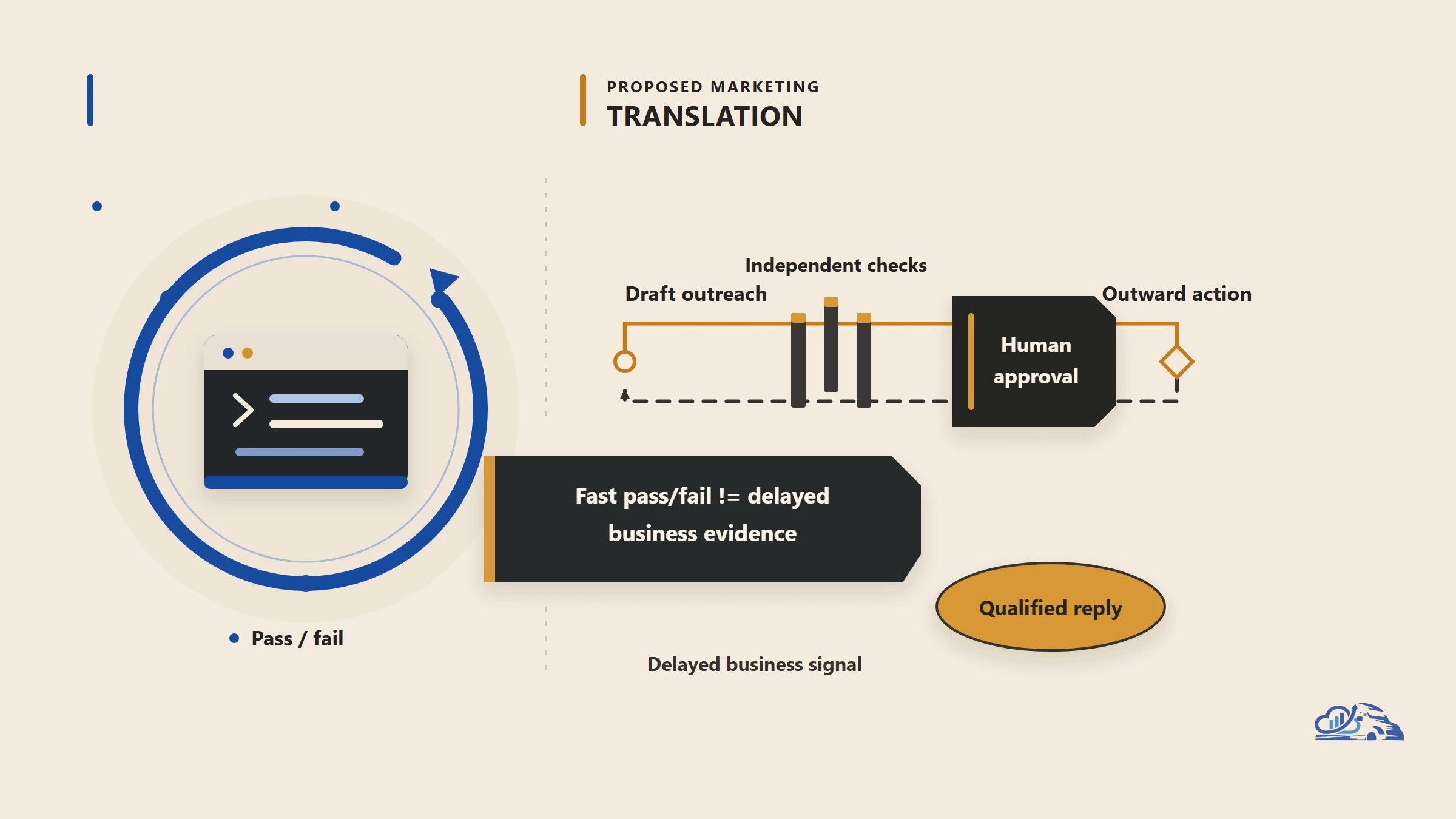
- Engineering reached useful loops first because builds and tests provide fast, machine-readable feedback; marketing signals are often delayed, disputed, or easy to game.
- A marketing agent needs a business outcome signal, separate quality gates, bounded permissions, complete action logs, human approval for outward actions, and a tested recovery path.
- If a team cannot define success, invalidation, attribution, and stop conditions, the workflow should remain in recommendation mode.
Map your SEO, GEO and AEO workflow before you build.

What Microsoft Actually Demonstrated in C++ Engineering
Reported fact: Microsoft demonstrated agents acting on real C++ projects, with engineering tools and observable project results closing the loop. The featured session, "From Completions to Agents: AI-Driven C++ in Visual Studio," framed the shift from producing an isolated suggestion to continuing work after each result.
Microsoft's official Pure Virtual C++ event guide described the CMake session in unusually concrete terms:
"Expect automatic CMakeLists.txt updates, broader test support, and live demos of the extension driving an agentic loop against a real project."
The supporting Microsoft material specifies how those loops operate:
- According to Microsoft's C++ and CMake integration guide, Copilot can use the active build configuration, invoke CMake, run tests, inspect failures, and adjust code until the project builds and the relevant tests pass.
- In Microsoft's C++ modernization announcement, the agent assesses an MSVC upgrade, proposes a plan, executes concrete tasks, launches another build, and iterates when issues remain.
- In Microsoft's iterative-build explanation, the build-performance agent tries a change, measures a build, rolls back a non-improvement, and keeps a useful change before moving on.
That creates a practical evaluate-act-verify sequence:
inspect → change → build → test → evaluate → continue or stop
The difference from familiar automation is not the presence of AI alone.
| Operating pattern | What changes between steps | Feedback | Best use |
|---|---|---|---|
| Completion | Nothing unless a person supplies another prompt | Human judgment on one output | Drafting, suggestions, isolated analysis |
| Decision-tree automation | A fixed rule selects a predefined branch | Condition matched or not matched | Stable, predictable, compliance-heavy workflows |
| Agentic loop | The agent selects the next allowed action from observed state | A measurable outcome plus quality gates | Dynamic but bounded work with trustworthy feedback |
For operators, this is the useful distinction behind Vanaxity versus manual SEO. An agentic workflow is not a longer checklist. It is a controlled loop that can gather evidence, revise its work, and know when to stop.
Microsoft's proof remains narrow: C++ engineering. Nothing in these sessions establishes that the same loop will improve pipeline, revenue, ad efficiency, or brand outcomes.
Why Engineering Got There First and Marketing Did Not
Vanaxity analysis: Engineering reached useful agentic loops first because its operating environment exposes comparatively hard, fast, and inspectable feedback. A build completes or returns errors. Tests return results tied to expected behavior. Source files, configuration, compiler output, and test logs show the agent what changed and what happened next.
The agent can often associate a failure with a recent action, revise that action, and run the same evaluator again. Even when builds are costly or tests are incomplete, the feedback is usually more machine-readable than a buyer's intent or a brand's reputation.
Marketing rarely offers that certainty. A reply may be interested, negative, automated, or unqualified. A booked meeting may not become a viable opportunity. Platform-reported performance may disagree with CRM attribution. Engagement can rise while message quality, audience trust, or revenue quality falls.
Consider an illustrative scenario, not a Microsoft use case. Maya, a RevOps lead, tells an AI SDR to maximize replies. The agent has no reliable way to distinguish buying intent from objections, curiosity, or unsubscribe requests, so Maya stops the pilot. She replaces raw reply volume with an agreed qualified-reply definition, but keeps human approval before every send while the team validates the signal.
That caveat is the whole issue: a capable agent with a weak objective can optimize the wrong result faster. Marketing feedback is often delayed, incomplete, subjective, or contaminated by attribution. If the signal cannot be trusted, uninterrupted autonomy is not maturity. It is uncontrolled experimentation.
How Agentic Loops in Marketing Need to Be Designed
A responsible marketing loop needs a business outcome signal, independent quality gates, and limited authority. The outcome tells the agent whether it is moving toward value. The gates prevent it from reaching that outcome through unacceptable targeting, language, claims, spending, or customer experience.
The following mappings are Vanaxity analysis and illustrative design choices, not Microsoft capabilities:
| Workflow | Candidate equivalent of "build passes" | Independent quality gates | Safe starting authority |
|---|---|---|---|
| AI SDR | A reply that meets an agreed qualification standard | Account fit, factual claims, tone, consent, frequency, suppression rules | Research and draft; human approves sends |
| Ad bidding | Performance above an approved ROAS threshold with trustworthy attribution | Budget, audience, brand safety, pacing, data freshness | Recommend changes until attribution is reliable |
| Content and offer optimization | Search visibility and qualified conversion signals that match intent | Source accuracy, brand voice, SEO, GEO, AEO, schema, legal review | Iterate internally; human approves publication |
A metric is not automatically a feedback signal. Opens, clicks, reply count, lead volume, and time on page can be useful observations, but each can reward behavior that misses the business goal. A qualified reply is usually a stronger category than any reply, yet the team still has to define qualification and detect false positives.
At Van Data Team, we start by separating outcome signals from quality gates. The outcome evaluator should not certify its own safety. A separate check should reject unsupported claims, off-brand language, invalid audiences, stale data, or unapproved spend. When a gate cannot evaluate an action, the workflow should fail closed and escalate.
This is where the content-agent pattern becomes practical. Vanaxity can research, draft, review, illustrate, prepare structured content, and build multichannel distribution assets inside the loop. Publication and consequential changes remain behind explicit approvals until the evidence supports broader authority.
A Readiness Framework for Controlled Autonomy
A team is ready for a controlled agentic loop only when it can define the signal, bound the actions, observe every decision, approve consequential outputs, and recover from failure.
Define a feedback contract
Name the business outcome in operational language. Document what qualifies, what must be excluded, which system produces the observation, how long the feedback takes, and what would invalidate attribution. If different teams use different definitions, resolve that conflict before the agent runs.
Bound tools, data, and actions
Specify which systems, records, audiences, channels, and action types the agent may access. Add stop conditions for missing data, conflicting signals, rejected gates, unusual tool responses, and policy exceptions. The agent must never expand its own objective or permissions.
Log every action and observation
Record the input state, chosen action, tool result, evaluator result, gate decision, approval, cost, and next step. A reviewer should be able to reconstruct why an action occurred without relying on the agent's summary. Teams evaluating observability can see the agent in action and compare that transparency with their own workflow.
Keep a human gate on outward actions
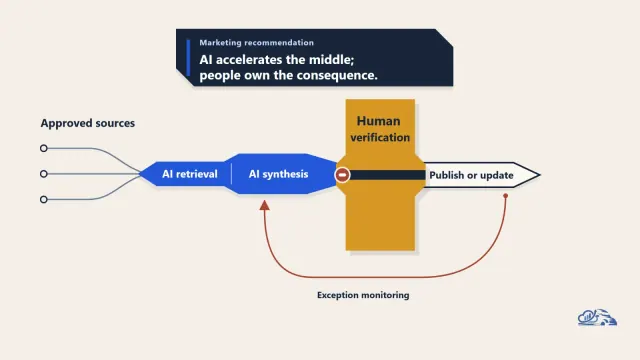
Let the agent research, classify, compare, draft, test, and recommend internally. Require approval before customer-facing sends, publication, material bid or budget changes, new claims, audience expansion, permission changes, or use of sensitive data. This removes the human from every intermediate step without removing human authority.
Measure before expanding permissions
Begin in shadow or recommendation mode. Compare proposed actions with an approved baseline, then review false passes, false failures, reviewer disagreement, cost, latency, token use, and recovery behavior. Expand authority by action type only after the logs show that the loop behaves as intended.
This pseudocode is Vanaxity's recommended control pattern, not code from Microsoft:
- Observe the approved state
- Choose an allowed action
- Draft or simulate
- Evaluate the business signal
- Run factual, brand, compliance, budget, and safety gates
- If the signal is missing or a gate fails: stop and escalate
- If the action is outward-facing: request human approval
- Execute and log
- Compare with the approved baseline
- Continue, roll back, or stop
Failure Modes, Illustrative Workflows, and Evaluation
The fastest way to reject an unsafe agentic workflow is to test how it fails, not how polished its demo looks.
Common failure modes include optimizing an easy proxy, acting on delayed attribution, exhausting an audience through repeated outreach, producing technically compliant but off-brand content, escalating spend without approval, and continuing after a connector or safety check fails. Another serious flaw is allowing the same agent to act and certify its own success without an independent evaluator.
Illustrative bidding scenario: Daniel, a demand-generation lead, gives an agent a campaign objective but discovers that CRM revenue data arrives too late to judge each proposed change. The platform metric looks current, but it cannot answer whether the pipeline is qualified. Daniel keeps the agent in recommendation mode, caps its accessible budget data, and waits for attribution checks before approving changes.
Illustrative content scenario: Priya, a content operations lead, lets an agent research a topic, assemble citations, draft an answer-first article, check brand rules, and prepare distribution copy. A citation check fails after a source changes. The loop stops before publication, records the failed source, and routes the draft for review rather than publishing a plausible but unsupported claim.
Evaluate the whole control system, not only output quality:
| Dimension | What the team must test |
|---|---|
| Signal quality | Does the observation track business value, and can the agent detect missing or corrupted data? |
| Cost and token budget | Is the value of another iteration worth the model, tool, review, and platform cost? |
| Latency | Does feedback arrive soon enough to guide the next action without teaching from stale conditions? |
| Observability | Can a reviewer reconstruct state, reasoning, actions, tool results, and approvals? |
| Review burden | Does the gate reduce risk without creating a queue that erases the value of autonomy? |
| Failure recovery | Can the team interrupt, roll back, suppress, correct, and notify affected owners? |
Do not expand authority because aggregate results hide poor-quality actions. Review individual decisions, exception rates, and the business meaning of the outcome. The same discipline applies when examining proof and case outcomes: evidence should show what was measured, what was controlled, and where human judgment remained.
How Van Data Team Makes This Operational
At Van Data Team, we turn agentic loops in marketing into an operating workflow, not a theory exercise. Microsoft’s C++ demonstration is the engineering proof point: agents worked against real projects, using builds and tests to determine whether to continue. Microsoft did not demonstrate marketing, sales, bidding, or AI SDR systems; that translation is Vanaxity’s analysis.
We begin by tracing the current handoff from source systems to decisions and outward actions. We document which signals enter the workflow, who owns each decision, where review gates sit, what dashboards reveal, and how the team pauses, rolls back, or recovers when a loop behaves incorrectly.
The deliverable is a scoped delivery plan, not a generic architecture diagram. It identifies the outcome signal to trust—such as a qualified reply, booked meeting, or validated ROAS threshold—alongside attribution limits and quality checks. It then specifies which workflow gaps to close, which automations may run unattended, which actions require human approval, and what must be logged for agent observability.
Finally, we define the dashboard and runbook that explain what happened, why the agent acted, when to intervene, and what the team should do next.
Frequently asked questions
What did Microsoft demonstrate at Pure Virtual C++?
Microsoft demonstrated C++ agents working with real project state across Visual Studio, CMake, build and test workflows, codebase modernization, build performance, and MSVC upgrade work. The official event announcement and session guide is the primary source.
What is an agentic loop?
An agentic loop is a repeated cycle in which an AI system observes a target, chooses an allowed action, executes it, reads feedback, and decides whether to continue, revise, escalate, or stop. The loop matters more than the chat interface.
How is an agent different from decision-tree automation?
A decision tree follows branches written in advance. An agent chooses the next action from the current state within defined permissions. If the choices and feedback are not dynamic, adding a language model does not make the workflow agentic.
Did Microsoft demonstrate an AI SDR or marketing agent?
No. Microsoft demonstrated software-development agents for C++ engineering. AI SDRs, autonomous bidding, and content optimization are Vanaxity's analysis of how the loop pattern might transfer under stronger controls.
What is marketing's equivalent of a passing build?
There is no universal equivalent. A team needs a workflow-specific business outcome, such as a qualified reply or performance above an approved threshold, plus separate quality gates for brand, compliance, targeting, and customer experience.
When should an agent remain in recommendation mode?
Keep it read-only when attribution is unreliable, feedback arrives too late, outward mistakes are hard to reverse, safety checks are incomplete, or reviewers cannot reconstruct its decisions. Recommendation mode is a control, not a failed deployment.