Multimodal Content: What Meta's AI Glasses Signal
Meta's Vision Ireland initiative signals that multimodal content must work across screens, audio, voice interfaces, wearables, and AI-generated answers.
Overview
Most brand content is built for screens, so it loses essential meaning when AI glasses read it aloud, describe an image, or answer by voice—leaving blind and low-vision people blocked and ambient interfaces underserved. This article explains what Meta’s Vision Ireland initiative signals and gives content, brand, marketing, and accessibility-minded leaders a practical checklist for accessible, multimodal content, using the same access-first discipline Van Data Team applies to SEO, GEO, and AEO.
Meta's Vision Ireland initiative signals that multimodal content must keep its meaning when people read, hear, describe, or question it through AI. For content, brand, marketing, and accessibility-minded leaders, the problem is screen-only publishing: key context gets blocked when an interface reads a page aloud or summarizes it. Vanaxity's practical response is an access-first production model, ending in a checklist for clear, sourced, multimodal-ready experiences.
Failure Modes And Review Gates
A practical guide to multimodal content needs a failure-mode view, not only advice. Use this checkpoint before treating the work as production-ready.
| Failure mode | Validation signal | Guardrail | Escalation or rollback |
|---|---|---|---|
| Advice sounds plausible but lacks evidence | Recommendation cannot be traced to a campaign result, customer signal, or source | Require a validation note before acting | Escalate to a reviewer and roll back unsupported claims |
| Tactics improve one metric while hurting another | Conversion, retention, CAC, or lead quality moves in the wrong direction | Review the full measurement window before declaring success | Pause the tactic and return to the previous baseline |
| Strategy depends on a single channel or assumption | Results fail when the channel, audience, or offer changes | Add a review gate for audience, offer, and distribution fit | Route to a second experiment or rollback plan |
| Learning loop stalls after execution | No post-campaign review, decision log, or next test is created | Make every campaign produce a decision record | Escalate ownership before starting the next campaign |
Review gate: before publishing or scaling multimodal content, confirm the validation evidence, owner, escalation path, and rollback trigger are visible in the decision record.
Map your SEO, GEO and AEO workflow before you build.

Key Takeaways
The central lesson is simple: access creates durable content quality across every interface.
- Meta's Vision Ireland initiative is first an accessibility and independence story, not a marketing device.
- Screen-only content can lose meaning when an interface reads it aloud, describes an image, or extracts an answer.
- Alt text, captions, transcripts, clear headings, and plain language serve disabled people first and ambient interfaces second.
- Voice-first writing needs direct answers, self-contained context, and visible sources. GEO and AEO are benefits, not substitutes for access.
- A repeatable review workflow should test read-aloud quality, AI-summary fidelity, provenance, and human approval before publication.
Meta's AI Glasses Initiative Puts Access First
Meta's Vision Ireland initiative is an accessibility program designed to support greater independence for blind and low-vision adults in Ireland.
On August 13, 2026, Meta announced the Vision Ireland initiative. The company will donate 15,000 Ray-Ban Meta AI glasses through Vision Ireland, with eligible adults able to register interest in the free initiative.
The announcement's title states:
"The future is for everyone."
According to Meta's accessibility page, the glasses' camera and built-in real-time AI can read text, identify objects, describe surroundings, translate live, and support hands-free calls. These functions can make everyday information and communication more available without requiring a handheld screen.
A donation alone doesn't settle every question about fit, support, or real-world use. The AccessWorld review from the American Foundation for the Blind provides independent context on the product's usefulness and limitations.
The initiative is about access. The content-strategy implication that follows is Vanaxity's analysis, not a claim by Meta or Vision Ireland. Keeping that boundary clear is part of respectful reporting.
What Does the Shift Mean Beyond the Screen?
The shift is simple: content must preserve its meaning even when the original screen disappears.
Information can reach someone as a web page, screen-reader output, spoken answer, AI summary, or wearable description. Adding a video or decorative image doesn't make a page ready for those modes. Readiness means the core message survives each transformation.
Vanaxity reads this initiative as a clear signal of a broader shift toward voice-first and ambient interfaces. It isn't an adoption forecast. The practical issue already exists: most brand content depends on layout, image text, color, or vague references such as "see above."
At Van Data Team, we make this operational through Vanaxity's SEO, GEO, and AEO content agent. The workflow moves research, writing, illustration, review, publishing, and syndication through defined gates. Access requirements belong inside those gates, not in a cleanup queue after launch.
| Screen-only pattern | Access-first response | What survives |
|---|---|---|
| A chart carries the conclusion | State the conclusion in nearby text and meaningful alt text | The finding remains available without sight |
| A link says "learn more" | Name the destination or action | Intent remains clear when heard alone |
| Copy says "as shown below" | Name the object and explain its point | Voice output keeps the reference |
| Sources sit in a loose end list | Place each source beside its claim | AI summaries can preserve attribution |
A page that works only as arranged pixels is incomplete. A durable page gives each interface enough context to communicate the same essential meaning.
Why Is Accessibility the Foundation for Multimodal Content?
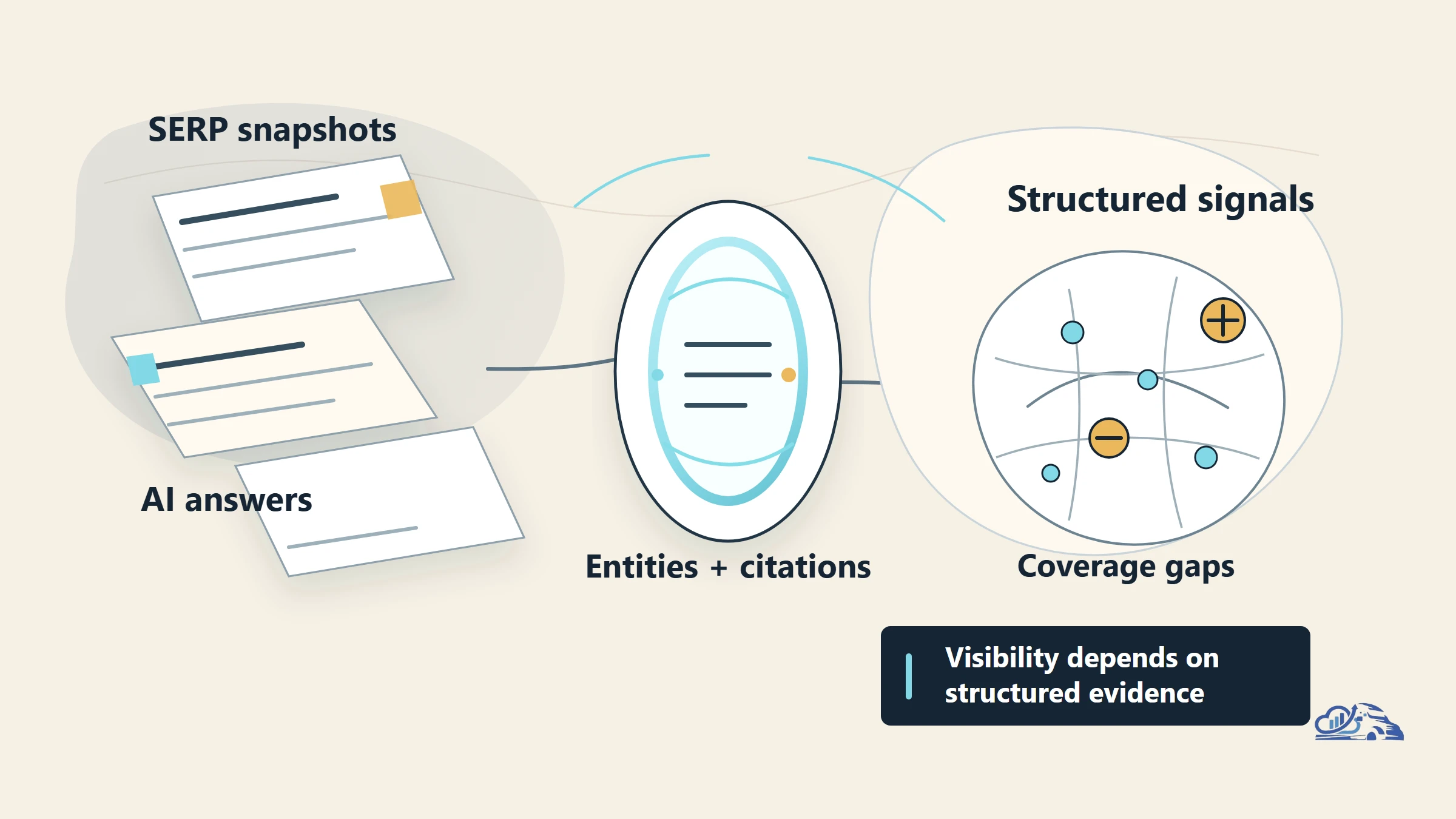
The following illustration summarizes one meaning, every interface:
Figure 1. Access-first source content preserves essential meaning for blind and low-vision people while also improving reliability across voice and ambient AI interfaces.
Accessibility is the foundation because disabled people need equal access to meaning, not merely copy that machines can parse.
Start with editorial basics that remove real barriers:
- Write alt text that explains an image's relevant purpose or information.
- Add descriptive captions and accurate transcripts for audio and video.
- Use headings that name the section and follow a logical order.
- Prefer plain language, short sentences, and explained abbreviations.
- Give links and buttons labels that make sense without surrounding copy.
- Put essential findings in text instead of leaving them inside an image.
Alt text isn't a keyword field. A caption isn't useful when it only repeats the file name. A transcript isn't complete if it drops speaker changes or essential non-speech information.
Consider a hypothetical product comparison shown only with green and red cells. Alt text that says "comparison chart" confirms an image exists but withholds the conclusion. Useful surrounding copy would name the stronger choice for each use case and explain the tradeoff. The image then reinforces meaning instead of owning it.
Automated checks can spot missing fields. They can't decide whether a description is respectful, sufficient, or accurate in context. Human review remains essential, and input from disabled users and accessibility professionals is valuable wherever teams can include it.
These practices serve disabled people first. Better compatibility with voice interfaces, multimodal AI, GEO, and AEO is an aligned secondary benefit. AI readiness never replaces accessibility work or lived-experience review.
What Does Voice-First Content Actually Require?
Voice-first content gives a listener the answer, context, and next action without relying on visual position.
A practical voice-ready edit should:
- Put a direct, self-contained answer near the start.
- Use descriptive headings that remain clear when heard alone.
- Break nested clauses into shorter sentences.
- Define an unfamiliar term before using its abbreviation.
- Explain the meaning of charts and screenshots in nearby copy.
- Replace "above," "below," and "here" with named references.
- Read every action label aloud without its surrounding paragraph.
This is where GEO and AEO overlap with accessibility. Answer systems need clear topic boundaries, explicit entities, and passages that can stand alone. Structured data can clarify relationships, but it can't repair missing meaning in the visible copy. Clear writing supports accurate extraction; it doesn't guarantee a citation or ranking.
A hypothetical content lead tests a campaign page by audio. The page says, "Our approach wins, as shown below," then moves to a vague button. The listener never hears what won, why it won, or where the button leads. Rewriting the sentence with the actual conclusion and renaming the action fixes the human barrier. It also gives an assistant a better answer passage.
Teams exploring governed agentic AI in marketing should make these checks part of the agent workflow. The model can propose structure and alternatives. A reviewer must still verify meaning, tone, and accessibility.
Why Do Provenance and Trust Matter More?
Provenance matters more in AI-mediated content because summaries can detach a claim from its source, owner, or level of certainty.
Put each source link beside the statement it supports. Name the organization making the claim. Separate reported facts from editorial interpretation. Keep eligibility details, dates, product functions, and limitations attached to their evidence. Avoid unsupported superlatives, market forecasts, and return claims.
That discipline is also good AI marketing governance. A review record should show which source supported a claim, who approved the interpretation, and what changed before publication.
Then test summary fidelity. Ask an AI system to summarize the page and compare the result with the source. Does it preserve the subject, factual details, attribution, and boundary between reporting and analysis? If it presents Vanaxity's interpretation as Meta's position, the page fails review. Rewrite the ambiguous passage and test again.
Where Should Content Teams Start?
Content teams should start with a representative audit, repair the barriers that remove meaning, and make the checks repeatable.
At Van Data Team, we start with the content formats that carry the most risk or reach. That may include a key landing page, an image-led article, a video page, and a research-heavy guide. The goal isn't a sitewide rewrite at the outset. It is to find repeatable failure patterns.
Use this operating sequence:
- Inventory the page's text, images, media, links, claims, and intended answers.
- Repair missing alternatives, weak structure, vague actions, and visual-only meaning.
- Render the page through text-to-speech and note every lost reference.
- Generate an AI summary, then compare it with the approved source.
- Send unresolved access, tone, and evidence issues to a human review gate.
- Publish only after approval, then monitor recurring failures by template and channel.
Access-First Readiness Checklist
Use this artifact during drafting and review. It is an editorial QA tool, not proof of legal or standards compliance.
| Area | Ready when | Practical test | Access-first value | Voice and AI value |
|---|---|---|---|---|
| Core answer | The main point appears before background or promotion | Read the opening without its title | Reduces effort to find meaning | Creates a clear answer passage |
| Headings | Labels describe sections in logical order | Listen to headings without body copy | Supports navigation | Marks topic boundaries |
| Images | Relevant meaning appears in text or useful alt text | Remove the image and read its alternative | Preserves information without sight | Supplies explicit image context |
| Media | Captions and transcripts carry essential meaning | Review with audio or video unavailable | Opens another access path | Creates searchable source text |
| Language | Sentences are direct and terms are explained | Read aloud and mark confusing clauses | Reduces listening and cognitive friction | Improves spoken delivery |
| Links and actions | Labels name the destination or action | Read each label by itself | Prevents ambiguous navigation | Preserves intent in voice output |
| Provenance | Claims name their owner and nearby source | Trace each fact to evidence | Helps readers assess trust | Reduces summary ambiguity |
| Read-aloud quality | Copy works without visual position cues | Use text-to-speech | Exposes screen dependence | Tests voice delivery |
| Summary fidelity | A summary preserves facts, sources, and analysis | Compare it line by line | Detects distorted meaning | Evaluates ambient answer readiness |
| Human gate | A reviewer owns access, tone, and accuracy | Record and resolve open barriers | Keeps people central | Prevents blind automation |
Production choices need the same discipline. Track failures by template, owner, and channel in a review dashboard. Scale cost and review burden by risk. Measure latency on the actual voice or AI interface instead of relying on a generic benchmark. Treat limited token budgets as a reason to keep related facts and sources together.
Use fixed evaluation prompts so results remain comparable. Define failure recovery before launch: hold publication, return the page to its owner, or restore the last approved version when a summary distorts the source. This makes accessibility and answer readiness observable operations, not good intentions.
A free Vanaxity content scan can return a scoped page audit, barrier map, read-aloud findings, AI-summary fidelity review, review-gate design, and phased delivery plan. Teams can build those checks into Vanaxity's content process instead of running a manual cleanup after every campaign.
Common Mistakes to Avoid
The biggest errors in accessibility-led content strategy either disrespect disabled people or treat machine output as proof of access.
- Turning the donation into trend bait, pity, heroism, or an "inspiration" device.
- Referring to blind and low-vision people as a market opportunity.
- Claiming Meta or Vision Ireland presented a marketing trend.
- Equating accessibility with GEO, AEO, or AI optimization.
- Publishing keyword-stuffed alt text, empty captions, or image-only calls to action.
- Using visual position as meaning through labels such as "above" or "on the right."
- Trusting generated descriptions and summaries without human review.
- Hiding sources at the end instead of linking the claims they support.
- Treating structured data as a substitute for clear, accessible page content.
The correction is consistent: preserve meaning, name the source, test the interface, and keep a person accountable for approval.
How Van Data Team Makes This Operational
At Van Data Team, we treat multimodal content as an operating workflow, not a theory section. We begin by mapping how each piece moves from source research to drafting, design, accessibility review, approval, publishing, and updates. That map includes source systems, decision owners, review gates, dashboards, and recovery paths when an asset or claim fails.
Next, we define the signals worth collecting: weak alt text, missing captions or transcripts, broken heading order, unclear link labels, unsupported claims, poor read-aloud flow, and AI summaries that lose meaning or attribution. Automated checks can surface gaps and route work. A person should still approve context, descriptive quality, sensitive language, factual accuracy, and final meaning—especially where content affects blind and low-vision people.
The result is a scoped delivery plan, not another principles document. It names which gaps to close first, which checks can be automated, where human judgment is required, and who owns remediation. A working dashboard shows content status and exceptions. A short runbook tells the team what to do next, how to escalate uncertainty, and how to recover before or after publication.
Frequently asked questions
What is multimodal content?
Multimodal content is information designed to remain useful across text, images, audio, video, voice interfaces, and AI-generated answers. It isn't media added for decoration. The essential meaning stays available whether a person reads, listens, asks, or receives a description.
Is accessible content the same as multimodal-ready content?
No. Accessible content starts with equal access for disabled people and must be judged against that purpose. Multimodal readiness asks whether meaning survives across formats and interfaces. The practices overlap, but the operational benefit must never replace the accessibility goal.
How do Meta's AI glasses help blind and low-vision people?
Meta says the glasses can read text, identify objects, describe surroundings, translate live, and support hands-free calls. Those functions can support more independent access to information and communication. Independent accessibility reviews remain important for understanding real-world usefulness and limitations.
What should a content team fix first?
Fix barriers that withhold meaning: unclear headings, weak alt text, missing captions or transcripts, image-only conclusions, and vague action labels. Then read the page aloud and compare an AI summary with the approved source. Repair lost or distorted meaning before adding new formats.
How do GEO and AEO relate to accessible content?
GEO and AEO help generative and answer systems interpret, summarize, and cite content clearly. Plain language, descriptive headings, direct answers, and visible sources support that goal. They don't replace accessibility testing, inclusive research, or human review.
Did Meta describe this as a marketing trend?
No. Meta presents the initiative as an accessibility partnership with Vision Ireland for blind and low-vision adults. The argument that it also signals a wider shift toward ambient, voice-first interfaces is Vanaxity's analysis, not a Meta or Vision Ireland claim.