Meta Humanoid Robot Max: What It Means for Marketers
Meta reportedly built a 48 kg humanoid robot called Max with China's Fourier in three months. What we know, what isn't confirmed and what marketers should do.

In short: Don't plan for robot shoppers yet. Meta has no product, no price and no launch date. Do plan for AI agents that choose products for people: make your product data clear and complete, check how Muse and other assistants describe you and keep trust and privacy at the center of any home-device plans.
On this page21
Overview
Meta has a humanoid robot, if a new report is right. The prototype is called Max. It was built with a Chinese startup in about three months, and Meta is already working on a second one.
The goal is bigger than one machine. Meta reportedly sees humanoid robots as a body for Muse, its personal AI agent. Muse can already shop, book travel and send emails from your phone. A robot version could do chores in your home.
The Meta humanoid robot is not for sale, and Meta says it has no plans to sell it. So why should marketers care? Because it shows where AI agents are going. They're moving from the screen into the physical world, and they make buying choices for people along the way.
This guide covers what was reported, what is still unconfirmed and what marketers should do now. Disclosure: Vanaxity sells SEO, GEO and AEO services, including work on how AI agents describe brands, so we have a stake in this topic. We cite our sources, label our own views and don't give investment advice.
Key takeaways
- The Information reported on October 31, 2026 that Meta built a humanoid robot prototype called Max with Chinese company Fourier, and Meta is already working on a second one.
- Max reportedly weighs about 48 kg and took three months.
- Meta showed Max to staff in late August and began work on a second version, Max 2, in September.
- Meta reportedly sees humanoid robots as a physical body for Muse, its AI agent, doing household tasks.
- Meta says the Fourier work is internal research and that it has no plans to sell the robots. There's no launch date.
- The story comes from one outlet. Reuters couldn't immediately verify it, and neither company has shared photos or specs.
Book a free fit checkMap your SEO, GEO and AEO workflow before you build.
Book a consultationMeta humanoid robot Max at a glance
| Detail | What was reported | Status |
|---|---|---|
| Name | Max (internal code name) | Reported |
| Partner | Fourier, a robotics company in Shanghai | Reported |
| Build time | About three months | Reported |
| Weight | About 48 kg (106 pounds) | Reported |
| Height | About 1.5 metres | Reported |
| Chip | Nvidia Jetson Thor | Reported |
| Next version | Max 2, started in September 2026 | Reported |
| Plans to sell | None, says Meta | Meta statement |
| Launch date | None set | Meta statement |
Details come from The Information's report as summarized by Reuters and DigitalToday. We marked each row "Reported" because neither Meta nor Fourier has published specs or images.
What The Information reported about the Meta humanoid robot
On Saturday, October 31, 2026, The Information said Meta had built a humanoid robot prototype with Fourier. It cited people familiar with the work, which means unnamed sources rather than anything Meta or Fourier said on the record. AI Weekly picked up the story the same day, and Reuters ran a short summary.
The robot is called Max inside Meta. It's about 1.5 metres tall, a bit shorter than most adults. It weighs about 48 kilograms. That's light for a humanoid robot, which matters for a machine meant to work near people at home.
Reported features sound built for a home. Here's what DigitalToday's summary of the report lists:
- Five-fingered hands that can pick up small bottles and toys.
- Two speakers on its chest.
- Eyes and a mouth that show facial expressions, which help people read what the robot is about to do and make a machine in the living room feel a little less strange.
- Voice pickup from 5 metres away and hand-gesture reading from 3 metres.
- Eye contact with the person it's talking to.
Meta showed Max to its own staff at an internal robot event in late August. In September, work began on Max 2. The new version is said to get a redesigned torso and hands for better grip, a projector for showing video and sensors to help it climb stairs. Busy month.
How the Meta humanoid robot was built in three months
Three months is fast for any humanoid robot, and it's the main reason the Meta humanoid robot report spread so quickly. Most new hardware takes years. Meta got there by working with a company that already builds humanoids.
Fourier supplied the hardware know-how. Li-Chen Miller, the Meta vice president in charge of robot products, reportedly spent nearly two months at Fourier's factory in Shanghai to help build the prototype. Before robots, Miller led work on Meta's smart glasses.
The brain? Bought, not built. Max reportedly runs on Nvidia's Jetson Thor, a computer for robots that Nvidia started selling in August 2025. Meta was named in Nvidia's launch announcement as one of its early users.
So Max looks less like a ground-up Meta invention and more like a fast assembly of parts from partners. That fits what Meta has said about its robotics plans all along. It cares most about the software.
Who is Fourier, Meta's robot partner?
Fourier is a robotics company based in Shanghai. It was founded in 2015 and used to be called Fourier Intelligence, according to its Wikipedia entry). It started out making rehab robots, such as exoskeletons that help patients walk again. Its investors include IDG Capital and Saudi Aramco.
Then came humanoids:
- GR-1, its first humanoid, unveiled in July 2023.
- GR-2, unveiled in September 2024, standing 1.75 metres tall and weighing 63 kilograms.
- GR-3, a newer line that came after that.
Meta looked at outside partners early. In February 2025, TechCrunch reported, based on Bloomberg, that Meta had talked with Unitree, another Chinese robot maker, and with Figure AI, a US company, about building prototypes together. Fourier is the partner the new report names.
Why the Meta humanoid robot is a body for Muse
Muse is Meta's personal AI agent. Meta launched it in the US on September 8, 2026, for adults 18 and older. It works in WhatsApp, on the web and on iOS and Android. Today it can:
- Book travel.
- Fill in forms and send emails.
- Shop and check out for you, from comparing options to paying, which matters most for brands because the agent, not the shopper, picks the product.
- Keep working after you close the app.
According to the report, Meta sees humanoid robots as the physical form of Muse. Meta CTO Andrew Bosworth reportedly described the robot inside the company as Muse getting a body. The aim is a helper that does household tasks.
Think about what that means in practice. Today, Muse acts inside apps and websites. A robot with Muse inside could act in your kitchen. It could see what's in the fridge, notice the laundry soap is low and, if you let it, order more.
That's still far off. But it explains why Meta would spend money on a robot it doesn't plan to sell. The robot is a way to test where Muse goes next.
Meta's humanoid robot plan so far
Max didn't come out of nowhere. Meta has been building toward a home robot, step by step, for almost two years. Here's the timeline as reported:
| When | What happened | Source |
|---|---|---|
| February 2025 | Meta forms a humanoid robotics group in Reality Labs, led by former Cruise CEO Marc Whitten | Bloomberg, via TechCrunch |
| September 2025 | Bosworth calls humanoid robots Meta's next "AR-size bet" | Sources newsletter |
| April 2026 | Meta releases Muse Spark, the model behind Muse | Meta |
| Late August 2026 | Max is shown to Meta staff at an internal event | The Information |
| September 8, 2026 | Muse launches in the US | Meta |
| September 2026 | Work on Max 2 begins | The Information |
| October 31, 2026 | The Information reports on Max and Fourier | The Information |
The "AR-size bet" line matters. Meta has spent billions of dollars a year on its AR and VR work. Comparing robots to it suggests a long, costly effort. In the same interview, Bosworth said hardware isn't the main problem: "The bottleneck is the software."
Meta has also said it may not want to be a robot maker at all. Reports since 2025 describe a plan to build the software and let other companies build robots that run it, a bit like Android on phones. A prototype built with a partner fits that plan.
The Meta humanoid robot and the US-China question
Meta chose a Chinese partner at a tense time. The US and China are in a long fight over chips and AI. Lawmakers in Washington have also started to target Chinese robots.
Two bills stand out:
- A Senate bill from March 2026, introduced by Tom Cotton and Chuck Schumer, would bar federal money from buying humanoid and other ground robots made by firms under a foreign adversary's control, as FDD described.
- The GUARD Act, introduced in the House in June 2026, would have security agencies review Chinese humanoid robots and could bar risky ones from the US.
Neither bill would stop Meta from working with Fourier on research, as far as we can tell. We also couldn't confirm whether either has passed. But they show the political risk of a Chinese partner if a Meta humanoid robot ever reached homes.
Meta has a reply. A spokesperson reportedly said that sourcing parts that are hard to get in the US is a reality the whole industry faces. Fair point. Many robot parts, from motors to hands, come from Chinese suppliers today, and US robot makers lean on them as much as anyone else does.
What we don't know yet
Careful here. This story rests on one outlet and unnamed sources. Reuters said it couldn't immediately verify the report, and neither Meta nor Fourier has shared a photo, a video or a spec sheet that would let anyone check it.
Meta did confirm, in a way, by commenting. It told The Information the Fourier work is for internal research and that it has no plans to sell these robots. It didn't deny that Max exists. There's no launch date.
It's tempting to call this a secret robot. That's a stretch. Meta has talked in public about humanoid robots since 2025, and a research prototype is normal for a company with a robotics team.
Plenty is still open, and some of it may not be settled for years, so treat every detail above as a starting point rather than a final answer:
- Whether Max works well outside a lab, or only in demos.
- Who designed what.
- Whether a future Meta robot would be built with Fourier, another partner or no partner at all.
- Whether Meta would ever sell a robot, or only license its software to others.
- What a home robot with Muse inside would cost, and when, if ever, it could ship.
How the Meta humanoid robot compares with other home robots
Max isn't the only humanoid aimed at the home. Others are further along, and some are already taking orders. Weight is a useful way to compare them, since a lighter robot is safer around children and pets.
Reported weight of four humanoid robots
Weight
The 1X NEO is the clearest home example. It opened for pre-order in October 2025 at $20,000, or $499 a month, with US deliveries promised for 2026, Notebookcheck reported. The Unitree G1 is a smaller humanoid sold mostly to labs and developers.
Max sits in the middle on weight: about 48 kg, against 63 kg for Fourier's GR-2, about 35 kg for the Unitree G1 and about 30 kg for the 1X NEO. Being lighter than Fourier's own GR-2 may mean Meta asked for something smaller and friendlier for a home. That's our reading, not a reported fact.
Still, a prototype shown to staff is a long way from a product in stores. Very long.
What a Meta humanoid robot means for marketers
For now, the Meta humanoid robot changes very little for marketers. There's no robot to sell to, no store and no ad format. Anyone pitching you "robot marketing" today is selling hype.
The bigger signal is the agent, not the robot. Meta is building Muse to act for people: to search, compare and buy. The robot is one more place that agent could live, after the phone, the web and Meta's smart glasses.
Each new place gives the agent more context. On a phone, Muse knows what you type. In a pair of glasses, it can see what you see. In a home robot, it could see your shelves, your fridge and the brands you already own.
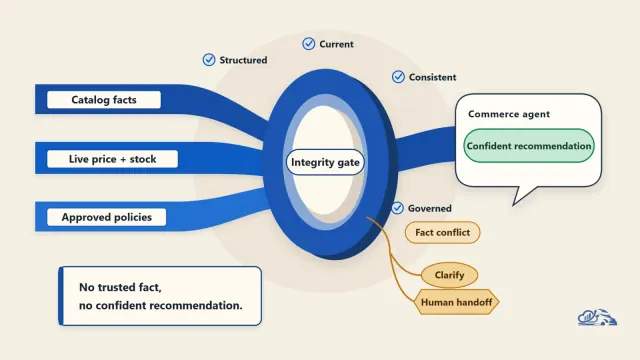
Here's the catch. When an agent picks the product, the brand that wins is the one the agent understands and trusts. Clear product data, honest reviews and a strong reputation matter more than a clever ad, a big slogan or a high bid in an auction that the agent never even sees.
From phone agent to home agent: how buying could change
Picture a simple chore. Today, you notice you're out of dish soap, open an app and pick a brand. You might search, read reviews, compare a few prices or just buy the same one you always buy, because habit wins most small purchases like this one.
With a phone agent like Muse, you can say "order more dish soap" and let it choose. It may pick your usual brand, the cheapest one or the one with the best reviews. That's already happening, and it's why we covered agentic commerce in depth.
With a home agent, you might not even ask. A robot could see the empty bottle and suggest a refill, or reorder it if you've said that's fine. The buying moment shrinks to almost nothing.
Brands lose the shelf. They lose the search page and the ad slot too, which are the places where most of them win the sale today.
Our guess. Meta hasn't announced anything like this, but it follows the same path as voice assistants and subscription refills, only with a much smarter agent in charge.
What to do now, and what can wait
You don't need a robot strategy. You need an agent strategy, and most of it is work you should be doing anyway. Here's how we'd sort it:
| Do now | Watch | Wait |
|---|---|---|
| Check how Muse, ChatGPT and Gemini describe your products | Whether Muse adds shopping fees or paid placement | Ads or content made for robots |
| Keep product data complete: names, sizes, prices, stock | Max 2 and any Meta robot news | Packaging redesigns for robot cameras |
| Make product pages easy for AI to read and quote | US rules on Chinese robots | Big budgets for home-robot channels |
| Earn honest reviews on trusted sites | 1X NEO deliveries and how buyers use them | Partnerships with robot makers |
Start with the first column. Ask Muse and other assistants the questions your buyers ask. Note which brands they pick and why. Our guide to Meta's Q3 2026 earnings explains why Muse is already a shopping channel worth checking.
Then fix the gaps. If an agent gets your price wrong or can't find your sizes, that's a data problem you can solve today. The same fix helps you in search, in chat assistants and in any home device that comes later.
A simple example
Here's a made-up case. A small brand sells eco-friendly cleaning products online and in a few stores. Most of its sales come from repeat buyers.
The team asks Muse, ChatGPT and Gemini to "recommend a refillable dish soap." Two of the three name a large rival. Ouch. One names the brand but lists an old price and a size it no longer sells.
Fixes come next. They fix their product feed, update their pages with clear sizes, prices and ingredients and add a simple FAQ about refills. They also ask happy customers to leave reviews on a trusted retail site.
A month later, two assistants name the brand, both with the right price. No robot was involved, yet the same work would help if a home agent ever made the call. We made up every detail in this example to show the steps, so don't read it as a real case or a promise of results.
What not to do
Robot news brings hype. Avoid these traps:
- Don't treat Max as a product, because Meta says it has no plans to sell it, there's no launch date and nobody outside the company has even seen a photo of it.
- Don't repeat the specs as facts. They come from one report that Reuters couldn't verify.
- Don't buy "robot-ready marketing" services. There's nothing to be ready for yet.
- Don't ignore the agent shift because the robot is far off, because Muse and other shopping agents are live now and already choose products for people every day.
- Don't collect home data in ways your customers wouldn't expect, because trust will decide which brands people let their home agents buy for them.
Trust, privacy and the home
A robot in the home sees a lot. It has cameras, microphones and, if Muse is inside, access to your accounts. That raises hard questions about privacy, and Meta's past makes some people wary.
Muse's launch already showed the trade-off. Launch coverage pointed out two sides of the same design:
- Meta runs Muse in a secure virtual machine that holds the agent, your data and your logins.
- Meta can still access that data when it needs to run, support or secure the service.
For brands, the lesson is simple. Any plan that touches the home, from smart speakers to future robots, has to respect what people expect. Brands that are open about data will be easier for people, and their agents, to trust.
What to watch next
A few signs will show whether the Meta humanoid robot is a side project or a real bet:
- Whether Meta confirms Max in public or shows it at an event.
- Max 2.
- Whether Meta hires more robot staff or buys a robot company.
- How US lawmakers treat Chinese robot parts and partners, including whether the GUARD Act or the Senate bill moves forward and whether either one ever reaches past federal buyers.
- How fast Muse grows as a shopping tool, and whether Meta adds commerce fees.
The last point matters most for marketers. Muse is real, live and growing. A robot is a maybe, years away.
Meta humanoid robot: our take
The Meta humanoid robot story is plausible but unconfirmed. It fits everything Meta has said about robots since 2025: a home helper, a software-first plan and partners for the hardware. But one report is not a launch.
The three-month build is the most telling detail. It shows how fast a company can now put a humanoid together with off-the-shelf chips and a partner's body. The hard part, as Bosworth said, is the software that makes it useful.
For marketers, the Meta humanoid robot is a sideshow. The main event is the agent. Make sure Muse and the other assistants understand your products today, and you'll be ready for wherever they show up next.
How Vanaxity helps
We help brands show up where buyers now ask for advice: in AI assistants like Muse, ChatGPT and Gemini. We check how they describe your products, which sources they trust and how often they recommend you. Then we fix the pages and data behind those answers.
If AI agents are starting to shape how your customers buy, explore our services or browse more insights.
Frequently asked questions
What is Meta's humanoid robot Max?
Max is the internal name of a humanoid robot prototype Meta reportedly built with Chinese company Fourier in about three months. The Information reported it on October 31, 2026. It reportedly weighs about 48 kg, stands about 1.5 metres tall and runs on an Nvidia Jetson Thor chip.
Can you buy Meta's humanoid robot?
No. Meta told The Information the Fourier work is internal research and that it has no plans to sell these robots. No launch date has been set.
Who is Fourier?
Fourier is a robotics company in Shanghai. It was founded in 2015, was formerly called Fourier Intelligence and began with rehab robots before it moved on to humanoids such as the GR-1, GR-2 and GR-3.
What does Muse have to do with the robot?
Muse is Meta's personal AI agent, launched in the US in September 2026. Meta reportedly sees humanoid robots as a physical body for Muse that could do household tasks.
Should marketers prepare for home robots now?
Not directly. There's no product to market to. Instead, prepare for AI agents that choose products: check how Muse and other assistants describe you, keep product data complete and earn honest reviews.