Agentic Marketing Governance: Lessons From AI Futures
OpenAI's new AI Futures blog warns about concentrated power in autonomous systems. Here is how to turn that warning into an agentic marketing governance playbook.
Overview
Agentic marketing governance is the set of rules, logs, and human checkpoints that keep an autonomous marketing agent accountable to a person, not just to a prompt. It matters now because OpenAI just put the underlying risk on the record. On August 20, 2026, the company launched a publication called AI Futures to study how AI reshapes power, law, and personal freedom. Its flagship worry is what it calls "concentration of power risks."
AI Futures comes from a new internal group, the Strategic Futures team, led by former White House AI adviser Dean Ball. The society-wide version of the risk is OpenAI's concern. The brand-scale version is ours to solve, and it's the subject of this piece.
This article reads that launch as a signal for marketing leaders, then turns it into a practical governance playbook. One honest caveat first: OpenAI itself notes that AI Futures posts convey the views of the authors, not official OpenAI positions, and the blog is about society-wide power, not marketing. So the reported facts here are OpenAI's; the marketing translation is Vanaxity analysis, framed as recommendation, not certainty. It builds on our work on AI marketing governance and AI marketing security.
Key Takeaways
- On August 20, 2026, OpenAI launched AI Futures, a blog from its Strategic Futures team led by Dean Ball and reporting to chief strategy officer Jason Kwon, focused on "concentration of power risks."
- The team's core principles map cleanly to marketing: preserve human agency, keep systems accountable to human oversight, use data with privacy-conscious governance, and accept that no single entity can manage transformative AI alone.
- For marketing, the risk is smaller in scale but the same in shape: autonomous content and audience agents can concentrate decisions no human reviewed, at a speed no human can catch up to.
- Agentic marketing governance answers that by naming a human owner for every agent, logging its decisions, setting hard limits, and gating irreversible or public actions behind approval.
- Vanaxity's recommendation: write your governance rules before you scale your agents, treat brand safety and consumer trust as first-class metrics, and audit agent decisions on a schedule.
Map your SEO, GEO and AEO workflow before you build.

What Did OpenAI Actually Launch?
OpenAI launched a publication, not a product. AI Futures is a blog run by a new internal group, the Strategic Futures team, created to think through how advanced AI could reshape institutions, the economy, and personal freedom over the coming decade.
The team is led by Dean Ball, a former White House AI policy adviser. He reports straight to OpenAI's chief strategy officer, Jason Kwon, not through the global affairs group. Observers noted that reporting line, because it signals the work is meant to shape frontier AI policy and even draft legislation. The blog's opening theme is "concentration of power risks": the danger that transformative AI centralizes authority and disrupts the old balance between 3 groups, governments, corporations, and individuals.
**Vanaxity analysis:** Strip away the geopolitics and a simple pattern remains. When a system acts at scale with no human in the loop, decisions pile up inside it, and the people affected lose both visibility and recourse. That is a societal argument at OpenAI's scale. It is also, in miniature, what happens when a brand hands content, targeting, and spend decisions to autonomous agents with no governance around them.
Why Does AI Futures Matter for Marketing Teams?
It matters because marketing now runs on agents more than most teams admit. Content agents draft and publish. Audience agents segment and target. Bidding agents move budget, and outreach agents send messages, often faster than any person can review each step.
**Vanaxity analysis:** That is the concentration-of-power problem in a marketing costume. The agent isn't out to cause harm; it's just fast and unwatched. When something goes wrong, an off-brand claim, a biased-looking targeting choice, a message that breaks a privacy rule, the harm is public before a human sees it. And because the agent made the call, there's often no clear record of why.
The stakes are not abstract. One autonomous misstep can trigger a brand-safety incident, a regulatory complaint, or a trust breach, any of which can cost far more than the campaign the agent was running. Regulators are already moving, too: labeling rules for AI-generated ads and content are tightening, a shift we cover in our note on Google's ad AI labeling. Governance is how you stay ahead of that, instead of reacting after the damage is done.
There's also an upside worth naming. Teams that can prove their agents are governed, logged, reviewable, and privacy-conscious, will win enterprise deals that ungoverned competitors can't touch. Governance is becoming a sales asset, not just a compliance cost.
How Do OpenAI's Principles Translate to Agentic Marketing Governance?
OpenAI's AI Futures principles read like abstract policy, but each one has a direct, concrete counterpart in how you run marketing agents. The table maps the principle to the practice.
| AI Futures principle | What it means at OpenAI's scale | Your agentic marketing governance practice |
|---|---|---|
| Human agency | Keep individuals in control of decisions that affect them | Name a human owner for every agent, accountable for what it publishes and spends |
| Human oversight | Autonomous systems stay accountable to people | Log every agent decision and gate public or irreversible actions behind approval |
| Privacy-conscious governance | Handle data responsibly by design, not after the fact | Limit what audience agents can access, and record how personal data is used |
| Avoid concentrated power | Don't let one system centralize authority unchecked | Set hard limits on budget, reach, and message volume per agent |
| Collective action | No single entity can manage transformative AI alone | Share governance across legal, brand, and data, not just the marketing team |
**Vanaxity analysis:** Read the right-hand column as a checklist. None of it slows a well-behaved agent down; it only catches the ones about to make a mistake. That is the whole point of governance: it's invisible until the moment it saves you.
What Does Agentic Marketing Governance Ask of Human Agency?
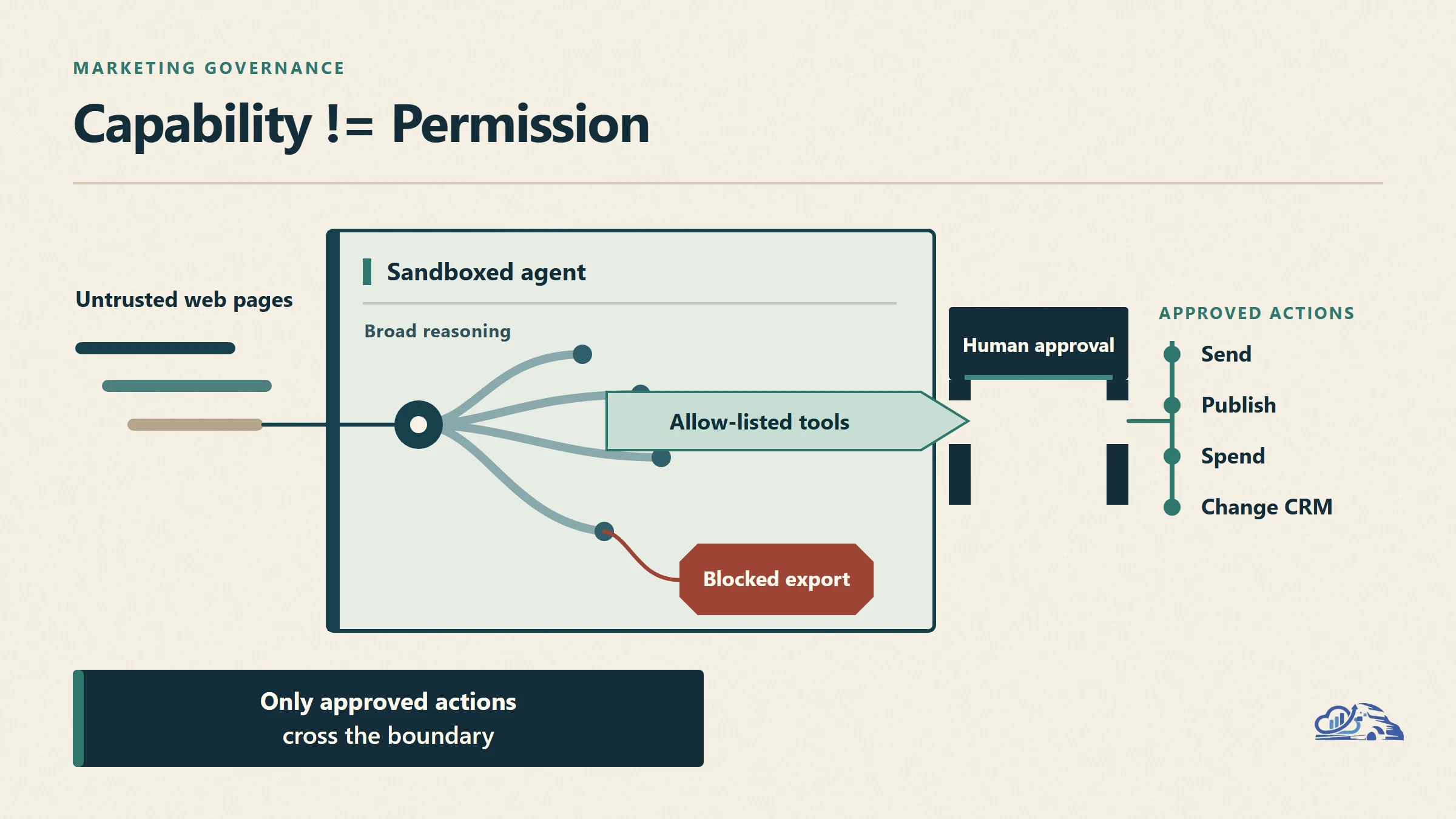
Human agency, in practice, means a named person is answerable for every agent, and that person can stop it. Not a committee, not "the marketing team," but one owner who understands what the agent does and holds the off switch.
- Every agent has a documented owner, a defined job, and an explicit list of what it may not do.
- Irreversible or public actions, publishing, sending, spending above a threshold, require a human approval step.
- A kill switch exists and is tested, so any agent can be paused in seconds, not hours.
- Escalation paths are written down, so the agent hands off to a person when it hits an edge case instead of guessing.
This mirrors the human-in-the-loop discipline we describe for production systems, and it's the single highest-leverage control you can add. An agent that must ask before it acts on anything public is dramatically harder to turn into a brand-safety story.
How Do You Keep Autonomous Agents Brand-Safe?
Brand safety for agents is mostly about constraints and evidence: tell the agent what it cannot say, and keep a record of what it did say. The goal is that an off-brand or non-compliant output is blocked before it ships, not caught after it trends.
- Maintain a living list of banned claims, prohibited topics, and required disclosures, and enforce it at generation time.
- Require sources for factual claims, so an agent can't publish a confident statement it can't support.
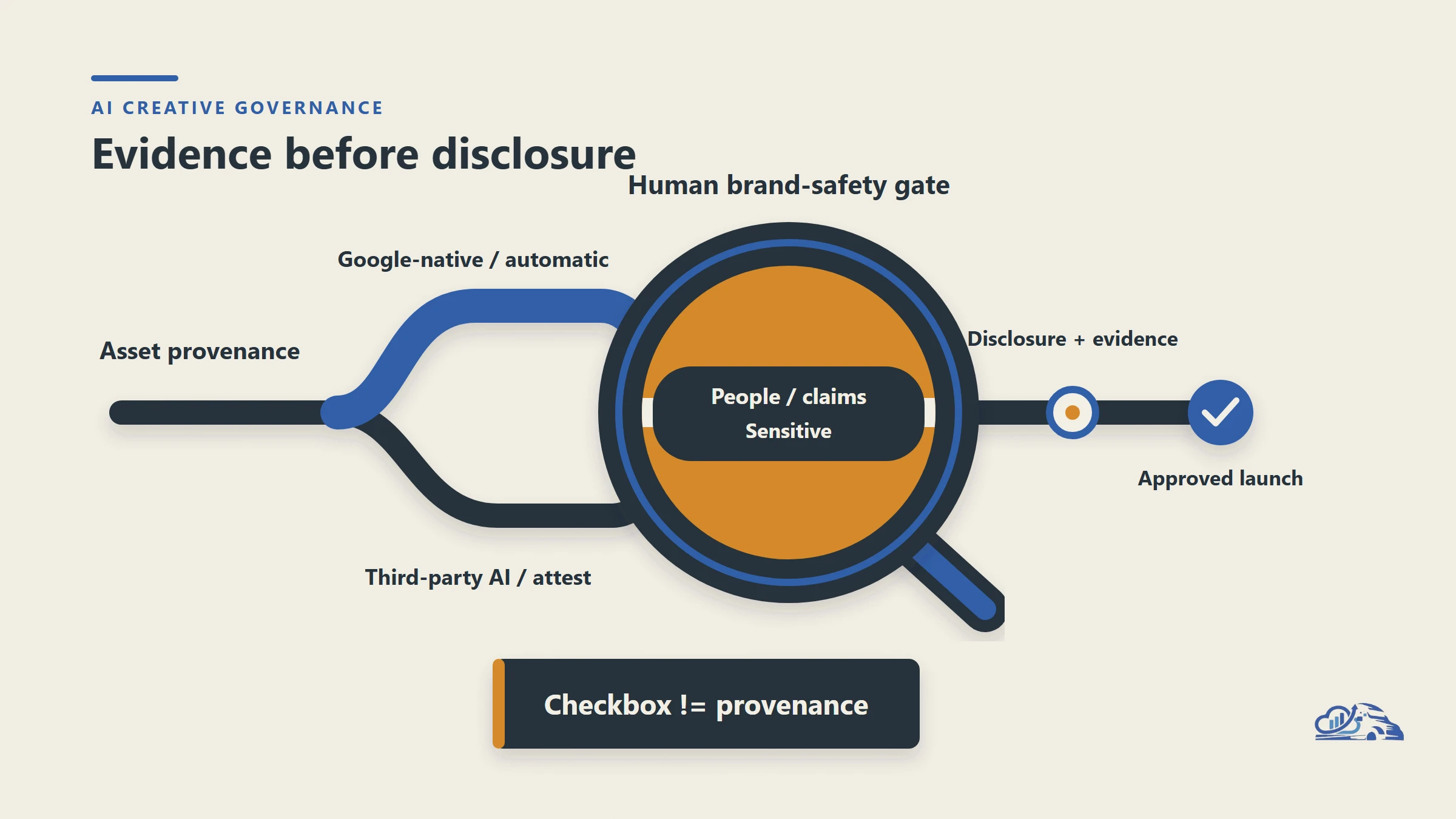
- Log every generated asset with its prompt, model, and approver, so any output is traceable after the fact.
- Run a periodic audit that samples agent output against your brand and legal standards, not just a launch-day review.
- Label AI-generated content where rules or platforms require it, and treat labeling as a default, not an afterthought.
**Vanaxity analysis:** Notice that four of these five controls produce a record. That's deliberate. When a regulator, a platform, or your own executive asks "why did the agent do that," a governed team has a log to point to, and an ungoverned team has a shrug. The log is the difference between an incident and a crisis.
What About Data and Consumer Trust?
Audience agents are where governance gets most sensitive, because they touch personal data. OpenAI's privacy-conscious framing fits here almost word for word. Handle data with care by design, and don't collect or use what you can't justify.
In practice, that means scoping each audience agent to the minimum data it needs, recording how personal data flows through it, and being able to explain any targeting decision in plain language. If you can't explain why a person was targeted, that's a governance gap, not a clever optimization. Consumer trust is the asset you're protecting, and it's far cheaper to keep than to rebuild.
This is also where marketing governance meets security. An audience agent with broad data access is both a privacy risk and an attack surface, a connection we explore in AI marketing security. Minimizing an agent's data access improves both at once.
Where Should You Start With Agentic Marketing Governance?
Start small and concrete. You don't need a governance department; you need to write down a few rules before your agents outrun them.
- Inventory every autonomous or semi-autonomous agent already touching your marketing, and name an owner for each.
- For each agent, write one page: what it does, what it must never do, and which actions need human approval.
- Turn on logging everywhere, so every agent decision leaves a record you can audit later.
- Add an approval gate to the riskiest action first, usually publishing or spending, then expand.
- Schedule a monthly audit that samples agent decisions against brand, privacy, and legal standards.
- Loop in legal and data owners early, so governance is shared, not a marketing-only burden.
This is a bounded first pass, not a boil-the-ocean program. The inventory alone usually surfaces one or two agents nobody realized were acting unsupervised. Fix those, and you've removed most of your risk for a fraction of the effort. From there, governance becomes a habit you extend agent by agent, the same incremental way we approach citation optimization.
How Vanaxity Approaches Agentic Marketing Governance
Vanaxity treats governance as something you can design once and reuse, not a document that sits in a drawer. We start with an inventory of your marketing agents and the decisions they make unsupervised, so the risk is visible before it's an incident.
From there, we help define owners, approval gates, logging, and audit routines that fit how your team actually works, and we tie brand safety and consumer trust to metrics you can track. If you want help, our services can produce a governance baseline, an agent inventory, and an approval-and-audit plan for your autonomous marketing. You can also browse more field notes in our insights library. The goal is simple: your agents move fast, and a human is still accountable for every move they make.
Frequently asked questions
What is OpenAI's AI Futures?
AI Futures is a publication OpenAI launched on August 20, 2026, run by its new Strategic Futures team, led by former White House AI adviser Dean Ball and reporting to chief strategy officer Jason Kwon. It studies how transformative AI reshapes power, law, and individual freedom, and its opening theme is "concentration of power risks." OpenAI notes the posts reflect the authors' views, not official OpenAI positions.
What is agentic marketing governance?
Agentic marketing governance is the practice of keeping autonomous marketing agents accountable to people. It means naming a human owner for every agent, logging its decisions, setting hard limits on what it can publish or spend, gating public and irreversible actions behind human approval, and using data in a privacy-conscious way, so speed never outruns brand safety or consumer trust.
Why does an OpenAI policy blog matter for marketers?
Because marketing is becoming highly agentic, and OpenAI's concentration-of-power warning describes the same risk in miniature: when systems act at scale without a human in the loop, decisions concentrate and accountability disappears. The society-wide version is OpenAI's concern; the brand-scale version, an unsupervised agent making a public mistake, is the one marketing leaders can act on today.
How do you keep an autonomous marketing agent brand-safe?
Constrain it and record it. Maintain an enforced list of banned claims and required disclosures, require sources for factual statements, log every asset with its prompt and approver, gate public actions behind human approval, and run periodic audits that sample output against brand and legal standards. Most of these controls produce a record, which is what turns a potential incident into a traceable, defensible decision.
Does governance slow marketing agents down?
Barely, if it's designed well. Good governance is invisible for well-behaved agents; it only intervenes on the risky actions, publishing, spending above a threshold, or touching sensitive data. The friction lands exactly where a mistake would be expensive, and nowhere else, so your agents keep their speed while a human stays accountable for the actions that matter.
Where should a team start with agentic marketing governance?
Inventory every agent already touching your marketing and name an owner for each. Write a one-page rulebook per agent covering what it does, what it must never do, and which actions need approval. Turn on logging everywhere, add an approval gate to the riskiest action first, and schedule a monthly audit. Bring legal and data owners in early so governance is shared, not a marketing-only task.