Google ATLAS AI Study: Collaborator, Not Automator
The Google ATLAS AI study finds collaboration dominates automation. Get verified adoption facts and a human-in-the-loop plan for marketing teams today.
Overview
B2B marketing, RevOps, and content teams evaluating autonomous agents face a specific decision: whether to redesign work for hands-off automation when Google’s ATLAS data shows workplace AI is used mainly as a collaborator. This article separates the Google ATLAS AI study’s verified adoption findings from Vanaxity’s marketing analysis and gives you a practical framework for citable content, assistive workflows, and human review checkpoints—the way Van Data Team approaches SEO, GEO, and AEO.
The Google ATLAS AI study shows that people currently use AI mainly to think, retrieve information, learn, and shape strategy, not to hand whole tasks to a machine. For B2B marketing, RevOps, and content leaders being sold a hands-off agent future, the useful headline is blunt: Google's July 23, 2026 ATLAS announcement reports that less than 10% of workplace AI interactions fully automate tasks.
Google published ATLAS as a comprehensive analysis of how people adopt and use AI. The finding does not make AI agents irrelevant; it makes workflow design decisive. Vanaxity, Van Data Team's AI content agent, turns approved research into writing, illustration, publishing, and syndication for SEO, GEO, and AEO, with human review at consequential steps. This article separates Google's evidence from Vanaxity's analysis, then gives operators a practical content, agent, and brand-audit framework. You can also see how Vanaxity makes the workflow operational.
Key Takeaways
- Google found that full task automation is a small minority; collaborative uses such as ideation, strategy, information retrieval, and learning dominate.
- Workplace adoption is wide across occupations and employment, yet AI use remains selective within a typical job. Breadth is not complete job automation.
- Most interactions observed in ATLAS occur outside work, but that does not prove a change in search behavior, purchase intent, or buying.
- Vanaxity's recommendation is to build assistive agents with review gates and make brand information specific, current, verifiable, and easy for machines and people to interpret.
Map your SEO, GEO and AEO workflow before you build.

What the Google ATLAS AI Study Actually Found
ATLAS is a large AI-adoption and usage study whose central result is broad, task-specific collaboration rather than wholesale automation.
| ATLAS question | Reported by Google | What the result does not establish |
|---|---|---|
| What does ATLAS stand for? | Activity, Task, Landscape, and Adoption Study. | It is not a keyword, search-intent, or customer-data study. |
| What are the core specifications? | ATLAS analyzed 15 million aggregated, de-identified interactions across 150+ countries, 140 languages, 800 occupations, and 4,000 tasks; in a typical job AI is used for only ~21% of tasks; workplace adoption spans 68% of all occupations representing 90% of total U. S. employment; and over 86% of interactions occur outside work. | Coverage and reach do not turn the dataset into evidence about searches, buyers, conversions, or revenue. |
| How much observed workplace use is full automation? | Less than 10% of workplace interactions fully automate tasks. | The study does not test autonomous marketing-agent performance. |
| What dominates instead? | Collaborative use, including ideation, strategy, information retrieval, and learning. | Collaboration does not establish productivity, displacement, wages, or job loss. |
The unit that matters is the human-AI interaction around a task. Assisting a person inside a task is different from independently completing the task and owning its consequences.
"less than 10% of those interactions fully automate tasks"
That trade example shows a mode of use. It does not establish a safety, productivity, or financial outcome.
The Boundary: Adoption Is Not Search or Buying Data
ATLAS measures how AI is adopted and used; it does not measure how people search, what they intend to buy, or whether marketing performs better.
That boundary blocks several tempting but invalid claims. The study provides no benchmark for conversational keywords, no evidence that keyword search has shifted to dialogue, no purchase-intent data, and no CDP or predictive-analytics benchmark. It also does not compare autonomous marketing agents with human teams.
Reported fact: AI use is broad and predominantly collaborative. Scope limit: the observed interactions do not reveal search journeys or commercial intent. Vanaxity analysis: brands should prepare for AI-assisted research because everyday AI use is broad. Operator action: test what selected AI systems surface about your brand, while labeling that output as representation data, not demand or revenue evidence.
This separation matters because scope inflation creates bad strategy. If an adoption study becomes a fictional conversion study in the next slide deck, the team will automate against assumptions it never validated.
Why the Collaborator Finding Tempers Agent Hype
Vanaxity's analysis is that ATLAS supports augmentation more strongly than abdication, although Google did not study marketing agents or recommend a marketing operating model.
The hands-off promise says an agent can research, decide, write, publish, distribute, update records, and contact customers without meaningful supervision. The evidence in ATLAS is narrower: people commonly use AI inside selected tasks, and collaboration dominates full automation. That pattern is more consistent with bounded assistance than with surrendering accountability.
The useful comparison is not people versus machines. It is unmanaged automation versus a governed system that gives agents clear inputs, permissions, evidence requirements, and stop conditions. The Vanaxity versus traditional SEO comparison shows where an agent can compress repetitive work while people retain judgment over sources, claims, positioning, and publication.
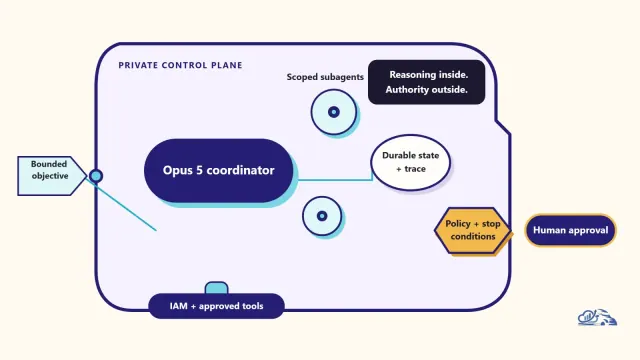
For consequential marketing and RevOps work, place human approval at these gates:
- Approve source sets before retrieval and drafting.
- Verify material facts and citations before publication.
- Review legal, brand, and policy-sensitive claims.
- Confirm entity matches before any CRM mutation or outbound action.
- Resolve conflicting, missing, or stale evidence before the workflow continues.
Hypothetical example: Elena leads content at a B2B software company. Her agent builds a brief from approved sources and drafts an answer page. During review, Elena finds that the central product claim points only to an old secondary article. The workflow stops, the claim is removed, and no page is published. The value is not hands-free output. It is faster preparation with visible accountability.
What Everyday AI Use Means for Brand Discovery
Vanaxity's analysis is that broad everyday AI use justifies making brand information answer-ready, but it does not prove that users changed their search habits or made purchases through AI.
The outside-work finding shows that AI is not confined to formal workplace processes. A reasonable editorial extrapolation is that brands should be prepared when people use AI for research, comparison, explanation, and learning. It is not reasonable to call those interactions product searches or buying journeys without separate evidence.
Answer-ready content reduces ambiguity that a brand can control. Maintain:
- A consistent company, product, and founder identity across owned pages.
- Clear descriptions of audiences, use cases, limitations, policies, and contact routes.
- Specific claims linked to primary evidence, with visible dates and responsible owners.
- Stable definitions and concise answers that can stand alone outside the surrounding page.
- Structured data that accurately matches visible content and uses the relevant Schema.org vocabulary.
Google's structured data guidelines reinforce a useful discipline: markup should represent the page accurately, stay current, and avoid misleading claims. Correct markup can make information easier to interpret, but it does not guarantee a rich result, ranking, AI citation, or recommendation. Readiness is an input you control, not an outcome you can promise.
A Human-in-the-Loop Operating Framework
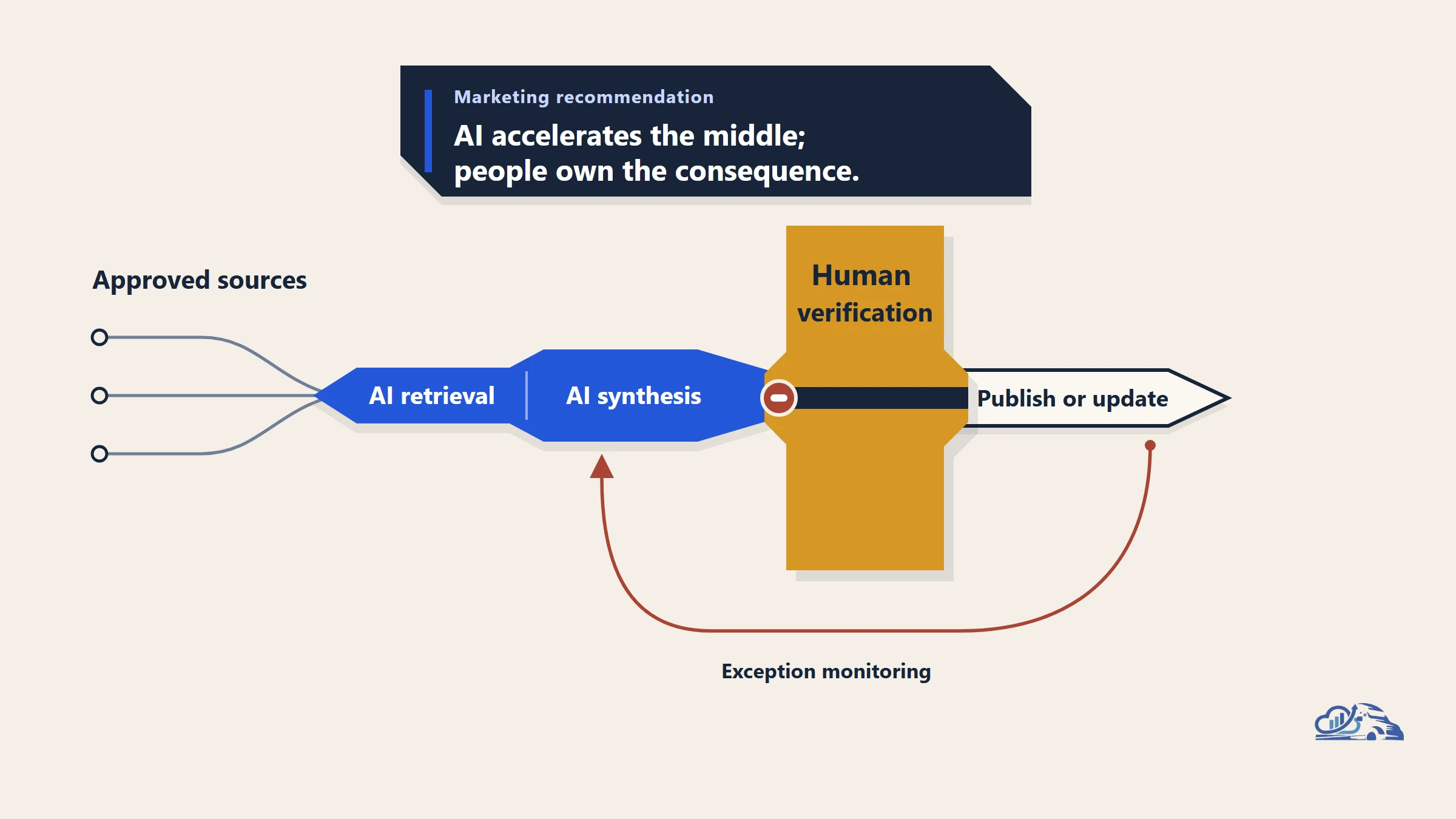
A production-ready AI collaborator workflow keeps evidence, permissions, human accountability, evaluation, and recovery visible from the first question to the final action.
At Van Data Team, we start by mapping claims and consequences. Then we decide where an agent can assist, what evidence it must return, and which actions require a named reviewer. The core flow is simple:
Question -> approved sources -> retrieval -> synthesis -> fact check -> human approval -> publication or action -> monitoring
| Stage | Agent responsibility | Human gate | Failure response |
|---|---|---|---|
| Define | Turn the business question into a bounded task and required output. | Confirm scope, audience, and prohibited claims. | Rewrite the task before retrieval begins. |
| Retrieve | Use approved sources and preserve source URLs with each claim. | Confirm source authority, freshness, and relevance. | Reject unsupported or conflicting evidence. |
| Synthesize | Draft the brief, answer, report, or recommended action. | Separate verified facts from analysis and assumptions. | Return ambiguous claims for research. |
| Validate | Check citations, entity matches, dates, and internal consistency. | Approve material claims and sensitive content. | Block publication or mutation on failure. |
| Act | Publish, syndicate, update, or prepare outbound work within permission limits. | Approve consequential external actions. | Roll back where possible and open an exception review. |
| Monitor | Record output, sources, reviewer decision, and later corrections. | Review drift, stale facts, and recurring errors. | Update the source of truth and rerun affected work. |
Treat operational quality as more than model output. Measure cost per approved deliverable, end-to-end latency including review, token budget and retry behavior, source coverage, factual accuracy, reviewer burden, and exception frequency. Observability should capture the question, model or tool environment, retrieved evidence, output, reviewer, decision, and remediation. Failure recovery needs a safe stop, a responsible owner, and a reversible path wherever the system can change external state.
For AI-assisted brand research, keep a repeatable audit record: the prompt, tool, environment, whether the brand appears, claims made, cited sources, accuracy, contradictions, and remediation decision. This audit measures representation and source visibility. It does not measure demand, intent, conversion, or revenue.
Want to inspect the operating model before scoping it? Watch the Vanaxity workflow. A useful review should leave you with a source map, claim ledger, permission matrix, review-gate design, measurement plan, and implementation scope.
Operator Scenarios, Stop Conditions, and Failure Modes
Good collaborator workflows stop when evidence, identity, permissions, or measurement meaning becomes uncertain.
Content Research and Drafting
Hypothetical scenario: Priya's content agent collects approved sources, proposes an outline, and marks every sourced statement. Priya validates the evidence and decides which conclusions are editorial analysis. The stop condition is simple: if a central claim cannot be traced to an approved source, the draft cannot move to publication.
RevOps Account Research
Hypothetical scenario: Marcus asks an agent to summarize a target account from public material. The agent produces a research note, but multiple companies share a similar name. Marcus confirms the legal entity and evidence before the CRM changes. If identity remains ambiguous, the workflow records the conflict and takes no action.
GEO and AEO Brand Auditing
Hypothetical scenario: A brand team submits representative research questions to selected AI tools, captures answers and cited sources, and corrects stale information on owned pages. The stop condition arrives when someone treats answer inclusion as proof of purchase intent or commercial impact. That conclusion requires separate measurement.
| Failure mode | Detection signal | Required guardrail |
|---|---|---|
| Scope inflation | Copy says ATLAS proved a search or buying shift. | Replace the claim with an explicit Vanaxity analysis label and scope caveat. |
| Hidden autonomy | An agent can publish, message, or mutate records without approval. | Restrict permissions and add a named review gate. |
| Citation failure | A material claim has no approved source. | Block the output until evidence is attached or remove the claim. |
| Entity confusion | Company, product, or contact details conflict. | Validate against an owned source-of-truth record. |
| Stale facts | AI repeats outdated features, policies, or positioning. | Assign update ownership and audit affected pages. |
| Misleading measurement | AI-answer presence is reported as revenue impact. | Separate visibility and accuracy metrics from commercial outcomes. |
How Van Data Team Makes This Operational
At Van Data Team, we turn the Google ATLAS AI study into an operating workflow rather than leaving its collaborator finding as theory. We map the current handoff across source systems, research, drafting, approval, publishing, and reporting. For each step, we record the decision owner, inputs, tool calls, review gate, failure state, and recovery path.
That map becomes a scoped delivery plan. It specifies the signals to capture: source provenance, citation accuracy, agent traces, reviewer interventions, and surfaced brand claims. It also identifies workflow gaps and the actions that may run automatically only behind human review checkpoints. The dashboard shows queued decisions, unsupported claims, exceptions, and failed handoffs; the runbook tells operators what to verify, retry, escalate, or roll back.
This is Vanaxity’s operational interpretation, not a Google finding. ATLAS measures AI adoption and usage, not search behavior, buying intent, or marketing performance. We therefore evaluate assistive agent workflows against observable outputs: whether research is verifiable, content is answer-ready, approvals are auditable, and the team can recover when an agent is wrong. The goal is not maximum autonomy. It is dependable collaboration that leaves the next action clear.
Frequently asked questions
What Is Google's ATLAS AI Study?
ATLAS stands for Activity, Task, Landscape, and Adoption Study. It is Google's comprehensive analysis of aggregated, de-identified human-AI interactions across countries, languages, occupations, and tasks. Its subject is adoption and usage, not search intent, customer journeys, or marketing performance.
What Did ATLAS Find About AI Automation?
Google found that full automation was a small minority of observed workplace interactions. Most interactions were collaborative, including ideation, strategy, information retrieval, and learning. The distinction is between assisting a person inside a task and completing the task without human involvement.
Does ATLAS Show That AI Is Replacing Entire Jobs?
No. Google's published findings describe AI use across occupations and tasks; they do not measure job displacement, wage effects, productivity, or entire-job replacement. Broad occupational adoption and selective task use cannot be converted into a job-loss claim.
Does ATLAS Measure Search or Purchase Behavior?
No. ATLAS does not measure queries, keyword patterns, search journeys, conversational search adoption, purchase intent, conversion, or revenue. Any GEO, AEO, or brand-discovery recommendation in this article is Vanaxity's extrapolation from adoption data, not a Google finding.
What Does ATLAS Mean for Autonomous Marketing Agents?
ATLAS does not test or validate autonomous marketing agents. Vanaxity's analysis is that its collaboration pattern favors bounded assistance with approved sources, limited permissions, human review, and clear stop conditions over unsupervised end-to-end execution.
Why Does Outside-Work AI Use Matter to Marketers?
It shows that AI use extends beyond formal job tasks. Vanaxity treats that breadth as a reason to prepare accurate, answer-ready brand information for possible AI-assisted research. It does not treat the finding as proof of a search shift or buying behavior.