AI Impressions vs Clicks: What Ziff Davis's 37% Drop Shows
Ziff Davis was cited 2.7 billion times in Google's AI answers, yet lost 37% of its Google clicks. How to read AI impressions, and what to track in their place.


In short: Treat AI impressions as a reach number, not a traffic number. Pull Search Console's generative AI report each week, set it beside clicks and conversions for the same pages, and watch branded search and direct visits for the delayed effect. Claim your ChatGPT business profile when it opens, but keep your own prompt tests, because neither dashboard shows the questions people ask.
On this page15
Overview
Ziff Davis owns sites such as IGN, PCMag, Mashable and RetailMeNot. On November 6, 2026, it shared the clearest public data yet on AI impressions vs clicks. Its content showed up in Google's AI answers about 2.7 billion times in one quarter, yet its Google clicks fell about 37% from a year earlier.
So being seen by AI is one thing. Being visited is another. Google already reports AI impressions in Search Console, and OpenAI looks set to do the same for ChatGPT. Both will give marketers a new number, and it's easy to read it wrong.
This guide covers what Ziff Davis reported and what AI impressions count. It also covers what the leaked ChatGPT tool shows, and how to measure AI visibility so it ties back to revenue.
Disclosure: Vanaxity builds AI agents for marketing, including tools that track how brands show up in AI answers. We have a stake in this topic. This article was drafted with help from Claude. Its numbers come from company statements and press reports, and we label our own math.
Key takeaways
- Ziff Davis said its content was cited in AI Overviews and AI Mode about 2.7 billion times in the third quarter, nearly ten times its Google clicks.
- Its organic Google referrals fell about 37% from a year earlier, and more than 50% over two years.
- The 2.7 billion number comes from Search Console's generative AI report, which counts impressions only.
- A leaked ChatGPT business tool shows daily impressions and clicks, but no prompts and no competitor data. OpenAI hasn't confirmed it.
- Search fell to 12% of North American publisher pageviews in the third quarter, down from 21%, Chartbeat says.
- Use AI impressions as a reach metric, and judge them by clicks, conversions and branded demand.
Book a free fit checkMap your SEO, GEO and AEO workflow before you build.
Book a consultationZiff Davis: 2.7 billion AI impressions, 37% fewer clicks
CEO Vivek Shah shared the numbers on the company's third-quarter call, per the transcript. Organic referrals from Google fell about 37% year over year. In the same quarter of 2025, they had fallen about 23%. Over two years, that's a drop of more than half.
Then came the number that made headlines. Shah said Ziff Davis content was cited in AI Overviews and AI Mode responses roughly 2.7 billion times in the quarter. He put that at nearly ten times the clicks those same sites got from Google Search.
The company didn't give its click total. By PPC Land's math, ten times fewer than 2.7 billion means about 270 million clicks. That's a rough figure, not a reported one.
Why does one company matter? Most publishers don't share search data on earnings calls. Ziff Davis did, with numbers from Google's own tool. That makes it one of the clearest public before-and-after views of AI answers at work, even if it's only one company.
Shah was blunt about what comes next. Ziff Davis is "not planning on a search recovery," he said, and expects referrals to keep falling.
The numbers behind the drop
Here are the main figures from the call and the coverage of it:
| Measure | Reported figure | Change |
|---|---|---|
| Organic Google referrals, Q3 2026 | Not given in total | Down about 37% from a year earlier |
| Organic Google referrals, Q3 2025 | Not given in total | Down about 23% from a year earlier |
| AI Overviews and AI Mode citations, Q3 2026 | About 2.7 billion | New metric, no prior year |
| Total revenue | $289.3 million | Down 5.6% from $306.5 million |
| Advertising and performance marketing | $186 million | Down 7.7% from $202 million |
| Subscription and licensing | $98 million | Down 2.7% from $101 million |
Ziff Davis: drop in organic Google referrals from a year earlier
Drop in the third quarter
Revenue fell far less than traffic. That's because Ziff Davis earns a lot from subscriptions, apps and licensing. A site that lives on ad views alone would feel a 37% traffic drop much more.
The company also said headcount would be down about 10% by the end of the year, though Shah noted not all of that is about AI. For the fourth quarter, it expects revenue to fall by a low to mid single digit percentage from last year.
What Google counts as AI impressions
Shah said the 2.7 billion figure came from Search Console. Google introduced its Search generative AI performance reports on June 3, 2026. By August 31, they had reached all websites worldwide.
The report is simple. It counts how often URLs from your site appeared in AI features such as AI Overviews and AI Mode. You can view the data by:
- Page, to see which URLs showed up
- Country, to see where you're visible
- Device, for Search results
- Date, by hour, day, week or month
What's missing matters more. The report shows no clicks and no queries, PPC Land notes. It also doesn't split AI Overviews from AI Mode. So you can see that a page was shown, but not what the person asked, or whether they clicked.
Google also folds this data into the overall performance report, so AI impressions are already inside the totals you've been reading since June. A jump in impressions with flat clicks may simply mean you're showing up in more AI answers.
That makes the Ziff Davis ratio a loose one. It sets AI impressions against all Google clicks, not against clicks from AI features. Both numbers are real. They just don't measure the same thing.
AI impressions in ChatGPT: the leaked business tool
OpenAI seems to be building its own version. On November 6, Search Engine Roundtable reported a screenshot shared on LinkedIn by Juozas Kaziukėnas. The banner reads "Claim your business in ChatGPT."
Here's what the leak shows, and what it leaves out:
| Feature | In the leaked tool? | What it means |
|---|---|---|
| How often you're mentioned | Yes, as daily impressions | A reach number for ChatGPT |
| Clicks to your website | Yes, daily | More than Google's AI report shows today |
| Product and business updates | Yes | You can correct what ChatGPT says |
| A business agent | Yes | It answers buyers with context you control |
| Prompt or query data | No | You won't see what people asked |
| Competitor benchmarks | No | No share of voice view |
In effect, it's a ChatGPT business profile, a bit like a Google Business Profile for AI answers. Only businesses that verify ownership can use it, for example by connecting a Shopify store. Kaziukėnas said he saw its first steps in August, and a recent banner hints that launch is near. OpenAI hasn't confirmed any of it, so the final version may differ.
We covered how the tool fits with ChatGPT's ads in our ChatGPT Ads bidding guide. Here the point is simpler. If it ships, ChatGPT would report clicks next to AI impressions, which Google's AI report doesn't.
How big is ChatGPT as a search channel?
Adam Fry, who leads ChatGPT's consumer product, said ChatGPT now has 1.2 billion weekly users, up from 1 billion in about 60 days. He also said its search-like queries equal about one-fifth of Google's. OpenAI didn't say where its Google figure came from.
Other estimates are lower:
| Source | ChatGPT search volume vs Google | Basis |
|---|---|---|
| OpenAI, November 2026 | About 20% | Its own count of questions that send ChatGPT to the web |
| Ahrefs, February 2026 | About 12% | 2.5 billion daily prompts, 65% treated as search |
| seoClarity, refined model | About 3% to 8% | Scenario model of daily searches |
Traffic is a different story. Ahrefs found that Google sent about 40% of traffic to 76,000 websites, while ChatGPT sent 0.21%. That's about 190 times less. So ChatGPT is big as a place where people ask, but still small as a source of visits.
seoClarity's range comes from its refined model. Each estimate uses a different method, so treat the spread as the honest answer.
Why AI impressions don't turn into clicks
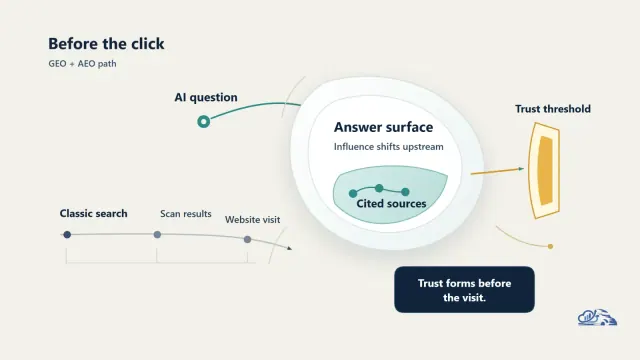
The gap isn't a bug. It's how AI answers work. The answer sits on the results page, so many people get what they need and leave. A citation is a link in a footnote, not a blue link at the top.
Four things widen the gap:
- Quick facts, such as a spec or a price, get answered in full
- Citations sit below or beside the answer, sometimes behind a click to expand
- One answer can cite many sources, so each gets a small share of attention
- People who do click are often further along and fewer in number
This is zero-click search taken one step further. For years, featured snippets and knowledge panels answered some queries on the results page. AI answers do it for far more of them, and in more depth. A person can compare three products or learn a whole topic without leaving Google or ChatGPT.
Publishers feel this most. Chartbeat data shows search fell to 12% of North American publisher pageviews in the third quarter, down from 21% a year earlier. That's a share, not a count, so it doesn't prove search sent fewer visits. Still, it points the same way as the Ziff Davis call.
Publishers vs brands: who loses the most
For a publisher, a visit is the product. Ads and affiliate links only pay when someone lands on the page. So an impression without a click earns close to nothing.
For a brand, the math is different. If an AI answer names your product to a buyer, that mention can still lead to a sale later. The buyer might search your name, visit your site directly or ask an AI agent to buy it.
That's why AI visibility can matter even when clicks fall. Our guide to citation optimization covers how to earn those mentions. The hard part is proving they pay off.
How to track AI impressions next to clicks
You don't need a new tool to start. Set up a weekly view that puts AI impressions beside the numbers that pay the bills:
- Export the generative AI report from Search Console by page and week
- Join it to clicks and conversions for the same pages from the main report and your analytics
- Track branded search and direct visits, where delayed demand tends to show up
- Tag visits from chatgpt.com and other AI tools as their own channel
Here's what each number tells you, and where to find it:
| Metric | What it tells you | Where to get it |
|---|---|---|
| AI impressions | How often AI answers show your pages | Search Console generative AI report |
| Clicks | How many people visit from search | Search Console performance report |
| AI referral visits | Visits from ChatGPT, Perplexity and others | Your analytics, by referrer |
| Branded search | Whether more people look for you by name | Search Console, filtered by brand terms |
| Conversions | Whether any of it pays | Your analytics or CRM |
Then add a manual check. Each week, ask ChatGPT, Gemini and Perplexity the questions your buyers ask, and note who gets named and which pages get cited. No dashboard shows prompts, so this is the only way to see them.
Look for pages with high AI impressions and few clicks. Those pages answer the question too well on the results page. Give them a reason to click, such as a tool, a full dataset or a comparison the summary can't hold.
A worked example with our own math
Take a software brand with these monthly numbers. They're made up, to show the method:
- AI impressions: 400,000 across 50 pages
- Clicks to those pages from Google: 20,000
- Trial signups from those clicks: 400, or 2%
- Branded searches: up 1,500 since the pages started showing in AI answers
Now the value. If 2% of those extra 1,500 branded searchers also sign up, that's 30 more trials. So the AI impressions bring 400 trials through clicks and perhaps 30 more through brand demand.
Clicks still carry most of the weight here. But the extra 30 trials are real, and a click-only report would miss them. The point isn't the exact figure. Measure the indirect path too, or you'll undervalue pages that AI answers quote.
To run this on your own data, you need about three months of AI impressions, clicks and branded searches. Fewer weeks than that, and normal swings will hide the pattern.
What to change in your content plan
Ziff Davis is moving toward direct audiences, apps, newsletters, video and licensing. Brands can take the same lesson at a smaller scale. Build reasons to come back that don't depend on a search click.
- Make pages AI tools can cite, with clear facts, dates and sources
- Add what a summary can't replace, such as tools, data and real examples
- Grow owned channels, such as email lists and communities
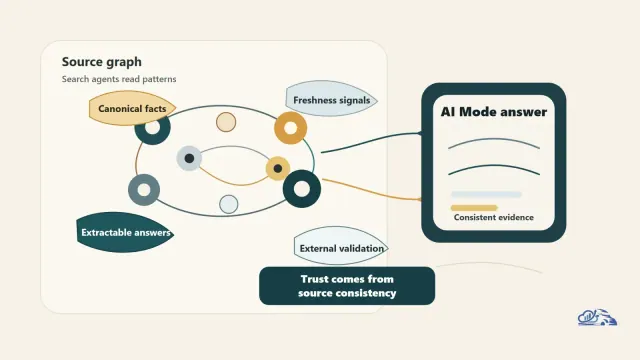
- Keep product and business facts the same everywhere AI tools read
Our explainer on generative engine optimization covers the content side in more depth.
The limits of AI impressions data
AI impressions are useful, but they're easy to over-read. Keep these limits in mind:
- Google doesn't publish how it counts an impression in AI features
- AI Overviews and AI Mode are mixed together in one number
- There are no queries, so you can't tell good reach from noise
- The ChatGPT tool is a leak, so its metrics may change before launch
And one company's numbers aren't a market trend. Ziff Davis is a large publisher with a lot of tech and shopping content. A local service firm or a B2B brand may see a very different pattern.
What to watch next
A few things will tell us more in the coming months:
- Whether OpenAI launches the ChatGPT business tool, and with which metrics
- Whether Google adds clicks or queries to its generative AI report
- Fourth-quarter results from Ziff Davis and other publishers
- The Ziff Davis lawsuit against OpenAI, filed in April 2025
Until then, the safest stance is simple. Count AI impressions, but don't celebrate them on their own. A rising line is good news only if clicks, signups or branded searches rise with it.
We'll update this guide as those land. For more on AI search, browse our insights, or see how we help brands track AI visibility.
AI impressions FAQ
What are AI impressions?
AI impressions count how often a page from your site appeared in an AI answer, such as Google's AI Overviews or AI Mode. Search Console reports them by page, country, device and date, but without clicks or queries.
Where do I find AI impressions in Search Console?
Google added generative AI performance reports to Search Console on June 3, 2026, and had rolled them out to all sites worldwide by August 31, 2026. The data is also part of the overall performance report.
How much Google traffic did Ziff Davis lose?
Ziff Davis said organic Google referrals fell about 37% year over year in the third quarter of 2026, after a 23% drop a year earlier. That's more than a 50% loss over two years.
Does ChatGPT have a Search Console for businesses?
Not yet, officially. A leaked screen reported on November 6, 2026 shows a tool to claim your business in ChatGPT, with daily impressions and clicks for verified businesses. OpenAI hasn't confirmed it.
Are AI impressions worth tracking if they don't bring clicks?
Yes, as a reach metric. Track them beside clicks, conversions, branded search and direct visits, so you can see whether AI visibility leads to demand later.