DeepSeek-V4-Flash: Evaluate a Silent Agent Upgrade
Evaluate DeepSeek-V4-Flash for production agents: pin the build, test the full tool loop, and compare cost per accepted outcome before a controlled rollout.
Overview
Bottom line
DeepSeek-V4-Flash-0731 is a post-training update delivered in public beta through the existing API alias, retaining the preview architecture, size, and API surface. DeepSeek reports a TerminalBench 2.1 score of 82.7, which makes the model worth testing but does not establish production readiness.
DeepSeek-V4-Flash is worth testing, but engineering and platform teams building agents and coding or automation workflows shouldn't adopt it from a benchmark headline. They also shouldn't accept a silent upgrade unchecked. Either choice can create slow, brittle, hard-to-debug production behavior. Use a controlled rollout: pin or record the build, regression-test the full agent loop, and model cost per accepted outcome before promotion.
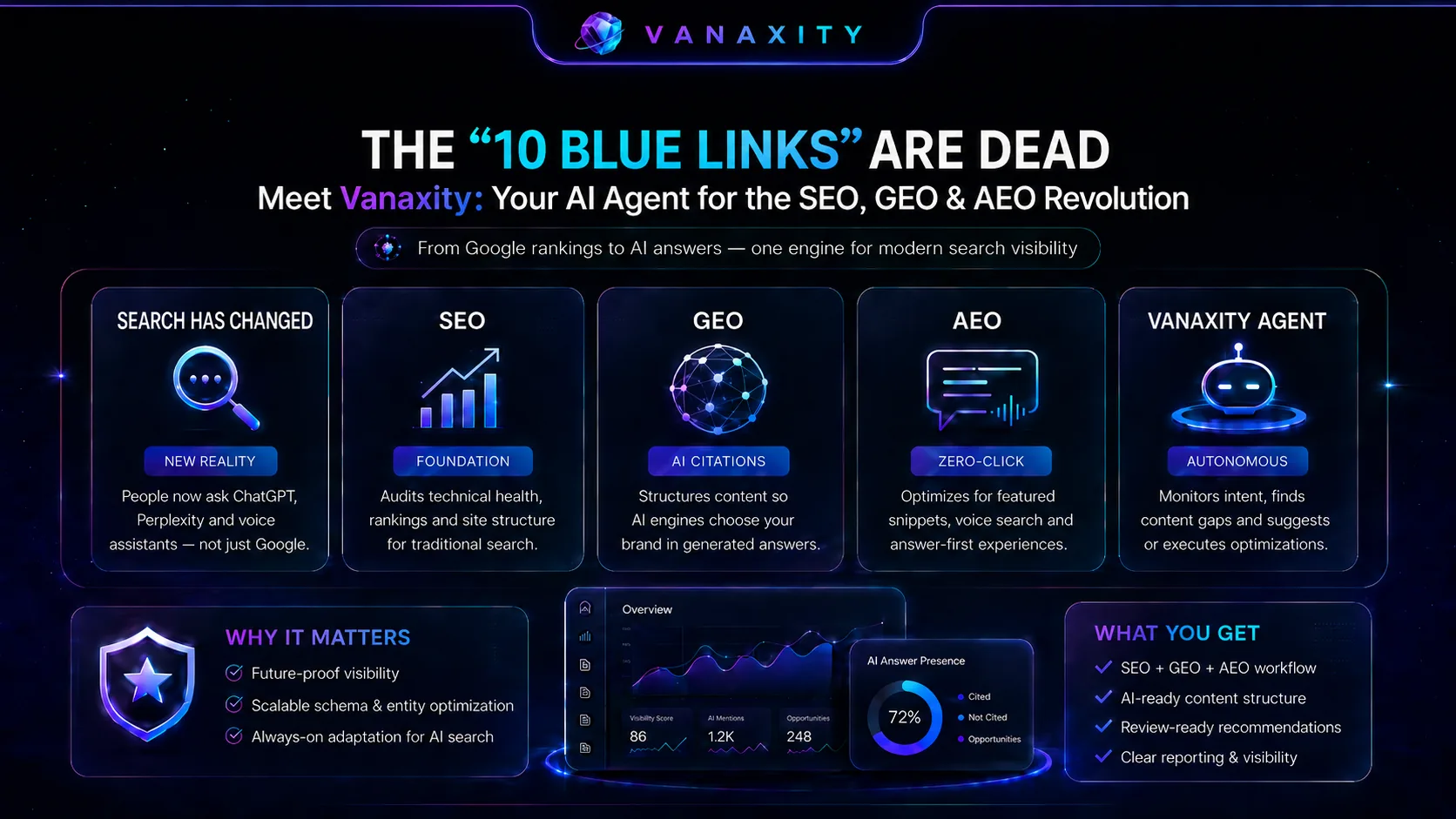
DeepSeek shipped the V4-Flash-0731 post-training update on July 31, 2026 in public beta through its existing API alias. The same API call can now produce different plans, tool choices, and stopping behavior. Vanaxity, Van Data Team's AI content agent for SEO, GEO, and AEO, applies this evaluation discipline across research, writing, illustration, publishing, and syndication. You can see how Vanaxity works and where its review gates sit.
Key Takeaways
The safest adoption path treats the release as a candidate build, not an automatic production replacement.
Can post-training still change agent behavior if the preview architecture and size are unchanged?
The retrained build keeps the preview architecture and size, but post-training can still change agent behavior.
Does retaining the endpoint, API key, and model name remove deployment risk?
Existing callers retain the endpoint, API key, and model name, reducing migration work without removing deployment risk.
Do public agent benchmarks approve the model for production?
Public agent benchmarks qualify the model for testing, not production approval.
What should teams evaluate across the complete agent loop?
Evaluate tools, retries, latency, token budgets, recovery, and review effort across the complete agent loop.
What should teams do if they cannot pin a callable build?
Pin a callable build when possible. Otherwise, preserve metadata, change monitoring, evaluation history, and a tested fallback.
Map your SEO, GEO and AEO workflow before you build.

Silent-Upgrade Rollout Checklist
The following illustration summarizes three gates before tool access:
Figure 1. Treat a silent model update like any production dependency: compare traces, test held-out tasks, canary safely, and preserve a working fallback.
A silent model upgrade should pass the same release gates as any other production dependency.
| Gate | Action | Evidence to retain | Promotion rule |
|---|---|---|---|
| Scope | Map affected workflows, tools, permissions, and failure impact | Agent inventory, workflow owner, and risk classification | Every affected workflow has an accountable owner |
| Identify | Record endpoint, alias, exposed build, settings, prompts, and tool schemas | Version manifest or deployment record | The candidate can be reproduced as far as the provider allows |
| Baseline | Replay representative tasks against the current production model | Outputs, traces, latency, tokens, tool calls, and review decisions | The baseline is complete before candidate review |
| Compare | Run the candidate through the unchanged harness and a held-out task set | Side-by-side results and failure taxonomy | Predeclared quality and safety requirements are met |
| Economics | Calculate cost per accepted outcome | Model, tool, retry, execution, and review costs | Savings don't depend on hidden quality loss |
| Canary | Limit exposure and retain approval for consequential actions | Canary traces, incident records, and reviewer decisions | No critical regression remains unresolved |
| Promote | Document approval, ownership, and rollback | Release record and working fallback route | Rollback doesn't require redesigning the agent |
| Monitor | Watch provider changes and run evaluations in CI | Alerts, evaluation history, and model metadata | Material changes trigger another review |
Keep human approval on code merges, external messages, record updates, and other consequential actions during the canary. A free Vanaxity agent workflow scan can return an affected-workflow map, evaluation scope, observability gaps, and a practical rollout plan.
What DeepSeek-V4-Flash-0731 Actually Changes
The release changes post-training and agent behavior while retaining the preview model's architecture, size, and API surface.
Reported release facts
This isn't a larger foundation model or a new architecture. It remains a Mixture-of-Experts model with about 284 billion total parameters, about 13 billion active per token, and a 1 million-token context window.
DeepSeek says the update significantly enhances agent capabilities and natively supports the Responses API format with a Codex adaptation. It reports a TerminalBench 2.1 score of 82.7 and says the build beats V4-Pro-Preview across all nine published agent and coding benchmarks.
For existing callers, migration work is effectively zero. The endpoint, API key, and deepseek-v4-flash model name remain unchanged. That refers to integration effort, not inference pricing or production risk.
"The API calling method remains unchanged," says the DeepSeek API change log.
The API is OpenAI-compatible and adapted for the Codex and Responses API format. Earlier DeepSeek API change-log entries separately document Anthropic-interface availability for V4 models and reduced Chinese-English mixing for V3.1-Terminus. Those details are not changes introduced by V4-Flash-0731, so refresh the documentation before deployment.
Why unchanged architecture can still mean changed behavior
Vanaxity analysis: API compatibility isn't behavioral compatibility. Post-training can alter planning, tool selection, argument construction, instruction priority, stopping behavior, and output style. Your application can pass its health checks while reviewer effort rises.
Consider a hypothetical coding agent that normally searches a repository before editing. After the silent upgrade, it may call the patch tool earlier and still produce a plausible summary. The code path hasn't changed, but the failure path has. Only trace-level regression testing exposes that shift.
Why Benchmark Leadership Is Not an Adoption Decision
Benchmark leadership shows capability under a particular test harness, not fitness for your repositories, tools, permissions, and failure costs.
What the benchmark signal tells you
TerminalBench provides useful evidence about long-horizon terminal work. Repository-level coding evaluations test issue resolution in a controlled setting. Neither reproduces your prompts, context assembly, tool schemas, deployment limits, approval rules, or recovery logic.
A benchmark can therefore answer, "Is this model worth evaluating?" It can't answer, "Should this model control our production tools?" A benchmark headline is a test invitation, not a production approval.
Keep benchmark names and scores separate
DeepSeek's V4-Flash beta entry does not report a SWE-bench Verified score. Its 66.0 SWE-bench Verified entry belongs to the earlier DeepSeek-V3.1 update, not V4-Flash-0731.
Some coverage separately cites DeepSWE at about 54.4. DeepSWE and SWE-bench Verified are different evaluations. Treating their scores as interchangeable corrupts the comparison before testing begins.
Turn the headline into a hypothesis
Use a falsifiable adoption hypothesis: the candidate will maintain or improve accepted-task quality without unacceptable regressions in tool correctness, latency, retries, safety, or human review.
Define those requirements before reading candidate results. Otherwise, teams tend to excuse failures after seeing a strong headline. Your baseline and workload risk should set the release bar, not the vendor leaderboard.
How the Model Fits Into an Agent Stack
An OpenAI-compatible model belongs behind the agent's model adapter, while orchestration, tools, evaluation, and policy remain under your control.
LangGraph or LangChain can manage state and branching. CrewAI can coordinate role-based agents. Native function calling exposes tools, while MCP connects the agent to external systems. A Plan-and-Execute pattern may use separate planner and executor calls, each with different cost and latency profiles.
Swapping the model client is the easy part. The production test must capture:
- The exact prompt, model settings, and context assembly
- Planner and executor decisions
- Tool schemas, selected tools, and generated arguments
- MCP calls, permissions, and returned observations
- Retries, timeouts, and recovery paths
- Input, output, and retry token consumption
- Step latency and end-to-end latency
- Final outcome and reviewer decision
These traces make cost, latency, token budget, observability, and evaluation measurable. They also show why a step failed instead of merely recording that the final answer was wrong.
In a hypothetical repository workflow, an agent receives an issue, searches files, edits code, runs tests, and prepares a summary. Two models may produce similar summaries. Yet one may repeat searches, send invalid arguments, or fail to recover from a test error. Teams need the complete trace to see that difference. You can watch how a production agent workflow connects execution and review.
Should You Pin or Float the Build?
Pin the build when reproducibility and failure control matter; float the alias only when the workload is reversible and strongly guarded.
Pin a callable version when the agent can modify code, data, customer records, or external systems. The same applies when auditability matters or a behavior change would create material review and rollback work.
A floating alias is more reasonable when:
- The workload has low and reversible impact
- Regression evaluations already run in CI
- Canary controls limit exposure
- A tested fallback is immediately available
- The team accepts provider-managed behavioral changes
If only deepseek-v4-flash is callable, don't claim that your backend is pinned. An internal label containing 0731 doesn't control the provider's deployment.
Instead, retain the endpoint, alias, deployment time, response metadata, prompts, tool schemas, model settings, retry policy, and evaluation snapshot. Monitor the change log and preserve a fallback route. Require human review before granting broader autonomy or write access.
Build a Task-Specific Agent Model Evaluation
A production evaluation should replay representative work against both the candidate and the current model under identical controls.
Create a representative task set
Include routine tasks, edge cases, ambiguous instructions, permission-sensitive actions, and failures seen in production. Keep part of the set hidden from prompt tuning. That holdout helps reveal whether improvements generalize beyond familiar examples.
At Van Data Team, we start by defining acceptance and failure evidence before tuning the agent. The mistake we see is optimizing against visible examples, then calling the resulting score an independent evaluation.
Compare the full loop
Use the same prompts, tool definitions, retry rules, execution limits, and approval policy for each candidate. Review execution traces alongside final outputs.
Measure:
- Task completion and reviewer acceptance
- Correct tool and argument selection
- Unnecessary or repeated calls
- Recovery after tool errors
- End-to-end latency
- Input, output, and retry tokens
- Human correction and review effort
- Unsafe, unauthorized, or irreversible actions
Don't invent a universal pass threshold. Set promotion rules from the existing baseline and the workload's risk tolerance before opening candidate results.
Consider a hypothetical MCP operations agent that reads records and proposes an update. Its evaluation should verify permissions, argument accuracy, confirmation behavior, trace completeness, and rollback. A candidate fails the safety gate if it writes before confirmation, even when the final record is correct.
This discipline also explains why a controlled agent workflow improves on manual SEO handoffs: repeatable evaluations expose failure patterns that isolated checklists miss.
Model Cost Per Outcome, Not Cost Per Token
Cost per accepted outcome is the useful economic measure because agent loops consume tools, retries, execution time, and human attention.
cost per accepted outcome = (model charges + tool charges + retry overhead + execution cost + review labor) / accepted outcomes
A lower token rate can produce a more expensive workflow when the model loops, expands context, repeats tools, or needs more correction. A higher unit rate can be cheaper when the agent completes accepted work with fewer steps.
Use your current account rates and observed traces. Compare candidates on the same tasks, then report acceptance, latency, token use, retry overhead, and review time together. For Plan-and-Execute systems, separate planner and executor costs so one stage doesn't hide another's waste.
An OpenAI-compatible API lowers adapter work, but it doesn't settle the build-versus-buy decision. Evaluate DeepSeek, GPT, Claude, Qwen, or another candidate with the same harness and release gates. Tie any savings claim to observable proof at the outcome layer, not a rate-card headline.
Frequently asked questions
What is DeepSeek-V4-Flash-0731?
It is a post-training update delivered in public beta through the existing API alias. It targets stronger agent and coding performance without introducing a larger architecture.
Is DeepSeek-V4-Flash-0731 a new or larger model?
No. It retains the preview model's Mixture-of-Experts architecture, parameter scale, and context window. The important change is post-training, which can still alter planning, tool selection, stopping, and instruction compliance.
Should I pin the DeepSeek-V4-Flash build or accept the silent upgrade?
Pin a callable version when reproducibility, auditability, or consequential tool access matters. If only a floating alias exists, capture deployment evidence, monitor changes, keep a tested fallback, and rerun regression evaluations before promotion.
Does the TerminalBench result prove production readiness?
No. The 82.7 score on TerminalBench 2.1 is strong evidence for evaluation. It doesn't prove that your prompts, tools, repositories, permissions, and recovery paths will produce acceptable outcomes.
Can it drop into an OpenAI-compatible agent stack?
The OpenAI-compatible API and Responses API adaptation reduce client migration work. Teams must still test streaming, structured output, tool schemas, retries, timeouts, and framework-specific error handling.
How should teams compare agent model costs?
Compare cost per accepted outcome. Include model and tool charges, retries, execution resources, and human review. Use current account pricing and traces from the same evaluation harness instead of publishing an unsupported savings estimate.