Kimi K3 on AWS: The Self-Hosting Blueprint for AI Agents
AWS documents how to deploy Kimi K3 with HyperPod or EKS. Learn when self-hosting improves AI agent cost, control, governance, and reliability in production.
Overview
If you run AI agents on a hosted API, three pains compound quietly: unpredictable token cost, vendor lock-in, and prompts leaving your VPC. Teams considering Kimi K3 on AWS face a specific decision: whether data control and model-version stability justify the cost and MLOps burden of serving a 2.8-trillion-parameter agent model on eight B300 GPUs. This guide is a decision runbook for founders, RevOps, and platform teams: it explains AWS’s new HyperPod and EKS deployment blueprint, the managed-versus-DIY tradeoff, and how to compare self-hosting with APIs by cost per accepted outcome, using Van Data Team’s approach to governed, observable agent operations.
AWS has shipped a production blueprint for deploying Kimi K3 on AWS through SageMaker HyperPod or Amazon EKS. It makes enterprise self-hosting of a frontier open-weight model viable, shifting the hard question from technical possibility to operating economics, governance, and reliable agent outcomes.
For founders, marketers, and RevOps leaders, that shift matters because autonomous agents touch sensitive data and consequential workflows. Vanaxity is Van Data Team's AI content agent for SEO, GEO, and AEO. It researches, writes, illustrates, publishes, and syndicates content across Google, AI Overviews, and answer engines. This guide applies that operator lens to AWS's blueprint: what the stack does, which path fits, and how to judge production readiness.
Your agent framework barely changes this decision. Whether your agents run on LangGraph, LangChain, CrewAI, or native function calling with MCP tools, they all depend on the same inference endpoint. What changes is the operating discipline: set a token budget per agent workflow, then track cost, latency, observability, and evaluation on every model or prompt change.
Key Takeaways
- AWS documents production paths through SageMaker HyperPod and plain Amazon EKS.
- Kimi K3 is a 2.8-trillion-parameter model with about 104 billion active parameters per token and a 1M-token context window.
- vLLM is the serving engine. MXFP4 is the quantization format.
- HyperPod adds managed GPU-cluster operations; plain EKS leaves more platform work with your team.
- Self-hosting wins only when control, sustained demand, and cost per accepted outcome justify dedicated capacity.
Map your SEO, GEO and AEO workflow before you build.

What AWS shipped for Kimi K3 on AWS
AWS's guide gives teams a documented production route from open weights to an agent-ready inference endpoint. According to the AWS Machine Learning Blog, the guide arrived on July 30, 2026 and covers two deployment paths: SageMaker HyperPod and Amazon EKS.
AWS recommends an ml.p6-b300.48xlarge instance with eight NVIDIA B300 Blackwell Ultra GPUs. High-bandwidth interconnects support tensor-parallel inference across the full expert pool. AWS also recommends vLLM because it supports Mixture-of-Experts serving, tensor parallelism, and Kimi K3's MXFP4 weight format.
AWS states the shift plainly in its official deployment guide:
"Open weight models have become powerful enough to handle complex tasks such as multi-step agentic workflows, advanced reasoning, and long-horizon coding."
Moonshot AI released the open weights on July 27, 2026. The release is the first open-weight system in the roughly three-trillion-parameter class. Its MoE design activates only part of the full parameter pool for each token. That distinction matters: total model size describes capacity, while active parameters better explain inference work.
Reported fact: AWS provides the infrastructure pattern, serving choice, and deployment routes. Vanaxity analysis: the blueprint moves the debate from "Can we host it?" to "Should we own this operating burden?"
To see how research, review gates, publishing, and distribution fit into an autonomous system, see the agent workflow in action.
How the serving stack actually works
The following illustration summarizes from mxfp4 weights to agent endpoint:
Figure 1. On AWS’s two deployment paths, MXFP4 defines the weight format, vLLM serves the model, and tensor parallelism spans eight B300 GPUs.
The stack works only when each layer has a clear job and a clear owner. Kimi K3 provides open weights, an MoE architecture, long context, and native vision. MXFP4 is the compact quantization format used to distribute those weights. A technical overview published on Hugging Face explains the relationship between the architecture, format, and self-hosting model.
vLLM is the serving engine. It loads the weights, schedules requests, manages inference, and exposes an API that agent applications can call. Tensor parallelism spreads model computation across the recommended GPUs so the full expert pool remains available.
Keep the roles straight: vLLM is the engine. MXFP4 is the format.
Agent frameworks sit above that endpoint. They manage prompts, tools, memory, workflow state, retries, and human escalation. They don't replace model serving, and model serving doesn't replace orchestration.
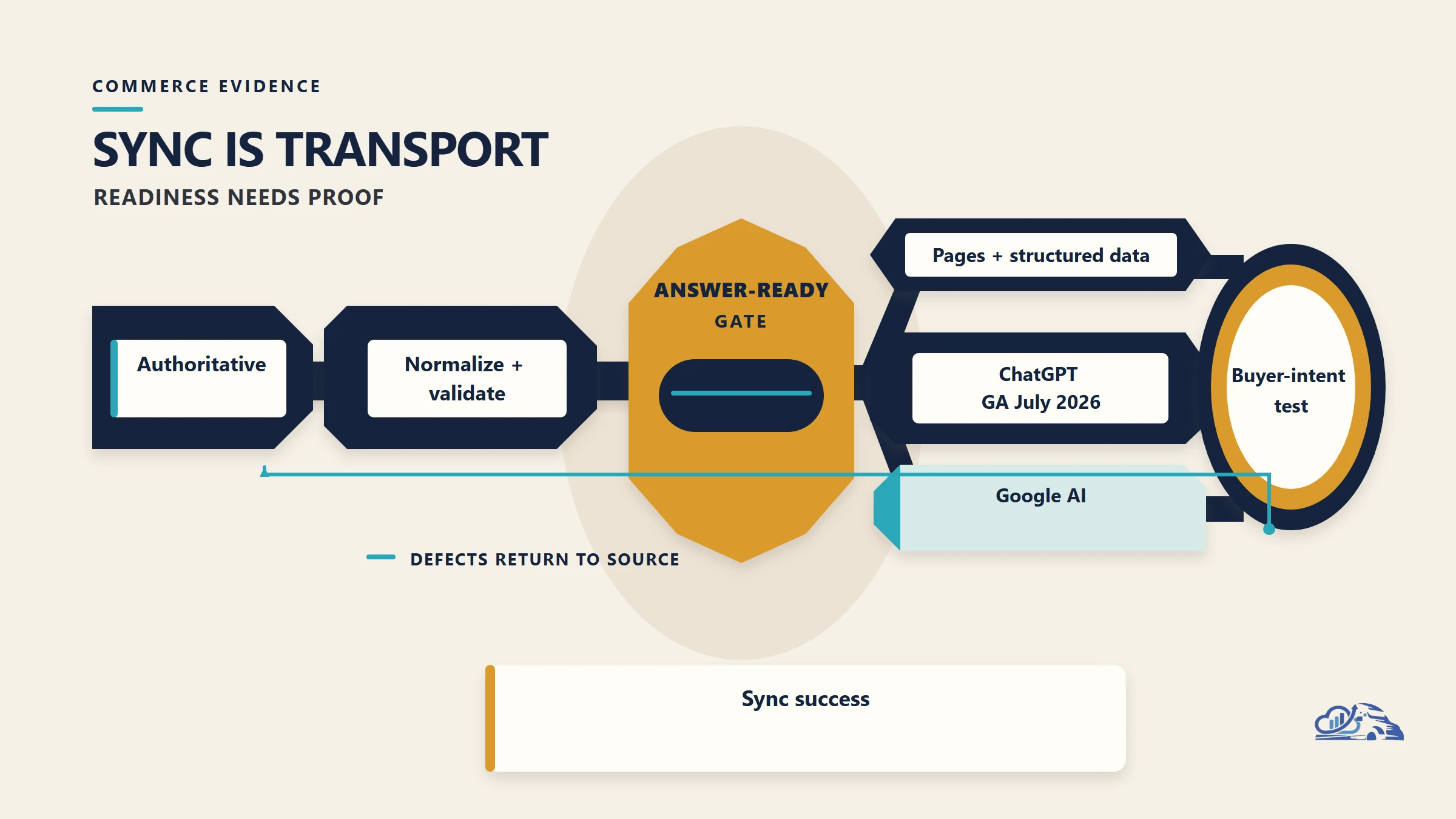
The data layer remains separate too. Agents depend on feeds, indexes, CRM records, product data, permissions, and business APIs. A powerful model served perfectly can still produce a bad outcome from stale, incomplete, or untraceable inputs.
SageMaker HyperPod vs Amazon EKS
SageMaker HyperPod is the managed GPU-cluster layer, while plain Amazon EKS gives experienced teams more direct operational control. They aren't mutually exclusive technologies. The AWS News Blog confirms that HyperPod supports EKS orchestration alongside Slurm, with a custom CLI, observability, and resilient cluster management.
| Decision factor | SageMaker HyperPod with EKS orchestration | Plain Amazon EKS |
|---|---|---|
| Operating model | Managed, resilient GPU-cluster orchestration around the workload | Self-managed Kubernetes deployment with more operations owned by your team |
| Platform capabilities | HyperPod tooling, autoscaling, observability, health management, and recovery support | Your team assembles and operates more of the equivalent cluster and serving workflow |
| Best fit | Teams that want to reduce custom GPU-platform work | Teams with mature Kubernetes, GPU, and SRE capabilities |
| Main tradeoff | More managed abstraction and AWS-defined workflows | More direct control and more operational responsibility |
| Responsibilities you retain | Evals, version governance, endpoint security, data access, and agent controls | The same duties, plus more cluster, capacity, and serving operations |
Our recommendation is straightforward. Choose HyperPod when the model is strategic but GPU orchestration isn't your differentiator. Test plain EKS when your platform team already runs demanding Kubernetes workloads and wants deeper control.
Don't choose EKS because it looks familiar on an architecture slide. Kimi K3's scale makes capacity, model loading, failure recovery, and distributed serving part of the product's reliability. Your team should already know how it will diagnose stalled model loads, unhealthy GPU workers, queue growth, and partial service failures.
AWS also separates capacity procurement in its guide. HyperPod uses Flexible Training Plans, while the plain EKS path uses EC2 Capacity Blocks. That means availability, reservation timing, and recovery planning belong in the platform decision, not in a later purchasing task.
When self-hosting beats a hosted API
Self-hosting beats a hosted API when control requirements and steady demand outweigh fixed GPU capacity and platform labor. It isn't automatically cheaper, more private, or easier simply because the weights are open.
A correctly configured self-hosted deployment can keep prompts, retrieved context, and model traffic inside your VPC security boundary. Your team also controls the exact model version behind its agents. That protects workflows from an upstream provider changing a model or retirement schedule without matching your release process.
The privacy benefit still depends on architecture. Logs, traces, monitoring exports, model artifacts, and support access can cross boundaries if they're configured carelessly. Treat encryption, egress, retention, and audit rules as deployment requirements.
Version control creates responsibility too. Your team decides when to update, but it also owns security patches, serving dependencies, compatibility tests, and rollback. Open weights remove one dependency; they don't remove release management.
Self-hosting replaces direct per-token vendor dependence with infrastructure and operating costs you control. Yet the recommended Blackwell Ultra capacity is a serious fixed commitment. Idle GPUs, low utilization, failed tasks, and staffing can erase an apparent token-price advantage.
A hosted Kimi K3 API or another frontier API is often the better starting point for uncertain, bursty, or modest traffic. It reduces platform work and makes model comparison faster. Its tradeoffs are external data processing, provider release control, usage pricing, and service limits.
Choose or test self-hosting when:
- Data residency or internal policy requires stronger infrastructure control.
- Model-version pinning is central to auditability.
- Agent demand is sustained enough to keep dedicated capacity productive.
- Your team can own evaluations, security, incident response, and GPU operations.
Choose or test an API when speed, flexibility, and low operational overhead matter more. Don't publish a break-even claim until you have regional pricing, representative throughput, and real accepted-outcome data.
MLOps for AI agents goes beyond the endpoint
Production MLOps for AI agents must govern the full workflow, not just the model server. Endpoint health is necessary, but it doesn't prove that an agent completed useful work safely.
Observe latency, errors, saturation, queue depth, GPU utilization, retries, and capacity. Then connect those signals to agent traces, tool calls, human escalations, and accepted outcomes. Autoscaling should respond to real workload patterns without hiding overload behind longer queues.
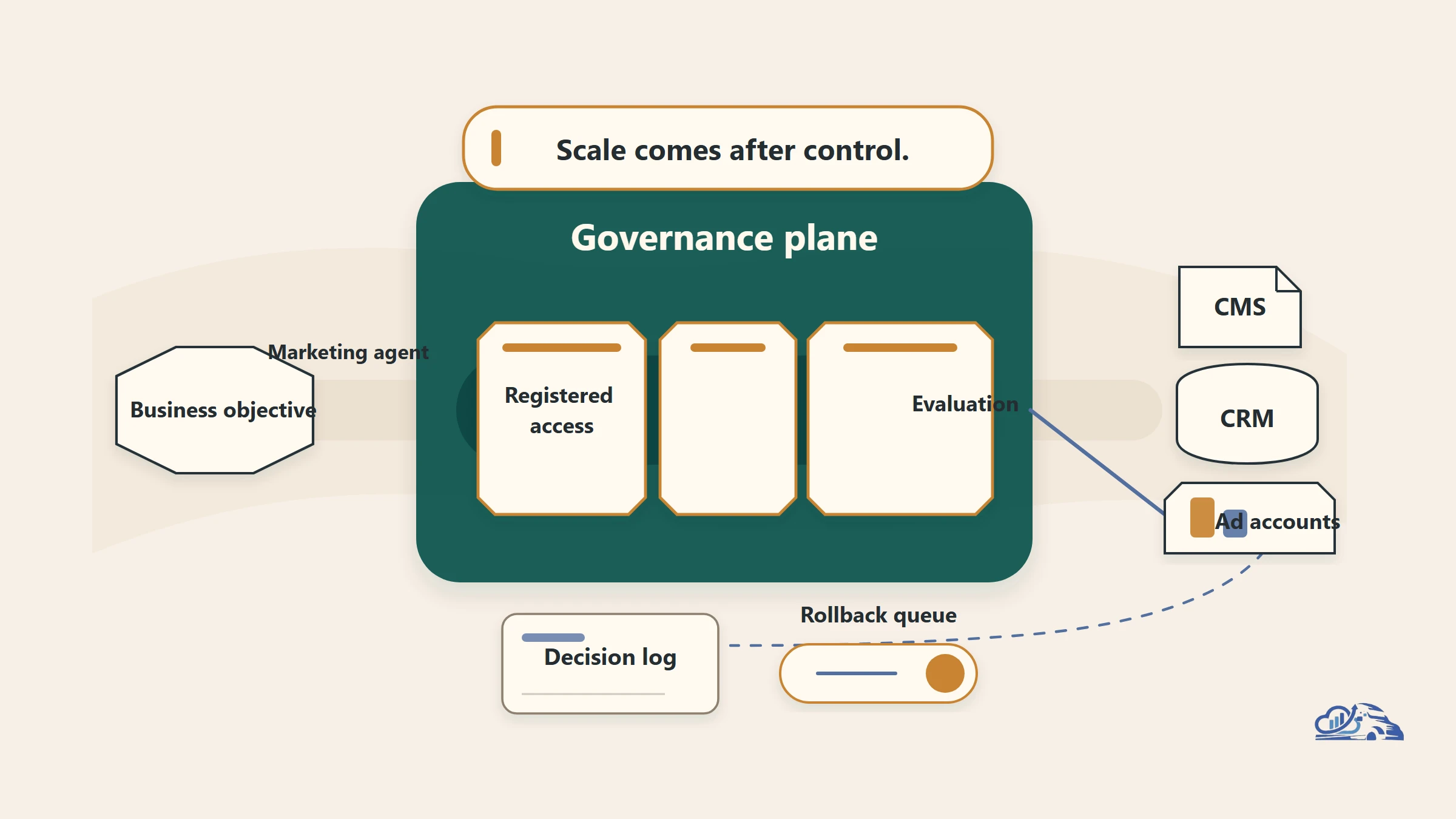
Gate every change. A model swap can alter tool selection, reasoning behavior, structured output, or refusal patterns. Changes to vLLM, prompts, tools, retrieval, or source data can do the same. Pin versions, run representative evaluations, stage releases, set regression thresholds, and maintain a tested rollback path.
Apply least privilege at both boundaries: from the agent to the inference endpoint, then from the agent to each internal tool and data source. Separate read and write permissions. Log consequential tool calls, protect credentials, and require policy approval where an action can affect customers, money, or records.
Data engineering is part of agent reliability. Track feed and index freshness, lineage, schema changes, quality checks, and service-level expectations. The model can't repair an account feed it never received or identify a stale record without provenance.
Consider an illustrative RevOps agent. It reads account data, recommends a retention action, and updates the CRM. A fluent answer isn't success. The outcome is accepted only when the source data is current, the recommendation passes policy, the write succeeds, and an audit trace exists.
A free Van Data Team workflow audit can turn that logic into an implementation scope. You'll receive a workload map, permission review, evaluation plan, dashboard gap list, and delivery sequence. Explore how Van Data Team makes agent operations measurable.
Measure cost per accepted outcome
Cost per accepted outcome is the fairest way to compare a self-hosted agent stack with an API stack. At Van Data Team, we start by defining what "accepted" means before comparing vendors or infrastructure.
For a self-hosted deployment, use:
~~~text Self-hosted cost per accepted outcome = (GPU capacity + cluster services + storage and network + observability + platform labor + retry and failed-run costs + human review) / accepted outcomes ~~~
For a hosted service, use:
~~~text Hosted API cost per accepted outcome = (API usage + orchestration + data and retrieval + observability + retry and failed-run costs + human review) / accepted outcomes ~~~
An accepted outcome is completed business work that passes quality, policy, and data-integrity checks. For the RevOps example, that might mean a valid recommendation based on current account data, followed by an authorized CRM update.
Run both paths against the same workload, time window, acceptance gate, and cost boundary. Include long contexts, tool loops, retries, failed runs, idle capacity, and human escalation. Measure latency and review burden beside cost because a cheaper outcome that arrives too late may have no value.
Segment the results by workflow type. A long-horizon coding agent, a vision-heavy review agent, and a short RevOps workflow can use capacity very differently. A blended average can hide the workload that's making self-hosting look cheaper or more expensive than it is.
This outcome focus is why an agent beats a checklist. Automation earns its place when it produces governed work repeatedly, not when it merely generates inexpensive tokens.
Common failure modes before go-live
Most deployment failures start with a category error or a missing operating control. Fix these before exposing the endpoint to production agents:
- Treating HyperPod as another name for EKS. HyperPod can use EKS orchestration, but it adds a managed operating layer.
- Calling MXFP4 a serving engine. vLLM serves the model; MXFP4 describes the weight format.
- Assuming the full parameter pool is active for every token. MoE inference activates a smaller portion.
- Comparing token prices while ignoring idle capacity, retries, failures, labor, and human review.
- Swapping models, prompts, tools, or data sources without regression evaluations and rollback.
- Giving agents broad access because the endpoint sits inside a trusted network.
- Monitoring server uptime while ignoring tool errors, policy failures, and outcome quality.
- Serving fresh weights against stale, low-quality, or untraceable business data.
- Claiming savings without current AWS pricing, API billing, capacity availability, and workload benchmarks.
How Van Data Team Makes This Operational
At Van Data Team, we treat Kimi K3 on AWS as an operating workflow, not an infrastructure experiment. We first map how an agent request moves from source data through orchestration, inference, tool calls, review, and final action. That map identifies owners, decision points, failure states, and recovery paths.
The useful output is a scoped delivery plan:
- Signals to collect for latency, capacity, tool use, data freshness, errors, and accepted outcomes
- Workflow gaps that need retries, fallbacks, permissions, or clearer ownership
- High-impact actions that require human review before execution
- Evaluation and regression gates for model, prompt, tool, or data changes
- Dashboards and runbooks that tell operators what happened and what to do next
This approach connects the serving layer to business operations. HyperPod or EKS can keep the endpoint available, but availability alone doesn’t make an agent reliable. Teams also need least-privilege access, traceable inputs, review checkpoints, and a tested path back from failed actions. The result is a production system measured by accepted outcomes—not merely tokens served or GPU utilization.
Operational Budget
Before production rollout, compare Kimi K3 on AWS with Kimi K3’s hosted API and other frontier APIs. Use the same representative agent jobs and acceptance rubric. Vendor token rates are only one input. They exclude idle GPU capacity, failed runs, repeated tool calls, reviewer time, and recovery work.
Cost per approved workflow result = (compute + serving + storage and network + platform labor + reviewer labor + retry and recovery costs) ÷ approved results.
For each candidate, record accepted-output cost, median and tail latency, token use, retry rate, reviewer minutes, and failure-recovery effort. Add evaluation results for task quality, tool use, grounding, safety, and regression against the current production model.
Run the scorecard on complete RevOps workflows, not isolated prompts. A fast, inexpensive response has little value if an agent needs several retries or human correction.
The recommended eight-GPU Kimi K3 node is costly dedicated capacity. It’s most likely to pay off under sustained, high-volume traffic with strong utilization. APIs can remain cheaper for uneven demand. Self-hosting earns its place when lower cost per accepted outcome, governance, and model control outweigh the added MLOps burden.
Tooling And Landscape Fit
Kimi K3 on AWS fits teams with sustained agent demand, strict data controls, and staff capable of operating large GPU clusters. Hosted APIs remain a better fit for bursty traffic, fast pilots, and teams that don’t want capacity risk.
Choose SageMaker HyperPod when managed resilience, autoscaling, observability, and cluster tooling outweigh the need for low-level control. Choose plain Amazon EKS when an experienced platform team already manages Kubernetes and wants direct ownership of scheduling, networking, security, and upgrades.
These infrastructure choices don’t replace agent orchestration. Frameworks such as LangGraph coordinate workflow state, tool calls, retries, and human review. vLLM serves the model, while MXFP4 describes the weight format. Each layer solves a different problem.
Production fit also depends on runtime controls. Model swaps need evaluation suites and regression gates. Agents need traceable tool calls, least-privilege access, and escalation paths for consequential actions. Their data sources need fresh feeds, reliable indexes, lineage, permissions, and clear service-level objectives. Without those foundations, a frontier model can execute the wrong workflow faster.
Frequently asked questions
What did AWS release for Kimi K3 on AWS?
AWS published a production deployment guide for SageMaker HyperPod and Amazon EKS. It specifies the recommended GPU infrastructure, vLLM serving, MXFP4 weights, capacity options, endpoint setup, and validation flow. The guide makes deployment concrete; it doesn't decide whether self-hosting fits your economics or governance needs.
Is SageMaker HyperPod the same as Amazon EKS?
No. SageMaker HyperPod supports EKS orchestration alongside Slurm, but it adds managed GPU-cluster tooling, resilience, scaling, and observability. A plain EKS deployment leaves more Kubernetes, capacity, and inference operations with your team. Both paths still require model governance, security, evaluations, and data controls.
Why does AWS recommend vLLM and MXFP4?
vLLM is the serving engine, while MXFP4 is the quantization format in which Kimi K3 ships. AWS recommends the combination because vLLM supports MoE architectures, tensor parallelism, and that weight format. Keeping those roles separate helps teams assign the right ownership for serving, model artifacts, and upgrades.
When does self-hosting beat using a hosted API?
Self-hosting becomes compelling when VPC data control, model-version control, sustained utilization, or governance needs justify dedicated capacity and platform operations. A hosted API remains attractive for variable demand and faster experimentation. Compare both with identical workloads, acceptance gates, and cost boundaries before choosing.
What should teams measure before putting AI agents into production?
Track endpoint latency, errors, queue depth, saturation, GPU utilization, retries, tool failures, human escalations, and accepted-outcome rate. Also monitor evaluation regressions, data freshness, lineage, permission failures, and security events. Token cost alone misses the work that fails, arrives late, or needs manual correction.
How should teams manage Kimi K3 model updates?
Pin the production model version and evaluate every candidate against representative tasks and policies. Use a staged rollout, watch both infrastructure and outcome signals, and preserve a tested rollback path. Re-test prompts, tool permissions, retrieval behavior, and structured outputs because a model change can alter the whole agent workflow.