Ring Drone Cam: How to Market AI Products People Fear
The $249.99 Ring Drone Cam and $999.99 Rover Cam launch after a privacy backlash. What Ring says, which specs conflict and lessons for AI product marketing.

In short: If you launch an AI product that people may fear, lead with the limits, not the magic. Say what it doesn't record, show the off switch and publish one plain spec page with every number buyers and AI answers will look for. Then capture interest honestly, with a notify-me list instead of a promise you can't keep yet.
On this page17
Overview
Amazon's Ring finally launched its flying home camera. On November 10, 2026, it introduced Ring Robotics, with the Ring Drone Cam for homes and the Ring Rover Cam for businesses. CNBC and a long list of tech sites covered it the same day.
The products are interesting. The launch is more interesting. Ring first showed the drone in 2020, and it arrives months after a privacy backlash over Ring's Super Bowl ad, as CNBC noted.
This guide covers what Ring announced and what the specs really say. It also looks at how Ring markets a camera that flies around your house, and what any brand launching an AI product people may fear can learn from it.
Disclosure: Vanaxity builds AI agents for marketing. We have no relationship with Ring or Amazon. This article was drafted with help from Claude. Its facts come from Ring's product pages and press coverage, and we label our own math.
Key takeaways
- The Ring Drone Cam costs $249.99 and ships in the US on January 27, 2027, if the FCC approves it.
- The Ring Rover Cam costs $999.99 and ships first.
- Both map a space with AI and need a Ring Protect plan for scheduled patrols.
- The launch comes nine months after Ring's Super Bowl ad sparked a privacy backlash.
- Ring leads with privacy: the drone records only while flying and has no microphone.
- Press specs conflict, which is a warning for any brand that wants AI answers to get its facts right.
Book a free fit checkMap your SEO, GEO and AEO workflow before you build.
Book a consultationWhat Ring announced on November 10
Ring Robotics has two products. The Ring Drone Cam is an indoor flying camera for homes. It launches from a dock, flies to rooms or saved viewpoints and returns on its own, per CNBC.
The Ring Rover Cam is a wheeled robot built on Amazon's Astro. It has a camera on a mast that extends, a siren, two-way audio and a light tower that shows where it is. Ring markets it mainly to businesses, such as offices and shops, on its product page. It's the bigger bet.
Both use AI to map a space on their own and suggest viewpoints. You can then label rooms, set patrols or send the device to a spot you tap on the map.
Ring founder Jamie Siminoff told CNBC that privacy is the default mode for both. That line does a lot of work in this launch, and we'll come back to it.
Ring Drone Cam and Rover Cam specs
Here are the key specs from Ring's own product pages:
| Spec | Ring Drone Cam | Ring Rover Cam |
|---|---|---|
| Price | $249.99 | $999.99 |
| Ships | January 27, 2027, pending FCC approval | December 16, 2026 |
| Video | 2K, 148 degree view | Up to 4K, 152 degree view |
| Run time | Up to 8 minutes per flight | Rechargeable battery, about 45 minutes to charge |
| Audio | None | Two-way talk and siren |
| Coverage | Indoor flights to rooms and viewpoints | Up to 5,000 square feet, one floor |
| Subscription | Needed for scheduled patrols | Needed for scheduled patrols |
Ring Robotics launch prices
Price in US dollars
Professional installation starts at $129.99 per device, billed separately. Neither product ships to Canada. And both say the subscription is needed for scheduled patrols and for up to 180 days of video history.
The Drone Cam can't be sold yet. Ring says the FCC hasn't authorized it, so for now there's only a notify-me sign-up on the product page, with no pre-orders and no firm promise beyond a date that's clearly marked as pending. The Rover Cam is open for pre-order.
Six years from preview to launch
The Ring Drone Cam isn't a new idea. Ring first showed it in 2020 as the Always Home Cam. Siminoff told CNBC the delay was about getting the design, sensors and data processing right.
Privacy groups noticed then, too. The concept of a camera that flies around your home drew sharp criticism when it was first shown, and the long gap gave those concerns time to settle in.
For marketers, a long gap like this cuts both ways. Interest stays alive because people remember the idea. But so do the doubts, and a launch has to answer the old questions before it can sell the new product.
Ring's trust problem in 2026
The timing makes the launch harder. In February 2026, Ring ran a Super Bowl ad for Search Party, an AI feature that uses neighbors' cameras to help find lost dogs. Critics saw a wider surveillance network in the pitch.
Four days after the game, Ring and Flock Safety called off a planned integration, CNBC reported. Flock is a police tech firm whose license plate readers have drawn their own backlash. Both companies said the integration never launched.
Search Party itself stayed available. But the episode showed how fast an AI feature can turn into a trust story. A cute dog-finding ad became a debate about who can see what, and the brand had to respond within days.
That's the backdrop for a camera that flies through your house. Ring needs buyers to believe the product serves them, not anyone else.
How Ring markets the Ring Drone Cam privacy first
Look at what Ring chose to stress. On the Drone Cam page, the facts that answer buyers' worries are concrete and easy to check:
- It records only while flying, and recording stops when it docks.
- It has no microphone or speaker, so it captures no audio.
- Patrols you schedule need a plan, but manual launches don't.
- The Rover Cam has a privacy button that turns recording off and pulls its camera mast down.
- Both show a light when they record.
These aren't vague promises. They're design limits a buyer can see. A camera that sits in a dock, dark and without a mic, answers the scariest question before anyone asks it.
That's the smart move. Saying "we take privacy seriously" costs nothing and convinces no one. Saying "it has no microphone" is a fact people can repeat to a skeptical partner.
It's the same idea we covered in privacy-first marketing: trust grows from things people can verify, not from promises in a policy page.
Lessons for marketing AI products people fear
Ring's launch is a useful template for any brand shipping an AI feature that touches homes, health, money or kids. Here's what it gets right, and what to copy:
- Lead with limits. Say what the product doesn't do before you say what it does.
- Make privacy physical. A dock, a light, a button and no mic beat any policy page.
- Use plain numbers. "Up to 8 minutes" is easier to trust than "long flight time."
- Separate free from paid. Say clearly which features need a subscription.
- Answer the old doubts. If your product had a rocky past, address it in the launch.
The pattern works beyond hardware. An AI email tool that reads your inbox, or an AI agent that books meetings, raises the same fear in a quieter form. The answer is the same: show the boundaries first.
It also helps your sales team. When every rep can name the three things the product won't do, objections get shorter.
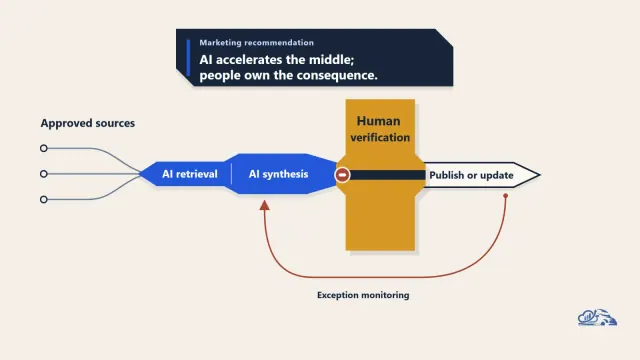
Good AI product marketing also needs an owner for these claims. Someone must check that the privacy lines in ads, product pages and support docs match the product as it ships. Our guide to AI marketing governance covers how to set that up.
Why Ring Drone Cam specs differ across the web
Here's a quieter lesson from this launch. Within a day, coverage disagreed on basic facts:
| Spec | What Ring's page says | What some coverage says |
|---|---|---|
| Drone flight time | Up to 8 minutes | 8 to 10 minutes, or 5 to 8 minutes |
| Drone weight | Not listed | 165 grams |
| Drone video | 2K | Sometimes mixed up with the Rover's 4K |
| Drone ship date | Notify-me only | January 27, 2027, pending FCC |
Some of these gaps are honest. Ring gave the January 27 date in its announcement but not on the product page, and older Always Home Cam specs still float around. Others come from rounding, guessing or copying.
Why does it matter? AI answers in Google, ChatGPT and Perplexity pull from all of these pages. If ten articles say 10 minutes and one Ring page says 8, an AI answer may repeat the wrong number. Our guide to citation optimization explains how AI tools pick which source to trust.
The fix is simple and often skipped. Publish one complete spec page with every number buyers ask for, including the ones you'd rather not stress. Then point press kits and partners to it.
Selling a product you can't sell yet
The Ring Drone Cam launched without a buy button. Under FCC rules, a radio device can't be sold until it's authorized, so Ring offers a notify-me sign-up instead.
That's a tricky spot for any brand. You want to catch the buzz while the press is writing about you, but you can't take orders. Ring's answer is a waiting list, with a date that's clearly marked as pending.
Marketers face this more often than you'd think. Software features wait on policy review, products wait on regulators, and AI tools wait on safety checks. In each case, the honest move is the same:
- Say what's blocking the launch, in plain words.
- Give a date only if you can mark it as pending.
- Collect emails, not payments.
- Follow up with real news, not hype.
The subscription behind the Ring Drone Cam
The device is only part of the sale. Scheduled patrols, long video history and video search all need a compatible Ring Protect plan. Manual launches don't.
That's a common model for AI hardware now. The device gets people in the door, and the plan pays for the AI and the cloud over time. Ring hasn't said which plan the drone needs or what it costs.
For buyers, that gap matters. For marketers, it's a reminder to price the full cost up front. Hidden plan costs are one of the fastest ways to turn a good review into a bad one.
Ring Rover Cam: the business pitch
The Rover Cam is a different sale. It costs four times as much as the drone, ships sooner and is pitched to businesses, not families. That changes the message.
A shop owner isn't worried about a drone in the bedroom. They care about coverage, cost and proof. So the Rover Cam page leads with numbers a manager can take to a budget meeting:
- Maps up to 5,000 square feet without extra cameras.
- Records up to 4K video while it moves or patrols.
- Has a siren, two-way talk and a light tower as deterrents.
- Takes about 5 to 10 minutes to install, or a pro can do it from $129.99.
The privacy story is still there, with a button that pulls the camera mast down. But it plays a supporting role. For B2B buyers, the lead is what the product replaces, such as a fixed camera in every aisle or a night guard on a slow shift.
That split is worth copying. The same AI tech can need two launch stories, one for people who fear it and one for people who buy it on a spreadsheet.
A worked example with our own math
Here's a made-up case to show why the plan matters. These are our numbers, not Ring's.
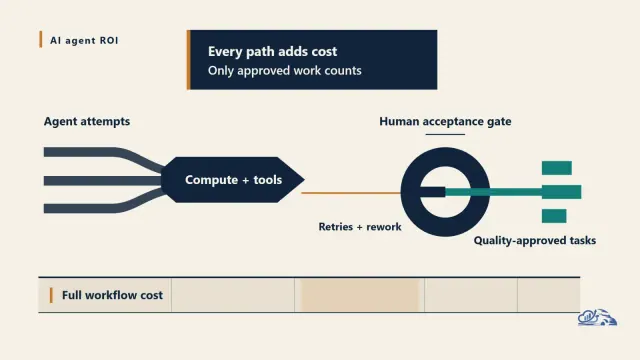
Say a brand sells a $250 AI device with a $10 monthly plan that unlocks its best features. Over three years, the plan adds $360, more than the device itself. The real price is $610, not $250.
Now say the launch page shows only the $250. Some buyers will feel misled when they see the plan, and some will say so in reviews. If even 5% of 10,000 buyers return the device, that's 500 returns and $125,000 in refunds before shipping costs.
Show the full cost up front, and some people won't buy. But the ones who do won't feel tricked. For a product built on trust, that trade is worth it.
What the Ring Drone Cam means for smart home marketers
The smart home market is big. CNBC cited a Grand View Research estimate that it will top $200 billion in sales this year, with Apple and Google also competing. So Ring's move matters beyond one product.
Moving cameras raise the stakes for the whole category. A fixed camera points at one spot. A drone or robot can go anywhere in the house, which makes every brand's privacy promise sound more important.
For marketers in this space, that means three things. Expect buyers to ask harder questions about cameras and AI. Expect reviewers to test privacy claims, not just video quality. And expect AI answers to summarize those reviews, good or bad, when someone asks which camera to buy.
A launch checklist for AI products
Use this before you ship any AI product or feature that people might worry about:
| Topic | What a good answer looks like |
|---|---|
| Data it never collects | A short, specific list, such as no audio |
| Off switch | A visible button or setting, shown in the launch |
| Paid features | A clear split between free and paid features |
| Full specs | One page with every number, linked from all coverage |
| Pending items | Plain words about approvals, dates and limits |
If you can't answer one of these in a sentence, fix that before launch day. It's far cheaper than fixing it in the comments.
What to watch next
A few things will show how this launch lands:
- FCC approval for the Ring Drone Cam before January 27, 2027
- First reviews of the Rover Cam after it ships on December 16
- Which Ring Protect plan the drone needs, and its price
- Reaction from privacy groups once people use it at home
We'll update this guide when the Drone Cam ships. For more on AI and marketing, see our insights, or how we help brands plan launches that hold up in AI search.
Ring Drone Cam FAQ
How much is the Ring Drone Cam?
The Ring Drone Cam costs $249.99. Professional installation starts at $129.99 per device, and scheduled patrols, long video history and video search need a compatible Ring Protect plan, whose price for the drone Ring hasn't announced yet.
When does the Ring Drone Cam ship?
Ring says it ships in the US on January 27, 2027, but only after FCC approval. As of November 12, 2026, Ring offers only a notify-me sign-up, not pre-orders.
How long can the Ring Drone Cam fly?
Ring says up to 8 minutes per flight, tested with a new, fully charged battery under controlled conditions. Some coverage reported longer or shorter times. Trust Ring's page.
Does the Ring Drone Cam record audio?
No. Ring's product page says it has no microphone or speaker. It records video only while flying, and recording stops when it returns to its dock.
What is the Ring Rover Cam?
The Ring Rover Cam is a $999.99 wheeled security robot built on Amazon's Astro. It records up to 4K video, maps up to 5,000 square feet on one floor and ships December 16, 2026. Ring markets it mainly to businesses.