SEO vs GEO vs AEO: The Complete 2026 Comparison
SEO earns rankings, AEO earns the direct answer and GEO earns citations in AI answers. How they differ, where they overlap, and how one page does all three.
Three Ways Search Answers People in 2026
Search used to mean a box and ten blue links. In 2026 a single query can return ranked links, a featured snippet and an AI-written answer on the same page, and many people never click any of them.
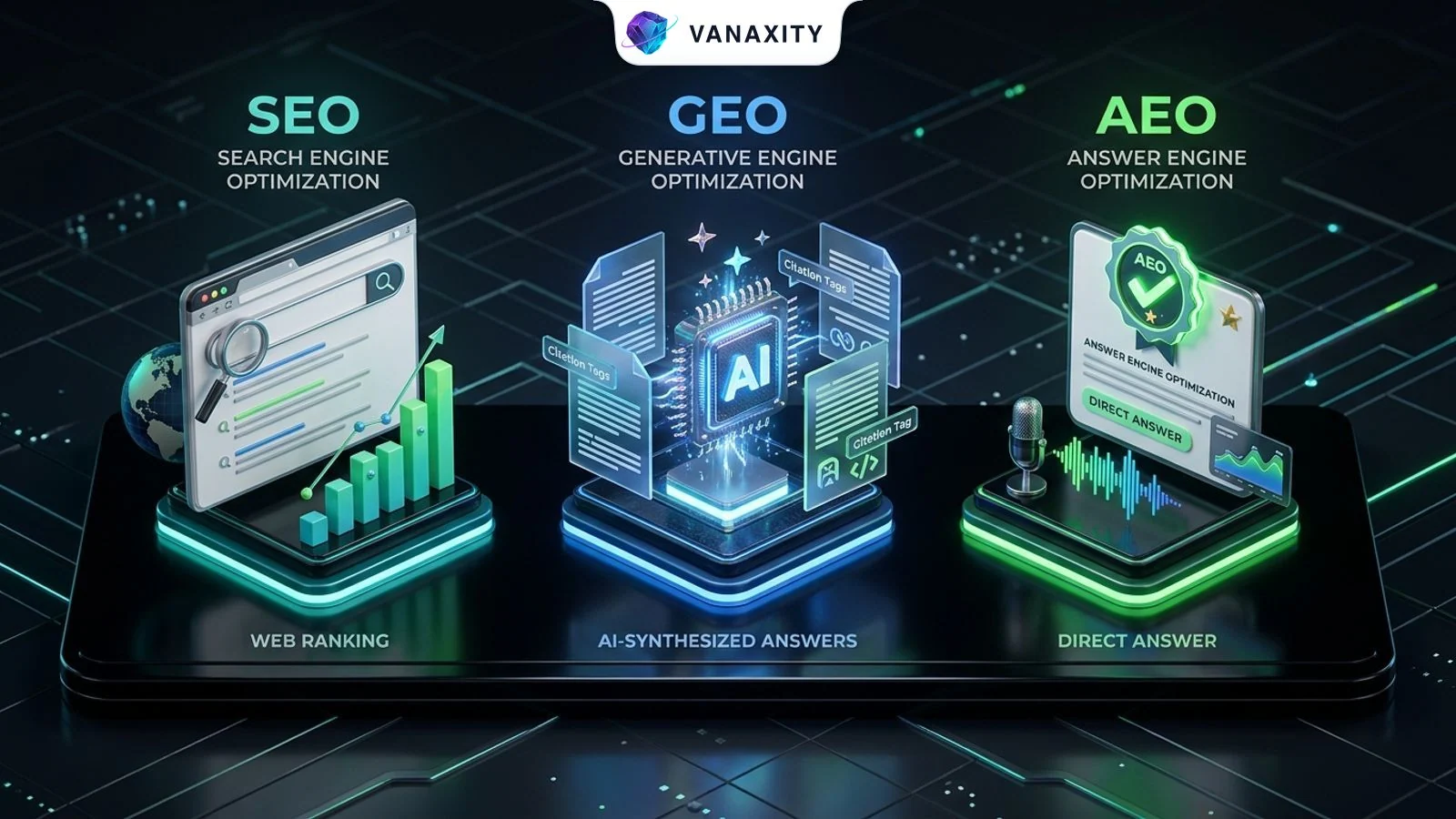
Each surface has its own discipline. SEO works on ranked results in Google, Bing and other engines. AEO (answer engine optimization) works on the direct answer: featured snippets, knowledge panels and voice assistants. GEO (generative engine optimization) works on AI-written answers in ChatGPT search, Perplexity and Google's AI Overviews and AI Mode, where sources appear as citations.
The numbers show how the surfaces connect, and where they don't. SparkToro's 2026 data covers US desktop and mobile web searches, not the Google app. Ahrefs found the top-10 share of AI Overview citations down from about 76% in July 2025, partly because its tools now detect more citations. And in its study of 15,000 prompts, most links cited by ChatGPT, Gemini and Copilot came from pages outside Google's top 10. Ranking still matters, but it does not decide citation on its own.
We introduced this three-layer view when we launched Vanaxity: the same asset should be useful to a reader, understandable to Google and clear enough for an AI system to summarize.
SEO vs GEO vs AEO, Side by Side
How the three compare on the decisions a content team actually makes:
| Dimension | SEO | GEO | AEO |
|---|---|---|---|
| Primary goal | Rank pages and earn clicks from search results | Be used and cited inside AI-generated answers | Be the direct answer: a featured snippet, answer box or voice reply |
| Where it shows up | Ranked results in Google, Bing and other engines | ChatGPT search, Perplexity, Google AI Overviews and AI Mode | Featured snippets, knowledge panels and voice assistants |
| How sources are picked | Crawling, indexing and ranking systems | A search step retrieves pages, then a language model writes the answer and links some of them | Google's systems choose the passage; no markup can request it |
| What helps most | Crawlable, useful pages; relevance; links | Original evidence; claims with sources, quotes and numbers; consistent entity facts | A direct answer near the question; clear lists and tables |
| Technical must-haves | Indexable HTML, sitemaps, canonical tags, hreflang | Crawler access (OAI-SearchBot for ChatGPT search); indexed, snippet-eligible pages for Google's AI features | Snippet-eligible pages; nosnippet and max-snippet decide what may be shown |
| What to measure | Rankings, impressions, clicks and conversions | Mentions and citations across a fixed set of prompts; AI referral visits; Search Console's Generative AI report | Featured snippet ownership; impressions and clicks for the query |
| Vanaxity's role | Maps search results and competitors, and prepares CMS-ready pages and schema | Maps citation gaps and writes source-backed content packages | Structures answer-first sections and lists for human review |
Map your SEO, GEO and AEO workflow before you build.

Where SEO, GEO and AEO Overlap
The three share most of their foundations, which is why neglecting SEO undermines the other two:
- Access: a page that crawlers cannot fetch and index cannot rank, appear in a snippet or be cited. Google requires a page to be indexed and eligible to be shown with a snippet before it can be a supporting link in AI Overviews or AI Mode, and ChatGPT search does not show sites that opt out of OAI-SearchBot.
- Quality: Google says that optimizing for generative AI search "is optimizing for the search experience, and thus still SEO". In Google there is no separate set of AI rules to chase.
- Links: Google uses links "as a signal when determining the relevancy of pages and to find new pages to crawl". In Google they help AI visibility through ranking; for ChatGPT, Gemini and Copilot, Ahrefs found far less overlap between ranking and citation.
- Consistency: the same names, prices and claims across your site, profiles and listings make the brand easier to describe correctly in results, snippets and AI answers.
For each discipline in depth, read our guide to Generative Engine Optimization (GEO) and our Answer Engine Optimization guide.
One Page, Three Jobs
Teams that run SEO, AEO and GEO as separate projects end up with three versions of the same page. It is cheaper to build one asset that does three jobs:
1. The ranking layer (SEO)
Cover the topic fully, use a clear heading hierarchy, link related pages, and serve fast, server-rendered HTML that crawlers can read.
2. The answer layer (AEO)
Answer each question directly under its heading, then add conditions and evidence. Use ordered lists for steps and tables for comparisons. No markup turns a page into a featured snippet: Google's answer to "How can I mark my page as a featured snippet?" is "You can't." And FAQ rich results stopped appearing in Google Search on May 7, 2026.
3. The citation layer (GEO)
Add what others can't copy: original data, named sources, dated numbers and quotes. In the GEO paper, these were the edits that raised a source's visibility most, by 30-40% on its main metric.
- Keep one canonical URL per topic so rankings and citations don't split across near-duplicates.
- Keep structured data identical to the visible text; Google lists this among its best practices for AI features.
- Run the same set of prompts in ChatGPT, Perplexity and Google every month and log mentions and citations. Answers vary between runs, so read trends, not single results.
Hidden text, and pages mass-produced to manipulate rankings, break Google's spam policies on hidden text and scaled content abuse. Rebuilding pages for AI is wasted effort in Google too: it says there's no requirement to break content into tiny pieces for AI, and that an llms.txt file will neither harm nor help in Google Search.
A note on our position: Vanaxity sells AI search content services, so we have a stake here. Vanaxity runs this three-layer workflow for B2B teams, from buyer-question research to CMS-ready pages with a human review gate. It starts with a free 30-minute fit check; engagements are scoped per project, and there is no self-serve subscription.
Key Facts
- SEO targets ranked results, AEO the direct answer, and GEO citations inside AI-written answers.
- 68.01% of US Google searches ended without a click from January to April 2026, according to SparkToro's analysis of Similarweb data.
- Ranking helps but doesn't decide citation: Ahrefs found 37.9% of AI Overview citations in the top 10, and 12% for ChatGPT, Gemini and Copilot.
- Google says optimizing for its generative AI features is still SEO, with no special markup or AI files required.
- One page can serve all three: a clear structure for ranking, direct answers for snippets and original evidence for citations.
FAQs on SEO, GEO and AEO
Should we stop investing in SEO and focus on GEO and AEO?
No. Google says its generative AI features are rooted in its core ranking and quality systems, and a page must be indexed and snippet-eligible to appear as a supporting link. SEO is the foundation the other two stand on.
How do backlinks affect GEO compared with classic rankings?
In Google, links feed ranking, and its AI features draw on the same ranking systems, so links help indirectly. Elsewhere the connection is looser: in Ahrefs' data, only 12% of links cited by ChatGPT, Gemini and Copilot were in Google's top 10 for the same prompt.
Which metrics should we add to keyword rankings?
Keep rankings and clicks for SEO. Add featured snippet ownership for AEO, and for GEO a monthly log of mentions and citations across a fixed set of prompts, AI referral visits, and Search Console's Generative AI performance report for Google.
Can an in-house team handle SEO, GEO and AEO without special tools?
Yes. The work is mostly editorial and technical discipline: crawlable pages, answer-first writing, sourced evidence and a regular prompt check. Specialist services such as Vanaxity, which is ours, can take on the research, production and review if the team lacks time.
How does Vanaxity cover SEO, GEO and AEO in one workflow?
Vanaxity researches buyer questions, maps search results, competitors and citation gaps, then produces content packages with sources, schema and visuals that a person reviews before they are published through your CMS. It improves the inputs; it cannot guarantee rankings or citations.
Sources
- SparkToro (June 2026): In 2026, less than one third of Google searches still send a click
- Ahrefs (March 2026): Update: 38% of AI Overview citations pull from the top 10
- Ahrefs (August 2025): Only 12% of AI-cited URLs rank in Google's top 10 for the original prompt
- Google Search Central: AI features and your website
- Google Search Central: Guide to optimizing for generative AI features on Google Search
- Google Search Central: Featured snippets and your website
- Google Search Central: Latest documentation updates (FAQ rich result deprecation, May 2026)
- Google Search Central: Link best practices for Google
- Google Search Central: Spam policies for Google web search
- OpenAI: Overview of OpenAI crawlers (OAI-SearchBot)
- Aggarwal et al. (2024), GEO: Generative Engine Optimization, KDD 2024 (arXiv)