ChatGPT Ads Hit $1B in 200 Days: A Marketer's Read
OpenAI's ChatGPT Ads reached a $1 billion run rate faster than Google AdWords did. Here is what the new AI-answer ad channel means for marketing and GEO strategy.
Overview
The AI answer box just grew a paid slot, and it filled up fast. OpenAI's ChatGPT Ads reached a $1 billion annualized revenue run rate in under 200 days, a pace that took Google's AdWords about four years. That's not just an OpenAI story; it's a signal that the surface your GEO and AEO work targets is now monetized, and that changes how marketers should think about showing up in AI answers.
This article explains what ChatGPT Ads is, how fast it's growing, how it works, and what a marketing team should actually do about it. The reported facts are OpenAI's and its advertisers'; the marketing implications are Vanaxity analysis, framed as recommendation rather than certainty. It builds on our work on answer engine optimization and GEO and AEO strategy.
Key Takeaways
- ChatGPT Ads reached a $1 billion annualized run rate in under 200 days, versus roughly four years for Google AdWords to hit the same mark.
- Ads launched in February 2026; the US pilot passed $100 million annualized in under two months and grew from 600 advertisers to tens of thousands.
- Ads appear as labeled sponsored links displayed separately from answers, matched to the current conversation, and advertisers cannot see private chats.
- Free and ChatGPT Go users see ads, while paid tiers from Plus upward stay ad-free, so ad reach is the large free base, not the premium seats.
- Vanaxity's recommendation: treat it as an early-mover channel worth a measured pilot, but keep investing in organic AEO, because paid placement does not replace being the cited answer.
Map your SEO, GEO and AEO workflow before you build.

What Is ChatGPT Ads?
ChatGPT Ads is OpenAI's advertising business inside ChatGPT. It places labeled sponsored links beneath AI answers for free and ChatGPT Go users, matched to the current conversation, and it hit a $1 billion annualized run rate in under 200 days. Paid tiers from Plus upward stay ad-free. For marketers, it opens a new contextual channel in the AI answer layer, and it signals that surface is now monetized.
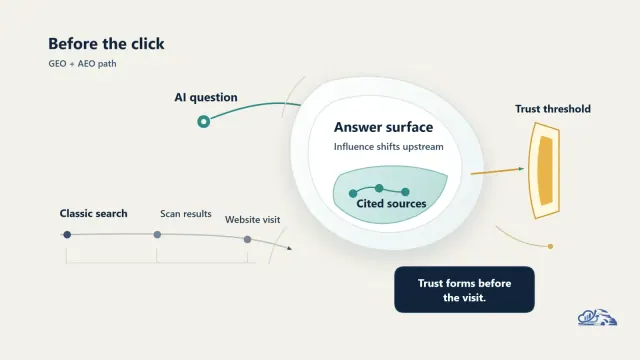
The strategic point is where these ads live. They don't sit on a separate search results page; they sit inside the answer, the exact place AEO has been fighting to occupy organically. So ChatGPT Ads isn't just a new line item in a media plan. It's paid real estate appearing on the same surface your organic citations are trying to win, which is why it matters even to teams that never buy an ad.
**Vanaxity analysis:** Read this as the answer engine growing up. Search engines monetized the results page years ago; answer engines are now doing the same to the answer itself. That doesn't make organic visibility worthless, it raises the stakes on it, because being the cited source now competes for attention with a paid slot right beside you. The teams who understand both halves, paid and organic, will own the answer box.
How Fast Is ChatGPT Ads Growing?
Faster than any comparable ad business on record, which is the part that should get a marketer's attention. As Forbes noted, the milestone arrived in months rather than years, and the numbers tell a clear story of a channel scaling before most teams have a plan for it.
| Milestone | Figure |
|---|---|
| First ads in ChatGPT | February 2026 |
| US pilot run rate in under 2 months | $100 million annualized |
| Run rate in under 200 days | $1 billion annualized |
| Time for Google AdWords to reach $1B | ~4 years (for comparison) |
| Advertisers | From 600 to tens of thousands |
| Reach | 40+ countries |
| OpenAI 2026 ad revenue target | ~$2.5 billion |
**Vanaxity analysis:** Keep one honest distinction in mind: a run rate is an annualized snapshot, not money already in the bank. A $1 billion run rate means the latest period, extrapolated to a year, not $1 billion collected. It's still a remarkable signal of demand, but treat it as momentum, not a finished result. The self-service Ads Manager now rolling out in India, Europe, the Middle East, and North Africa is the real tell, because self-service is how ad platforms scale past their pilot.
How Do ChatGPT Ads Actually Work?
Contextually, and with a deliberately narrow targeting story, at least for now. Understanding the mechanics tells you both the opportunity and its current limits.
- Placement: ads appear as sponsored links displayed separately from the AI answer and clearly labeled as advertising, not woven into the model's response.
- Targeting: ads are matched to what someone is asking in the current conversation, and, where a user has enabled it, their wider interests, so intent is the primary signal.
- Privacy: OpenAI states advertisers cannot access private conversations, which keeps targeting at the topic level rather than the individual-chat level.
- Who sees them: free and ChatGPT Go users, while Plus and higher tiers remain ad-free, so the audience skews to the large non-paying base.
- Reported results: one ecommerce advertiser cited 3x return on ad spend over 28 days, and a partner claimed over 80% of ad-driven traffic came from new customers.
**Vanaxity analysis:** The contextual, intent-first design is the interesting part for marketers. An ad triggered by what someone is actively asking is closer to high-intent search than to interruptive display, which is why early return-on-ad-spend anecdotes look strong. But note the word anecdotes: the 3x ROAS and 80%-new-customer figures are advertiser and partner reported, on short windows, and almost certainly cherry-picked. Treat them as encouraging signals to test, not benchmarks to expect. Category demand is real, though: industry reporting notes financial-services ad spend on the platform tripled, a sign that regulated, high-value verticals are already moving in.
What Do ChatGPT Ads Mean for GEO and AEO?
They raise the stakes on organic answer visibility rather than replacing it. When a paid slot appears next to the answer, being the cited organic source becomes more valuable, not less, because attention on that surface is now contested. Concretely, three things shift for an AEO team:
- The answer surface is now shared. Your organic citation may appear alongside a competitor's paid slot, so being cited is necessary but no longer the whole game.
- Intent data gets more visible. What people ask ChatGPT, and what advertisers bid on, is a fresh signal for the questions your content should answer.
- Measurement has to span both. Judging AEO on citations alone misses the paid context around them, so track share of the answer, not just presence in it.
**Vanaxity analysis:** There's a temptation to read paid placement as a shortcut that makes AEO optional. It's the opposite. Paid slots and organic citations do different jobs: an ad buys a moment of visibility, while being the model's cited source buys trust and durability that outlasts any campaign budget. The two are complements. The smart posture is to keep winning citations through the work we cover in generative search and conversational search optimization, and layer paid on top where the economics justify it, not to trade one for the other.
There's also a longer arc to watch. As the answer surface monetizes, the balance of paid and organic real estate inside answers may shift over time, the way it did on traditional search results pages. Marketers who track that balance early will adapt faster than those who assume the AI answer stays mostly organic forever.
Should Marketers Advertise on ChatGPT?
For many teams, it's worth a measured test now, precisely because it's early. Early channels reward experimentation before competition and prices catch up, but only if you measure honestly.
- Pilot if your customers use free ChatGPT and your offer maps to clear questions, since intent-matched ads fit high-consideration purchases well.
- Start small and instrument it, treating the early ROAS claims as hypotheses to verify on your own campaigns, not numbers to bank on.
- Measure cost per acquired customer, not clicks, and watch the new-customer share, since that is where the early channel may over- or under-deliver.
- Do not defund organic AEO to pay for ads, because the cited-answer position keeps working when the campaign stops.
- Reassess quarterly, since formats, measurement, and pricing on a six-month-old ad platform will change fast.
**Vanaxity analysis:** The mistake at either extreme is easy to make. Ignoring ChatGPT Ads entirely cedes an early channel to competitors; pouring budget in on the strength of vendor anecdotes risks paying to learn what a small test would have told you cheaply. The disciplined path is a scoped pilot with real measurement, run alongside your organic work, so you learn whether this channel earns a place in your mix on your numbers, not OpenAI's press release.
How Vanaxity Helps You Navigate AI Ad Channels
Vanaxity helps marketing teams decide when a new AI channel is worth entering and how to enter it without neglecting the organic visibility that compounds. We start by mapping where your audience actually meets AI answers, and whether a paid slot or a cited citation is the better bet for each of your key queries.
Then we design a scoped pilot with real measurement, run it alongside your answer-engine work, and score results on your own cost per acquired customer rather than vendor benchmarks. If you want help, our services can build a combined paid-and-organic AI visibility plan, and you can browse more field notes in our insights library. The goal is simple: own the answer box with the right mix of earned and paid, decided on evidence.
Frequently asked questions
What is ChatGPT Ads?
ChatGPT Ads is OpenAI's advertising product inside ChatGPT, which places labeled sponsored links beneath AI answers for free and ChatGPT Go users, matched to the current conversation. It launched in February 2026 and reached a $1 billion annualized revenue run rate in under 200 days. Paid tiers from Plus upward remain ad-free, and OpenAI says advertisers cannot access private conversations, so targeting works at the topic level rather than on individual chats.
How fast did ChatGPT Ads grow?
Very fast. It reached a $1 billion annualized run rate in under 200 days, compared with roughly four years for Google AdWords to hit the same figure. The US pilot alone passed $100 million annualized in under two months, and the advertiser base grew from about 600 to tens of thousands. OpenAI is reportedly targeting around $2.5 billion in advertising revenue for 2026, though a run rate is an annualized snapshot rather than revenue already collected.
Do ChatGPT Ads replace answer engine optimization?
No. Paid ads and organic citations do different jobs. An ad buys a moment of visibility that stops when the budget stops, while being the model's cited source builds trust and durability that lasts. As the answer surface monetizes, being the cited organic answer becomes more valuable, not less, because attention is now contested. The right approach is to keep investing in AEO and layer paid on top where the economics justify it, not to trade one for the other.
Should my business advertise on ChatGPT?
It is worth a measured pilot for many teams, especially if your customers use free ChatGPT and your offer maps to clear questions, since intent-matched ads suit high-consideration purchases. Start small, measure cost per acquired customer rather than clicks, and treat early return-on-ad-spend claims as hypotheses to verify on your own campaigns. Do not defund your organic work to fund ads, and reassess quarterly, since a six-month-old ad platform will keep changing quickly.
Can ChatGPT advertisers see my conversations?
OpenAI states that advertisers cannot access private conversations. Ads are matched to the topic of the current conversation and, where a user has enabled it, their wider interests, but the targeting operates at the topic level rather than exposing individual chats to advertisers. As with any ad platform, the exact data practices are worth reading directly in OpenAI's own documentation before you rely on them for a campaign.