Fable 5.1 vs Gemini 3.7 Flash vs Kimi K3 vs Qwen 3.8 Max
Four flagship models, four very different bets on price, openness, and proof. Here is how Fable 5.1, Gemini 3.7 Flash, Kimi K3, and Qwen 3.8 Max compare.
Overview
Comparing Claude Fable 5.1, Gemini 3.7 Flash, Kimi K3, and Qwen 3.8 Max is really comparing four different bets: on capability, on price, on open weights, and on how much of the claim is proven. As of September 2026 they don't line up on one axis. Fable 5.1 is priciest and most capable on its own benchmarks; Gemini 3.7 Flash is the cheap, fast workhorse; Kimi K3 is the strongest verified open-weight model; and Qwen 3.8 Max is a capable enterprise API whose benchmarks are still vendor claims.
This article compares them for marketing and content teams, where cost and control matter as much as raw capability. The reported facts are the vendors' and independent testers'; the marketing implications are Vanaxity analysis, framed as recommendation rather than certainty. It builds on our work on open-weights AI for marketing and FinOps for AI agents.
Key Takeaways
- Fable 5.1 (Anthropic, September 2026) is the most capable on its own benchmarks and the priciest at $10 per million input and $50 per million output, with cache reads cut to $0.25.
- Gemini 3.7 Flash (Google, August 2026) is the cheap fast workhorse: introductory $0.75 input and $3.75 output per million, a 1M-token context, and strong coding and agentic scores.
- Kimi K3 (Moonshot AI) is the strongest open-weight model, with downloadable weights and independent verification, including 93.4% SWE-bench Verified on Vals AI's harness and a top open-weight Intelligence Index score.
- Qwen 3.8 Max (Alibaba) is a capable multimodal enterprise API, but Alibaba has published no benchmarks, so its 'second only to Fable 5' claim is unverified for now.
- Vanaxity's recommendation: pick by the axis that binds you, cost, openness, or verified capability, and measure the finalists on your own tasks.
Map your SEO, GEO and AEO workflow before you build.

What Are Fable 5.1, Gemini, Kimi, and Qwen?
Each model is the flagship of a different lab, and each optimizes for something different. Knowing what each is built for is most of the decision.
- Claude Fable 5.1: Anthropic's top model, released September 2026. Most capable on its own launch benchmarks, most expensive, closed weights, with a 75% cache-read cut that helps agentic cost.
- Gemini 3.7 Flash: Google's 'workhorse' model, released August 13, 2026. Fast and cheap on introductory pricing, a 1M-token context, and built for coding and agentic workflows.
- Kimi K3: Moonshot AI's open-weight flagship, a 2.8-trillion-parameter mixture-of-experts with a 1M-token context, native vision, and downloadable weights.
- Qwen 3.8 Max: Alibaba's flagship, a 2.4-trillion-parameter multimodal model offered mainly as an API, positioned for enterprise but without published benchmarks so far.
**Vanaxity analysis:** Notice these aren't four versions of the same thing. Two are closed and hosted (Fable 5.1, Gemini 3.7 Flash), one is genuinely open-weight (Kimi K3), and one is an enterprise API with an open-weight sibling but a closed flagship (Qwen 3.8 Max). For a marketing team, that openness axis matters as much as the benchmark row, because it decides whether you can run the model on your own data.
How Do Fable 5.1 and Its Rivals Compare?
The clearest view is side by side. The table lines up price, openness, and evidence, with the caveat that vendor benchmarks and independent ones deserve different levels of trust.
| Model | Input / output per 1M | Weights | Evidence |
|---|---|---|---|
| Fable 5.1 | $10 / $50 (cache $0.25) | Closed | Leads its own launch benchmarks |
| Gemini 3.7 Flash | $0.75 / $3.75 intro | Closed | Google-published coding and agent scores |
| Kimi K3 | Open weights, self-host or API | Open | Independently verified (Vals AI, Artificial Analysis) |
| Qwen 3.8 Max | Competitive API pricing | API (flagship) | Vendor claim only, no published benchmarks |
**Vanaxity analysis:** Read the evidence column as carefully as the price column. Kimi K3 stands out not just for being open, but for having third-party numbers behind it, while Qwen 3.8 Max asks you to take a strong claim on faith. In a field full of launch-day benchmarks, independent verification is a real differentiator, and it should weigh on your choice.
Is Fable 5.1 the Most Capable of the Four?
It depends on whose numbers you trust, which is exactly the point. Fable 5.1 leads on its own benchmarks; Kimi K3 leads where independent testers have looked.
**Reported fact:** Anthropic reports Fable 5.1 leading all seven of its published launch benchmarks, including 52.6% on Terminal-Bench-Science. On independent harnesses, Kimi K3 posts 93.4% on SWE-bench Verified via Vals AI, 88.3 on Terminal-Bench 2.1, and the top open-weight score on the Artificial Analysis Intelligence Index. Google reports Gemini 3.7 Flash at 43.6% on FrontierCode 1.1 and 90.7% on a complex legal-workflow benchmark, positioning it as a capable workhorse rather than a frontier leader. Alibaba claims Qwen 3.8 Max is second only to Fable 5, but has published no benchmarks to support it.
**Vanaxity analysis:** The honest read is that Fable 5.1 and Kimi K3 are the two capability contenders, but they earn that status differently: Fable 5.1 on vendor benchmarks, Kimi K3 on independent ones. Gemini 3.7 Flash isn't trying to top the frontier; it's trying to be good enough at a fraction of the price. And Qwen 3.8 Max simply can't be ranked yet, because there's nothing independent to rank. Treat 'most capable' as a claim to verify on your own tasks, not a settled title.
Which Model Is Cheapest to Run?
On hosted API price, Gemini 3.7 Flash is far and away the cheapest; on total control of cost, Kimi K3's open weights change the equation entirely.
Gemini 3.7 Flash's introductory $0.75 input and $3.75 output per million undercut Fable 5.1 by more than tenfold on output, which is why it's positioned for high-volume, cost-sensitive work. Fable 5.1 is the premium option, though its $0.25 cache reads soften agentic cost. Kimi K3, being open-weight, can be self-hosted, so its cost becomes your infrastructure rather than a per-token bill, an option that pays off at scale. Qwen 3.8 Max advertises competitive API pricing, but without benchmarks you can't yet judge its cost per unit of real work.
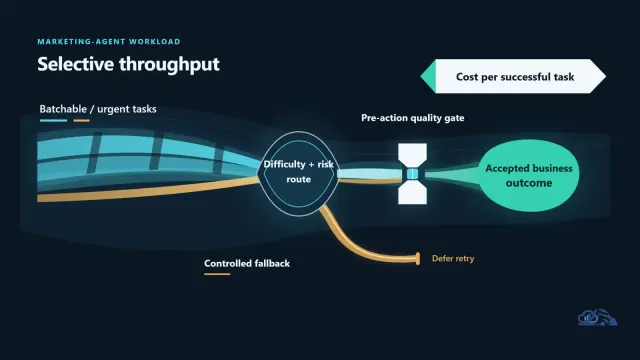
**Vanaxity analysis:** For most marketing content work, the cost question isn't 'which sticker price is lowest,' it's 'which model does my task well enough at the lowest total cost.' A cheap model that needs three tries is dearer than a mid-priced one that nails it once. That's why we measure cost per accepted output, not per token, the discipline we detail in FinOps for AI agents, and it's how a workhorse like Gemini 3.7 Flash can win the budget while a frontier model wins the benchmark.
Why Do Open Weights Matter Here?
Open weights are the axis that separates Kimi K3 from the rest, and for marketing teams handling sensitive data, that difference can outweigh a few benchmark points.
**Vanaxity analysis:** An open-weight model like Kimi K3 can run in your own environment, so customer and brand data never leaves it, and you can fine-tune it on your voice without a vendor's permission. Fable 5.1 and Gemini 3.7 Flash are closed and hosted, which is simpler but means your data goes to their API. Qwen 3.8 Max muddies this: it has an open-weight lineage, but its flagship is effectively an API product. So if control and privacy are the deciding factors, Kimi K3 is the clear pick, for the same reasons we lay out in open-weights AI for marketing.
The honest caveat is effort. Self-hosting a 2.8-trillion-parameter model is a real infrastructure project, so most teams will access even Kimi K3 through a hosted endpoint. The value of open weights is the option, run it privately when you must, rent it when you can, and never be locked to one vendor's terms.
Fable 5.1 or a Rival: Which Should Marketers Use?
Match the model to the constraint that binds you, because no single one wins on every axis. Each is the right answer for a different priority.
- Hardest reasoning and quality-critical work: Fable 5.1, if its benchmark lead justifies the premium for your tasks.
- High-volume, cost-sensitive content and agents: Gemini 3.7 Flash, whose low price and speed fit repetitive work.
- Privacy, control, or a verified open model: Kimi K3, the strongest open-weight option with independent numbers behind it.
- Existing Alibaba or enterprise-China stack: Qwen 3.8 Max may fit, but pilot it yourself since its benchmarks are unpublished.
- Unsure: run a small bake-off across two or three of them on your real tasks and compare cost per accepted output.
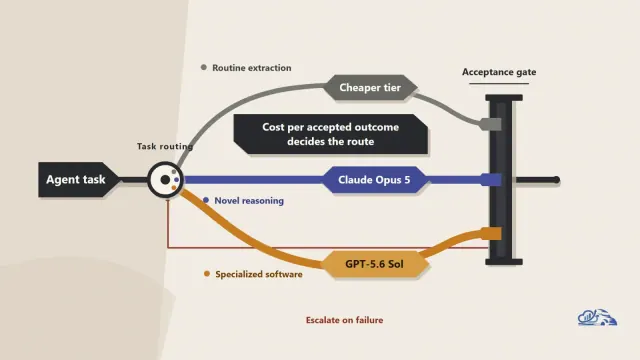
**Vanaxity analysis:** The mistake is asking which is best in the abstract; the useful question is which is best for your binding constraint. A privacy-bound team and a cost-bound team should reach different answers from the same table, and both can be right. Keep your stack portable so you can route by task and re-run this comparison when the next flagship ships, which in 2026 is roughly monthly.
Where Should a Team Start?
Start by naming your binding constraint, then test only the finalists that fit it. You don't need to trial all four; you need to trial the two that match your priority.
- Decide your constraint first: lowest cost, maximum capability, or data control and openness.
- Shortlist the two models that fit it, rather than benchmarking all four against each other.
- Run your real, representative tasks through them and score cost per accepted output, not per token.
- Weight verified evidence over vendor claims, especially where a model has no independent numbers.
- Keep the choice portable, so switching when the next release lands is a config change, not a migration.
- Re-run the comparison quarterly, because prices, scores, and even openness terms move fast.
This is a scoped bake-off, not a research project. One structured test on your own tasks tells you more than any leaderboard, because your workload is the only benchmark that bills you. From there, model choice becomes evidence you can defend, the same incremental way we approach AI agent ROI.
How Vanaxity Approaches Model Selection
Vanaxity helps marketing teams choose models on their own tasks and their own constraints, not on a launch-day leaderboard. We start by naming what actually binds you, cost, capability, or control, so the comparison answers your question, not a generic one.
Then we run your real workloads through the finalists, weight independent evidence over vendor claims, score cost per accepted output, and keep your stack portable across open and closed options. If you want help, our services can produce a model-selection assessment and a routing plan for your content and agent workloads. You can also browse more field notes in our insights library. The goal is simple: the right model for each job, chosen on evidence and easy to change when the board reshuffles.
Frequently asked questions
Which is the best model: Fable 5.1, Gemini 3.7 Flash, Kimi K3, or Qwen 3.8 Max?
There's no single best; they win on different axes. Fable 5.1 is the most capable on its own benchmarks but the priciest, Gemini 3.7 Flash is the cheapest fast workhorse, Kimi K3 is the strongest independently verified open-weight model, and Qwen 3.8 Max is a capable enterprise API whose benchmarks are still unpublished. The right pick depends on whether cost, capability, or data control binds you, measured on your own tasks.
Is Kimi K3 really open-weight?
Yes. Moonshot AI publishes downloadable weights for Kimi K3, a 2.8-trillion-parameter mixture-of-experts model with a 1M-token context and native vision. That means you can run it in your own environment for privacy and control, or use a hosted endpoint. It also carries independent verification, including 93.4% on SWE-bench Verified via Vals AI, which sets it apart from models with only vendor-published numbers.
Why can't Qwen 3.8 Max be ranked yet?
Because Alibaba has published no benchmarks for it. It's positioned as second only to Fable 5, but that's a vendor claim without independent numbers to check, so there's no evidence-based way to rank it against the others yet. It's a capable multimodal enterprise API worth piloting on your own tasks, but treat its capability claims as unverified until third-party testers index it.
Which model is cheapest for high-volume content?
On hosted API price, Gemini 3.7 Flash is the cheapest of the four, with introductory rates of $0.75 per million input and $3.75 per million output, far below Fable 5.1. For very high volume, Kimi K3's open weights can be cheaper still if you self-host, since cost becomes infrastructure rather than per-token billing. The real measure is cost per accepted output on your tasks, not the sticker rate.
Should I trust vendor benchmarks in these comparisons?
Treat them as a signal, not proof. Fable 5.1's leading scores are Anthropic's own, Gemini 3.7 Flash's are Google's, and Qwen 3.8 Max has none published, while Kimi K3 has independent numbers from Vals AI and Artificial Analysis. Weight independently verified results more heavily, and always confirm with a small test on your own representative tasks before committing.
How should a marketing team choose between them?
Name your binding constraint first, lowest cost, maximum capability, or data control, then shortlist the two models that fit it and run your real tasks through them, scoring cost per accepted output rather than per token. Weight verified evidence over vendor claims, keep your stack portable so switching is easy, and re-run the comparison quarterly since prices and scores change fast in this field.