GPT-6 Astra vs GPT-5.6 Sol: Is the Upgrade Worth 2.5x?
GPT-6 Astra costs 2.5x its predecessor but ties it on independent general intelligence. Here is when the upgrade pays off, and when Sol is still the smarter buy.
Overview
GPT-6 Astra is OpenAI's newest frontier model, and GPT-5.6 Sol is the one it succeeds. The obvious assumption is that newer means better, so you upgrade. The numbers complicate that. On the one independent aggregator in this comparison, Astra and Sol tie on general intelligence, yet Astra lists at 2.5x Sol's price.
This article reads the two models the way a marketing or content team should: as a budget decision, not a leaderboard. The reported facts are OpenAI's and independent testers'; the marketing implications are Vanaxity analysis, framed as recommendation rather than certainty. It builds on our work on FinOps for AI agents and our earlier Opus 5 vs GPT-5.6 Sol comparison.
Key Takeaways
- GPT-6 Astra (OpenAI, September 3, 2026) lists at $10 per million input and $50 per million output, which is 2.5x GPT-5.6 Sol's $4 and $20.
- On the independent Artificial Analysis Intelligence Index, Astra and Sol tie at 61, so the premium does not buy more general intelligence.
- Astra's real gains are specialized: OpenAI's own table shows big leads on computer use (OSWorld 2.0 72.6% vs 65.7%), hard math (FrontierMath Tier 4 97.6% vs 83.0%), and agentic terminal work (Terminal-Bench 4.0 57.7% vs 37.3%).
- Artificial Analysis puts Astra 75% more expensive per task at max effort, so cost per completed job, not sticker price, is the number that decides.
- Vanaxity's recommendation: keep Sol as the value default for content generation, and upgrade to Astra only where computer use, long context, or hard reasoning is the job.
Map your SEO, GEO and AEO workflow before you build.

What Are GPT-6 Astra and GPT-5.6 Sol?
They are consecutive OpenAI frontier models, released months apart, aimed at different points on the cost curve. Sol was the workhorse; Astra is the flagship. Knowing what each was built for is most of the decision.
- GPT-6 Astra: OpenAI's new frontier model, launched as a limited preview on September 3, 2026, with a broader rollout across ChatGPT, the API, and Amazon Web Services following. OpenAI calls it its most intelligent and aligned model, and it is the first OpenAI model whose cyber capability triggered the company's advanced internal safety protections before release.
- GPT-5.6 Sol: the prior generation, positioned as the fast, cost-efficient default, and recently made cheaper again in a round of GPT-5.6 price cuts. It remains a strong general model that most everyday workloads never outgrow.
**Vanaxity analysis:** The framing gap matters. OpenAI did not price Astra as a drop-in replacement for Sol; it priced it as a premium tier for harder work. That is your first clue that the right question is not whether Astra is better, but whether your workload needs the specific things it is better at.
GPT-6 Astra vs GPT-5.6 Sol: How Do They Compare?
The clearest view is side by side. The table lines up price and the headline benchmarks, with each row labeled by who produced it, because a vendor's own table and an independent index deserve different levels of trust.
| Dimension | GPT-6 Astra | GPT-5.6 Sol | Source |
|---|---|---|---|
| Price / 1M (input / output) | $10 / $50 | $4 / $20 | Vendor |
| Intelligence Index | 61 | 61 | Independent |
| FrontierMath Tier 4 (v2) | 97.6% | 83.0% | OpenAI table |
| OSWorld 2.0 (computer use) | 72.6% | 65.7% | OpenAI table |
| Terminal-Bench 4.0 | 57.7% | 37.3% | OpenAI table |
| Cost per task (max effort) | +75% vs Sol | baseline | Independent |
**Vanaxity analysis:** Read the second row against the first. The two models tie on independent general intelligence, but Astra costs 2.5x on the sticker and 75% more per task at max effort. The specialized rows are where the money goes: if none of those workloads is yours, you are paying a premium for a benchmark you will never run.
On Intelligence, GPT-6 Astra vs GPT-5.6 Sol Is a Tie
On general intelligence, independently, no. This is the finding that should reset expectations before anyone approves a budget line for the upgrade.
**Reported fact:** On the Artificial Analysis Intelligence Index, a composite of independent evaluations, GPT-6 Astra and GPT-5.6 Sol both score 61. Artificial Analysis also places Astra roughly 75% more expensive per task than Sol at max effort, and notes it largely sits behind its predecessor on the intelligence-versus-cost frontier. OpenAI's own launch table tells a different story on specialized tasks, which is a real difference, not a contradiction.
**Vanaxity analysis:** Both things are true at once, and holding them together is the whole point. Astra is not a broadly smarter model than Sol; it is a similarly intelligent model with sharper specialized skills, sold at a premium. For a team whose main use is drafting, summarizing, and rewriting marketing copy, the tie is the headline, because that is general-purpose work, and general-purpose intelligence is where the two are level.
Where GPT-6 Astra vs GPT-5.6 Sol Actually Diverges
In three places that are easy to name and easy to check against your own workload. Astra's premium is justified only if your work lives in one of them. The figures below come from OpenAI's own launch table, so read them as a strong signal rather than proof.
- Computer use and agents: OpenAI reports Astra at 72.6% on OSWorld 2.0 at roughly 47% less time per task than Sol, plus 92.7% on ScreenSpot-Pro versus Sol's 76.9%. If your agents click through real interfaces, this gap is felt.
- Long-context retrieval: OpenAI's reported long-context numbers put Astra near-perfect on million-token retrieval where Sol drops off, which matters for large knowledge bases and RAG over big document sets.
- Hard reasoning, math, and cyber: FrontierMath Tier 4 at 97.6% versus 83.0%, Terminal-Bench 4.0 at 57.7% versus 37.3%, and a large ARC-AGI-3 gap under OpenAI's own adapter harness. These are research-grade and security tasks, not everyday copy.
**Vanaxity analysis:** Every one of these wins is real and every one is narrow. None of them is 'write a better product description.' So the honest test is a single question: does your highest-value workload involve autonomous computer use, retrieval over very long context, or hard technical reasoning? If yes, Astra earns its price. If no, you are buying capability you will not use.
Is GPT-6 Astra Worth 2.5x the Price?
For most marketing content work, no, and the tie on general intelligence is why. Sol does the same general-purpose job at 40% of the token price.
The cost question is never 'which sticker is higher.' It is 'which model does my task well enough at the lowest total cost.' When two models tie on general intelligence, the cheaper one wins every general task by default. Sol is the cheaper one by a wide margin. Astra only changes that math when a task needs its specialized edge. There, Sol may fail or need several tries, and a model that nails it once can be cheaper even at 2.5x the rate.
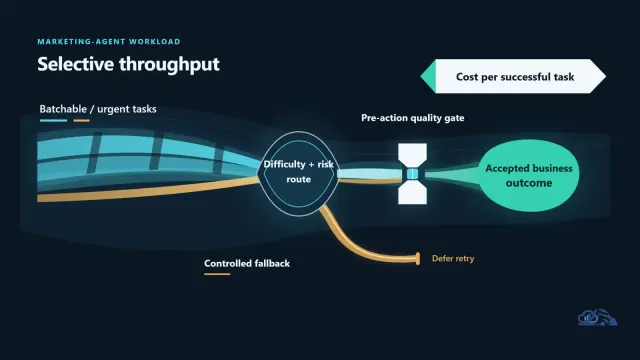
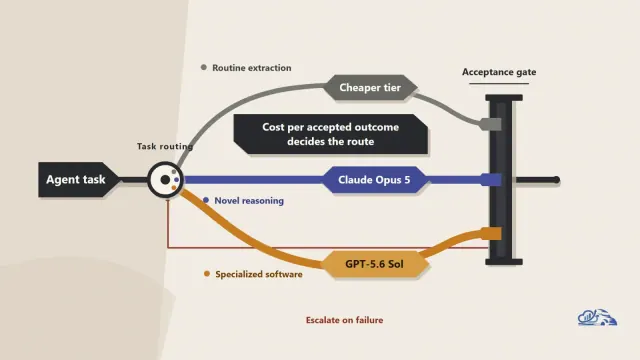
**Vanaxity analysis:** This is why we measure cost per accepted output, not cost per token, the discipline we detail in FinOps for AI agents. Route high-volume content to Sol and reserve Astra for the agentic or long-context jobs that justify it. A blended stack that sends each task to the cheapest model that can do it will almost always beat standardizing on the priciest option, the same way it did in our AI agent ROI work.
A concrete split makes this real. Say your team drafts 500 blog and email pieces a month. It also runs one agent that navigates a booking portal. Send all 500 drafts to Sol, since that is general writing, where the two models tie.
Then send the portal agent to Astra, since that is computer use, where its lead is largest. You pay the premium on one workload, not five hundred. Your monthly bill barely moves, and your hardest task still gets the better model. That is the point of routing: the flagship earns its price only where the task spends it.
GPT-6 Astra vs GPT-5.6 Sol: Which Should Marketers Use?
Match the model to the task, not to the release date. Each is the right answer for a different kind of work.
- High-volume content generation, summaries, and rewrites: GPT-5.6 Sol, since it ties Astra on general intelligence at a fraction of the cost.
- Autonomous agents that operate real software interfaces: GPT-6 Astra, whose computer-use lead is its clearest advantage.
- Retrieval over very large document sets or long context: GPT-6 Astra, for its stronger long-context recall.
- Research-grade math, analysis, or security tooling: GPT-6 Astra, where its reasoning gains are largest.
- Unsure: run both on a sample of your real tasks and compare cost per accepted output before you standardize.
**Vanaxity analysis:** The trap is treating the upgrade as automatic. A newer flagship is not a mandate to migrate; it is a new option to route to when the task fits. Keep your stack portable so you can send each job to the model that clears it cheapest, and re-check the split whenever prices move, which in 2026 is often.
How Vanaxity Approaches the Upgrade Question
Vanaxity helps marketing teams decide when a new frontier model is worth adopting, on their own tasks rather than on a launch-day chart. We start by naming what the workload actually needs, general drafting, agentic execution, or long-context retrieval, so the comparison answers your question, not a generic one.
Then we route your real workloads to the cheapest model that clears each one, weight independent evidence over vendor claims, and score cost per accepted output so the upgrade decision is defensible. If you want help, our services can produce a model-routing plan for your content and agent workloads, and you can browse more field notes in our insights library. The goal is simple: pay for capability only where the task uses it.
Frequently asked questions
Is GPT-6 Astra better than GPT-5.6 Sol?
It depends on the task. On the independent Artificial Analysis Intelligence Index, GPT-6 Astra and GPT-5.6 Sol tie at 61, so Astra is not broadly smarter. But on OpenAI's own launch table Astra leads clearly on specialized work like computer use, long-context retrieval, and hard math, for example 72.6% versus 65.7% on OSWorld 2.0. Astra is better where those specific skills matter, and level with Sol on general-purpose work.
How much more does GPT-6 Astra cost than GPT-5.6 Sol?
Astra lists at $10 per million input and $50 per million output tokens, which is 2.5x Sol's $4 and $20. Artificial Analysis also estimates Astra is about 75% more expensive per task at max effort. Because the two tie on general intelligence, that premium only earns its keep on the specialized tasks where Astra outperforms, not on everyday content generation.
Should marketing teams upgrade from Sol to Astra?
Not by default. For high-volume content generation, summaries, and rewrites, Sol ties Astra on general intelligence at a much lower price, so it remains the better value. Upgrade to Astra only for workloads that need autonomous computer use, retrieval over very long context, or research-grade reasoning. The safest approach is to route by task and measure cost per accepted output rather than migrating everything.
Why do Astra and Sol tie on intelligence but not on benchmarks?
Because they measure different things. The Artificial Analysis Intelligence Index is an independent composite of general reasoning, where the two are level at 61. OpenAI's launch table reports specialized benchmarks like OSWorld, FrontierMath, and Terminal-Bench, where Astra leads. Both can be true at once: similar general intelligence, sharper specialized skills. Weight the independent composite for general work and the specialized rows for the specific job you have.
Can I trust the benchmark numbers comparing Astra and Sol?
Treat them by source. The tie on the Intelligence Index comes from Artificial Analysis, an independent tester, so it carries more weight. The specialized leads come from OpenAI's own launch table, run on OpenAI's harness, so treat them as a strong signal rather than proof. The reliable move is to run both models on a representative sample of your own tasks and compare results and cost directly.