What 4-Bit Inference Means for Your AI Marketing Bill
NVFP4 4-bit inference on Blackwell GPUs roughly halves the hardware needed to serve a model. Here is what that structural cost cut means for marketing and agent teams.

Overview
Most marketing teams never see the GPU their AI runs on, but they pay for it in every token. The quiet story of 2026 is that the cost of that token is dropping at the hardware level, and 4-bit inference is the reason. NVIDIA's NVFP4 format, running on Blackwell GPUs, lets a model take far less memory and far fewer chips to serve, which lowers the unit cost of every AI feature you ship.
This article explains what 4-bit inference is, how much it actually cuts costs, and what a marketing or content team should do about it. The reported facts are NVIDIA's and independent testers'; the marketing implications are Vanaxity analysis, framed as recommendation rather than certainty. It builds on our work on FinOps for AI agents and AI agent ROI.
Key Takeaways
- 4-bit inference runs models in NVIDIA's NVFP4 format, which uses 4 bits per value instead of 8 or 16, and runs natively on Blackwell GPUs like the B200 and B300.
- NVFP4 shrinks a model's memory footprint about 3.5x versus 16-bit and 1.8x versus 8-bit, so a 70B model that needed two H100s at FP8 can fit on a single B200.
- The quality cost is small: NVIDIA reports 1% or less accuracy degradation versus FP8 on DeepSeek-R1, and on one math benchmark NVFP4 scored slightly higher.
- For marketing teams, this is a structural cut to inference cost, not a model upgrade, and it mostly reaches you through cheaper provider pricing rather than your own hardware.
- Vanaxity's recommendation: treat 4-bit inference as a discount to capture, favor providers that pass it on, and verify quality on your own tasks before switching.
Map your SEO, GEO and AEO workflow before you build.

What Is 4-Bit Inference, and Why Now?
4-bit inference is running an AI model with each number stored in just 4 bits, instead of the 16 or 8 bits used before. Fewer bits per number means less memory and less bandwidth to move the model, which is where most inference cost hides. The reason it matters now is that the hardware finally executes 4-bit math natively, so the savings are real rather than a lossy trick.
**Reported fact:** NVIDIA's NVFP4 format uses 4 bits per value, with a shared scale per 16-value block to preserve accuracy. It runs on Blackwell and Blackwell Ultra GPUs, which have native FP4 tensor cores, and it's fully supported in NVIDIA's TensorRT-LLM serving stack, now at version 1.2. The earlier idea that 4-bit was too lossy for production is what changed: the format and the silicon were co-designed to keep quality while cutting bits.
Three things had to line up for 4-bit to become a serious production option rather than a research trick, and in 2026 they finally did:
- Native hardware: Blackwell tensor cores execute FP4 directly, so the format isn't emulated in software, which is what makes the speedup real.
- A smarter format: NVFP4's per-block scaling keeps accuracy close to 8-bit, unlike the blunt 4-bit methods that came before it.
- Mature serving software: NVFP4 is now first-class in TensorRT-LLM and its serving API, so teams can run it without hand-building kernels.
**Vanaxity analysis:** You don't need to care about tensor cores to care about this. The one-line version is that the industry just made it much cheaper to serve the same model, and that discount flows downhill to anyone who buys AI by the token. The teams who understand why their bill is dropping are the ones who'll negotiate and route to capture it, instead of leaving it on the table.
How Much Does 4-Bit Inference Cut AI Costs?
Enough to change how many GPUs a workload needs, which is the number that drives price. The clearest way to see it is memory footprint, because that decides how much model fits on one chip.
| Precision | Bits per value | Memory vs FP16 | Where it runs |
|---|---|---|---|
| FP16 / BF16 | 16 | baseline | Most GPUs |
| FP8 | 8 | ~2x smaller | Hopper, Blackwell |
| NVFP4 (4-bit) | 4 | ~3.5x smaller | Blackwell (native FP4) |
**Reported fact:** NVIDIA reports NVFP4 cuts a model's memory footprint about 3.5x versus FP16 and about 1.8x versus FP8. In practice, that density means a single B200 running NVFP4 can serve a 70B model that previously required two H100s at FP8, with memory left over for a larger context cache. NVIDIA also cites up to 25x and 50x energy efficiency per token on Blackwell and Blackwell Ultra versus an H100 baseline.
**Vanaxity analysis:** Translate that into a bill. Halving the GPUs to serve a model roughly halves the hardware line behind your inference, and energy is a big part of the rest. You'll rarely see a switch labeled "4-bit" in your dashboard; you'll see it as falling per-token prices from providers who moved to Blackwell. For a team running high-volume content generation, retrieval, and agents, that's the difference between an AI feature that pencils out and one that doesn't, which is the same math we walk through in FinOps for AI agents.
Here's an illustrative example, using round numbers rather than any provider's real rate. Suppose you run 200 million tokens a month through a model priced at $6.00 per million tokens on 8-bit hardware, which is $1,200 a month. If a move to 4-bit on Blackwell lets a provider serve the same model on half the chips and they pass through even part of that, a drop to roughly $4.00 per million takes the same volume to about $800. That's a $400 monthly cut, or about 33%, for zero change to your product. Real numbers will vary, but the direction is the point: the discount is structural, and it compounds with volume.
There's a second benefit that matters for marketing workloads specifically. The memory 4-bit frees up doesn't have to become fewer GPUs; it can become more context. That freed space lets a provider hold a larger key-value cache, which means longer prompts, bigger retrieval windows, and more concurrent requests on the same chip. For RAG over your content library or agents that carry long histories, that headroom can matter as much as the price cut, because it's the same constraint that usually forces you onto a pricier tier.
Does 4-Bit Inference Hurt Quality?
Less than you'd expect, but not zero, and the honest answer is to measure it. The whole point of NVFP4 was to make 4-bit accurate enough for production, not just fast.
**Reported fact:** On NVIDIA's benchmarks, NVFP4 showed 1% or less accuracy degradation versus FP8 on DeepSeek-R1, and on the AIME 2024 math benchmark it actually scored about 2% higher. That is a much smaller quality gap than older 4-bit methods, which is why it is viable for real workloads rather than just demos. These are NVIDIA's own figures, so treat them as a strong signal rather than proof for your specific tasks.
**Vanaxity analysis:** A 1% benchmark gap isn't the same as no difference on your content. Quantization tends to bite hardest on the edges, long outputs, rare formats, and tasks needing exact recall, which is where marketing work sometimes lives. So don't assume 4-bit is free quality-wise; assume it's cheap and verify. Run your real prompts at 4-bit and at 8-bit, compare accepted outputs, and let cost per accepted result decide, not the sticker precision.
What Should Marketing Teams Do About 4-Bit Inference?
Capture the discount without overpaying for control you do not need. For most teams, 4-bit inference is a reason to shop, not a reason to buy hardware.
- Ask your providers what precision they serve. If they have moved to Blackwell and NVFP4, your per-token price should reflect it, so use that as leverage at renewal.
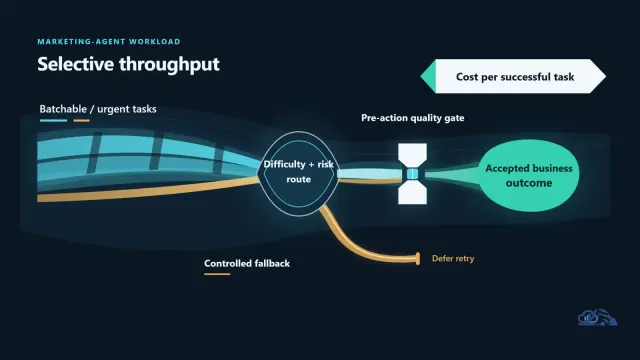
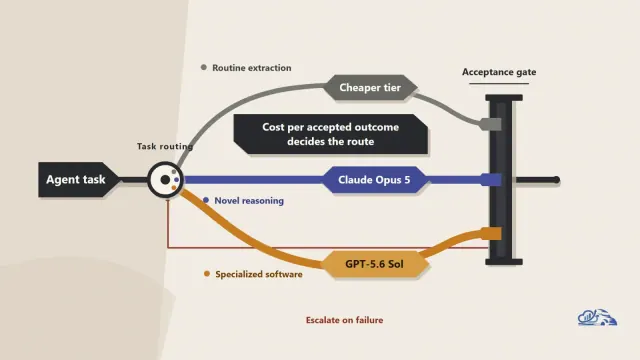
- Route high-volume, cost-sensitive work to the cheapest endpoint that passes your quality bar, since 4-bit makes more endpoints good enough.
- Self-host only if you already run your own GPUs. On Blackwell hardware, TensorRT-LLM serves NVFP4 directly, which pairs well with open-weight models as we cover in open-weights AI for marketing.
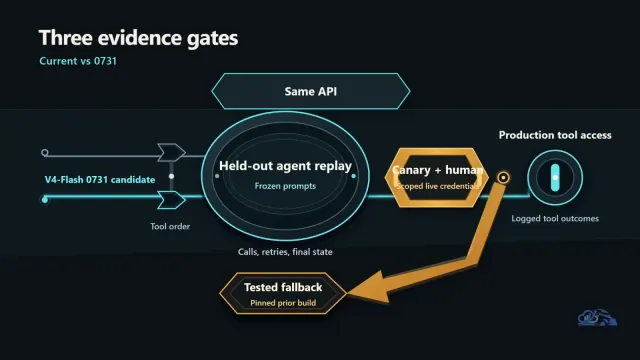
- Always benchmark quality at 4-bit on your own tasks before switching a production workload, not just on vendor benchmarks.
- Track cost per accepted output, not cost per token, so a cheaper precision that needs a retry does not fool you into a false saving.
**Vanaxity analysis:** The mistake is treating this as an infrastructure topic you can ignore because you don't run GPUs. It's a pricing topic, and pricing is everyone's job. The teams that win the 4-bit dividend are the ones who ask the right question at renewal and route by measured cost, not the ones who happen to own the fastest chips. For a deeper cost guide, see how we frame FP4 quantization economics on Blackwell against your own workload.
How Vanaxity Turns 4-Bit Savings Into Budget
Vanaxity helps marketing teams turn falling inference costs into a smaller, more defensible AI bill. We start by mapping where your spend actually goes, which workloads are token-heavy, which are latency-bound, and which could move to a cheaper precision without hurting quality.
Then we test your real tasks across precisions and providers, score cost per accepted output, and route each workload to the cheapest endpoint that clears your quality bar. We also re-check the split on a schedule, because precision support and provider pricing both move fast, and a saving you captured last quarter can widen or shrink by the next. If you want help, our services can produce a model-and-precision routing plan for your content and agent workloads, and you can browse more field notes in our insights library. The goal is simple: pay 2026 prices for AI, not last year's.
Frequently asked questions
What is 4-bit inference?
4-bit inference runs an AI model with each number stored in 4 bits instead of the 16 or 8 bits used before, which sharply reduces the memory and bandwidth needed to serve the model. NVIDIA's version is called NVFP4, and it runs natively on Blackwell GPUs like the B200. Fewer bits per value means more of the model fits on one chip, so it takes fewer GPUs, and less energy, to serve the same workload, which is what lowers the cost.
How much cheaper is 4-bit inference?
NVIDIA reports NVFP4 shrinks a model's memory footprint about 3.5x versus 16-bit and about 1.8x versus 8-bit. In practice a 70B model that needed two H100s at FP8 can run on a single B200 at NVFP4, which roughly halves the hardware behind that workload, and Blackwell adds large energy-efficiency gains per token. For a buyer, that shows up as lower per-token pricing from providers who have adopted it, rather than a line item labeled 4-bit.
Does 4-bit inference reduce quality?
Only slightly, according to NVIDIA's benchmarks, which show 1% or less accuracy degradation versus FP8 on DeepSeek-R1, and a small gain on one math benchmark. That is far better than older 4-bit methods, which is why it is production-viable. But those are vendor figures on specific tasks, so you should verify on your own workloads, since quantization can bite harder on long outputs, rare formats, or tasks needing exact recall.
Do I need to buy Blackwell GPUs to benefit?
No, not for most teams. If you use hosted AI APIs, you benefit automatically when your provider serves models on Blackwell with NVFP4, through lower per-token prices, so the action is to ask what precision they run and use it at renewal. Only teams that already operate their own GPUs need to think about hardware, and for them TensorRT-LLM serves NVFP4 directly on Blackwell.
How should marketing teams act on 4-bit inference?
Treat it as a pricing opportunity, not an infrastructure project. Ask providers what precision they serve, route high-volume work to the cheapest endpoint that passes your quality bar, and always benchmark quality at 4-bit on your own tasks before switching a production workload. Measure cost per accepted output rather than cost per token, so a cheaper precision that needs a retry does not create a false saving.