GPT-6.1 Terra vs Claude and OpenAI Models for Marketers
GPT-6.1 Terra costs $1/$5 per million tokens. How it compares with Luna, Sol, Astra and Claude Haiku, Sonnet and Opus, and which model fits each marketing job.
Overview
How does GPT-6.1 Terra compare with the other OpenAI and Claude models a marketing team might use? In short: it's cheaper than almost everything above it, smarter than everything below it and a little behind the top models on independent tests.
OpenAI released Terra on October 26, 2026. It now sits in the middle of a crowded field: two budget models, three or four premium ones and a few mid-tier options from both labs. Picking the right one for each job can save money and protect quality.
This guide compares Terra with OpenAI's Luna, Sol and Astra, and with Anthropic's Claude Haiku 5.5, Sonnet 5.5, Opus 5.5 and Fable 5.1. Then it maps each model to common marketing jobs.
Disclosure: Vanaxity is run by Van Data Team, which builds with models from both companies. This article was researched with Claude, made by Anthropic, whose models are compared here. We rely on independent test results and label our own math.
Key takeaways
- GPT-6.1 Terra costs $1 per million input tokens and $5 per million output tokens, half the price of GPT-6.1 Sol and Claude Sonnet 5.5.
- On Artificial Analysis's index, Terra scores 48, below Sol (52), Astra (53), Sonnet 5.5 (56) and Opus 5.5 (58).
- Its cost per test task is $0.40, against $0.72 for Sol and more than $5 for Sonnet 5.5 and Opus 5.5 at their highest settings.
- Budget models are far cheaper.
- GPT-6 Luna and Claude Haiku 5.5 cost a tenth of Terra's price and score 38 and 41.
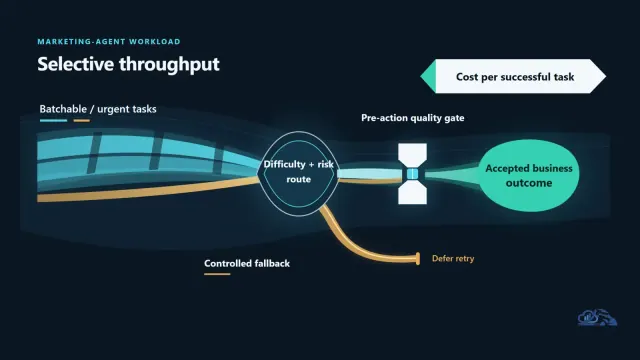
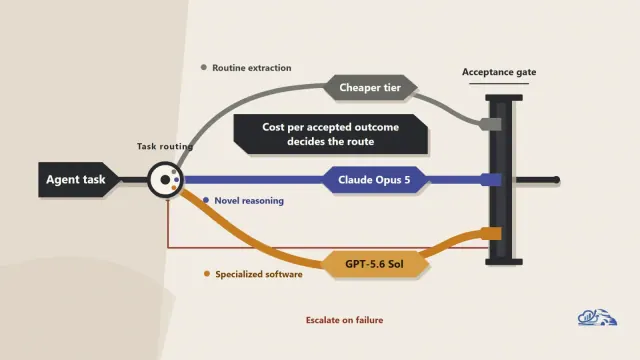
- For marketers, the best setup is usually a mix: a budget model for bulk work, Terra for routine tasks and a top model for brand-critical content.
Map your SEO, GEO and AEO workflow before you build.
GPT-6.1 Terra vs other models at a glance
| Model | Maker | Price per million tokens (input / output) | Intelligence Index | Cost per index task |
|---|---|---|---|---|
| GPT-6 Luna | OpenAI | $0.10 / $0.50 | 38 | $0.07 |
| Claude Haiku 5.5 | Anthropic | $0.10 / $0.50 | 41 | $0.12 |
| GPT-6.1 Terra | OpenAI | $1 / $5 | 48 | $0.40 |
| GPT-6.1 Sol | OpenAI | $2 / $10 | 52 | $0.72 |
| GPT-6 Astra | OpenAI | $10 / $50 | 53 | $3.26 |
| Claude Fable 5.1 | Anthropic | $10 / $50 | 53 | $7.63 |
| Claude Sonnet 5.5 | Anthropic | $2 / $10 | 56 | $5.46 |
| Claude Opus 5.5 | Anthropic | $4 / $20 | 58 | $5.98 |
Index scores and cost per task come from Artificial Analysis, mostly at each model's highest setting, as of October 27, 2026. Haiku 5.5 is shown at its extra-high setting. Higher index scores are better; cost per task is what it cost to run each test question.
What is GPT-6.1 Terra?
Terra is OpenAI's middle model. It sits between the cheap GPT-6 Luna and the more capable GPT-6.1 Sol and GPT-6 Astra. OpenAI pitches it for workday tasks: drafting proposals, reading images and documents, filling out forms and using a computer like a person would.
It's available in ChatGPT Work and Codex for Plus, Pro, Enterprise and Edu users, and in the API as gpt-6.1-terra. According to BleepingComputer, OpenAI says it's half the price of GPT-5.6 Terra and GPT-6.1 Sol, and much better than the model it replaces.
Independent tests agree on that last point. Artificial Analysis scores it six points above GPT-5.6 Terra, at under a third of the cost per task.
GPT-6.1 Terra vs OpenAI's other models
Within OpenAI's own lineup, each model has a clear lane:
- GPT-6 Luna: the cheapest. Good for simple, high-volume jobs like tagging and short summaries.
- GPT-6.1 Terra: the new middle. Good for everyday drafting, documents, images and computer use, which covers a large share of what a typical marketing team asks AI to do in a normal week.
- GPT-6.1 Sol: stronger at research, coding and complex analysis, at twice Terra's price.
- GPT-6 Astra: OpenAI's most capable model, priced for hard problems where quality matters most.
OpenAI itself recommends Sol or Astra for in-depth research and complex coding. For most marketing work, though, the gap between Terra and Sol is small enough that Terra's lower price wins. Our comparison of GPT-6 Astra and GPT-5.6 Sol covers the top of OpenAI's range.
How Claude's models line up
Anthropic's Claude family follows a similar pattern, with one budget model and several premium ones:
- Claude Haiku 5.5: the budget model, priced like Luna but scoring a little higher on the index.
- Claude Sonnet 5.5: the mid-to-high option at $2 and $10, scoring 56, second on the index.
- Claude Opus 5.5: the top scorer at 58, at $4 and $20.
- Claude Fable 5.1: a premium model at $10 and $50 that scores 53 on this index.
Note that there's no Claude model at Terra's exact price. Terra slots between Haiku and Sonnet. Our comparison of Claude Sonnet 5.5 and Opus 5.5 covers how those two differ for marketing work.
Why price per token can mislead
Sonnet 5.5 and GPT-6.1 Sol have the same list price. Yet on Artificial Analysis's tests, Sonnet cost $5.46 per task and Sol cost $0.72. Why?
The answer is how much each model writes. At its highest setting, Sonnet produced 420 million output tokens to finish the index. Sol used 67 million. Terra used 130 million, and Opus 5.5 used 260 million.
| Model (highest setting) | Output tokens to run the index | Cost per index task |
|---|---|---|
| GPT-6.1 Sol | 67 million | $0.72 |
| GPT-6.1 Terra | 130 million | $0.40 |
| Claude Opus 5.5 | 260 million | $5.98 |
| Claude Sonnet 5.5 | 420 million | $5.46 |
So a model's real cost depends on its price and on how much it thinks and writes. Most marketing tasks don't need the highest setting. At lower settings, the premium models cost far less, so test the setting you'd actually use.
GPT-6.1 Terra vs Claude Sonnet 5.5
This is the matchup most teams will weigh. The Decoder and other outlets framed Terra as OpenAI's value answer to Anthropic's mid-tier models.
| Factor | GPT-6.1 Terra | Claude Sonnet 5.5 |
|---|---|---|
| Price per million tokens | $1 / $5 | $2 / $10 |
| Intelligence Index | 48 | 56 |
| Cost per index task (highest setting) | $0.40 | $5.46 |
| Output speed | About 91 tokens a second | About 141 tokens a second |
| Pitched for | Computer use, documents, everyday writing | Strong all-round work, agents and writing |
Sonnet scores clearly higher. Terra is far cheaper.
For routine work where good is good enough, Terra wins on cost. For work where a small quality gap shows up in front of customers, Sonnet is the safer bet. Many teams will use both.
Do you even need Terra? The budget option
For a lot of marketing work, a budget model is enough. GPT-6 Luna and Claude Haiku 5.5 both cost $0.10 and $0.50 per million tokens, a tenth of Terra's price.
They're fine for simple, repeatable jobs: tagging comments, sorting leads, pulling fields from forms and writing first-pass meta descriptions. They're also fast, which helps for live chat and quick suggestions inside tools. Haiku 5.5 scores a little higher. It costs slightly more per task.
One detail to check: a report says Haiku 5.5's price rises for very long prompts, above 100,000 tokens. If you feed it long documents, confirm the pricing before you scale up.
Which model for which marketing job?
Here's a starting point. Treat it as a hypothesis to test, not a rule.
| Marketing job | Suggested tier | Example models |
|---|---|---|
| Tagging reviews, comments and leads | Budget | GPT-6 Luna, Claude Haiku 5.5 |
| First-draft emails, briefs and social posts | Middle | GPT-6.1 Terra |
| Filling forms and working in ad or CMS tools | Middle | GPT-6.1 Terra |
| Reading screenshots, charts and documents | Middle | GPT-6.1 Terra |
| Brand-critical copy and long-form content | Top | Claude Sonnet 5.5, Claude Opus 5.5 |
| Research, strategy and complex analysis | Top | GPT-6.1 Sol, Claude Opus 5.5, GPT-6 Astra |
The pattern: the closer the output gets to your customers, or the harder the thinking, the more it's worth paying for a top model.
Can GPT-6.1 Terra write in your brand voice?
No benchmark measures brand voice, so this is the part you have to test yourself. OpenAI says Terra writes more clearly and naturally than the model it replaces. An OpenAI staff member also suggested it's strong at technical communication but a bit behind Sol and Astra on most other things.
For marketing, that points to a simple test. Give each model the same brief and brand guide, and ask your team to rank the drafts blind. Count how many edits each needs before it's ready.
Edits are the hidden cost. A cheaper model that needs ten minutes of rewriting per post can cost more than a premium one that needs two.
GPT-6.1 Terra for marketing operations
Terra's standout strength is computer use: clicking, typing and filling in forms on screen. For marketing teams, that maps to real chores, like updating listings in a CMS, entering campaign settings or pulling numbers from dashboards that have no API.
Use it carefully. An AI that can click can also click the wrong thing. Start in a test account, give it narrow permissions and require approval before it changes budgets, sends emails or publishes anything. Our piece on AI agent monitoring covers the checks to put in place.
Accuracy and made-up facts
Terra makes far fewer things up than the model it replaces. OpenAI's internal test shows its error rate dropping from 53.6% to 16.7% at low effort. On Artificial Analysis's test of how often a model guesses instead of admitting it doesn't know, Terra scored 38%, against 54% for Sol.
That's good progress, but no model is safe to publish unchecked. Any statistic, product claim or price in marketing copy should be checked against a source before it goes live, whichever model wrote it.
What it costs for a typical content team
Here's a made-up example to put the prices in context. Say an agency drafts 200 blog posts a month. Each one uses about 8,000 tokens of input, such as the brief, sources and brand guide, and 4,000 tokens of output.
| Model | Rough monthly cost for 200 drafts (our math) |
|---|---|
| GPT-6 Luna or Claude Haiku 5.5 | About $0.56 |
| GPT-6.1 Terra | About $5.60 |
| GPT-6.1 Sol or Claude Sonnet 5.5 | About $11 |
| Claude Opus 5.5 | About $22 |
These numbers ignore extra thinking tokens, which can multiply the output bill at high settings. Even so, the point stands. At this scale, model costs are tiny next to the cost of a writer's time.
So for content teams, the right question is rarely "which model is cheapest?" It's "which model needs the fewest edits?" Price matters most for very high-volume jobs like tagging millions of comments.
How to choose between GPT-6.1 Terra and Claude
A short test on your own work beats any chart. Here's a simple plan:
- Pick three real jobs: one bulk task, one routine draft and one brand-critical piece.
- Run each job on a budget model, Terra and a top model, using the same instructions.
- Ask your team to rank the results without knowing which model wrote them.
- Track edit time.
- Track cost per finished piece, not price per token.
- Pick the cheapest model that meets your quality bar for each job.
Repeat the test every few months. Prices and models change fast, and this year's best choice may not be next year's.
Why most teams should use more than one model
Picking a single model for everything wastes money or quality. A budget model on brand copy hurts quality. A top model on comment tagging wastes money.
Most AI tools and platforms now let you choose a model per task. Set sensible defaults: budget for bulk, Terra or a similar mid-tier model for routine work and a top model for anything customers will read closely. Then review the split each quarter, and write the defaults down so new team members follow them.
This also protects you from lock-in. If one company raises prices or changes a model, you can shift work to another without starting over.
What this means for AI search
Cheaper, capable models mean more AI tools, more AI answers and more AI-written content online. As that grows, the brands that stand out are the ones whose facts are clear and consistent enough for any model to repeat correctly.
Whichever model your team picks, the content it helps you publish should be accurate, well sourced and easy for AI assistants to cite. That part doesn't change.
GPT-6.1 Terra vs Claude: our take
GPT-6.1 Terra is a strong value model and a sensible default for routine marketing work. It's cheaper per task than any premium model from either company. It's also a big step up from OpenAI's previous middle model.
It isn't the top performer, though. Claude Opus 5.5 and Sonnet 5.5 score higher on independent tests, and OpenAI points its own complex work to Sol and Astra. For brand-critical writing and strategy, test a top model before you settle. For everything else, Terra is well worth a trial.
How Vanaxity helps teams pick AI models
We help marketing teams choose and combine AI models for real work. That includes blind tests on your own briefs, cost-per-piece tracking, sensible model routing and checks on how AI assistants describe your brand.
If you're weighing GPT-6.1 Terra against Claude, explore our services or browse more insights.
Frequently asked questions
Is GPT-6.1 Terra better than Claude Sonnet 5.5?
Not on independent tests. Artificial Analysis scores Sonnet 5.5 at 56 and Terra at 48. But Terra costs half as much per token and far less per test task, so it can be the better choice for routine work where its quality is good enough.
How much does GPT-6.1 Terra cost?
The API price is $1 per million input tokens and $5 per million output tokens. That's half the price of GPT-6.1 Sol and Claude Sonnet 5.5, and ten times the price of GPT-6 Luna and Claude Haiku 5.5.
Which model is cheapest for marketing tasks?
GPT-6 Luna and Claude Haiku 5.5 are the cheapest at $0.10 and $0.50 per million tokens. They suit simple, high-volume jobs like tagging and sorting. For drafting and more complex work, mid-tier or top models usually need fewer edits.
Which model is best for brand content?
No benchmark measures brand voice. The highest-scoring models on independent tests are Claude Opus 5.5 and Sonnet 5.5, followed by OpenAI's Astra and Sol. Run a blind test on your own briefs and count the edits each draft needs.
Should marketing teams use one AI model or several?
Several, in most cases. Use a budget model for bulk tasks, a mid-tier model like GPT-6.1 Terra for routine drafting and a top model for brand-critical work. This balances cost and quality and reduces lock-in to one vendor.